. 2011 Jul 5;108(27):11235-40.
doi: 10.1073/pnas.1103317108. Epub 2011 Jun 20.

Detection and avoidance of a carnivore odor by prey

Affiliations

Detection and avoidance of a carnivore odor by prey

David M Ferrero et al. Proc Natl Acad Sci U S A. .

Abstract

Predator-prey relationships provide a classic paradigm for the study of innate animal behavior. Odors from carnivores elicit stereotyped fear and avoidance responses in rodents, although sensory mechanisms involved are largely unknown. Here, we identified a chemical produced by predators that activates a mouse olfactory receptor and produces an innate behavioral response. We purified this predator cue from bobcat urine and identified it to be a biogenic amine, 2-phenylethylamine. Quantitative HPLC analysis across 38 mammalian species indicates enriched 2-phenylethylamine production by numerous carnivores, with some producing >3,000-fold more than herbivores examined. Calcium imaging of neuronal responses in mouse olfactory tissue slices identified dispersed carnivore odor-selective sensory neurons that also responded to 2-phenylethylamine. Two prey species, rat and mouse, avoid a 2-phenylethylamine odor source, and loss-of-function studies involving enzymatic depletion of 2-phenylethylamine from a carnivore odor indicate it to be required for full avoidance behavior. Thus, rodent olfactory sensory neurons and chemosensory receptors have the capacity for recognizing interspecies odors. One such cue, carnivore-derived 2-phenylethylamine, is a key component of a predator odor blend that triggers hard-wired aversion circuits in the rodent brain. These data show how a single, volatile chemical detected in the environment can drive an elaborate danger-associated behavioral response in mammals.


Conflict of interest statement

The authors declare no conflict of interest.

Figures

Fig. 1.
Fig. 1.
TAAR4 detects predator odors. (A) HEK293 cells were transfected with TAAR4 and reporter plasmids, incubated with urine extracts of species indicated, and assayed for reporter activity (triplicates ± SD). TAAR4 was activated by urine extracts (10-fold dilution) of two rodent predators, bobcat and mountain lion, but not of mouse, rat, or human. No responses were observed to animal odors in control cells transfected with reporter plasmid alone. TAAR4 was expressed as a fusion protein with an N-terminal sequence of bovine rhodopsin, which provided enhanced signal (24). (B) Rat TAAR9, rat TAAR8c, and mouse TAAR7f detected urine of multiple species, including mouse, rat, and human. Urine (diluted 300- or 100-fold) or urine extracts (diluted 30-, 10-, or 3-fold) of species indicated were tested (triplicates ± SD).
Fig. 2.
Fig. 2.
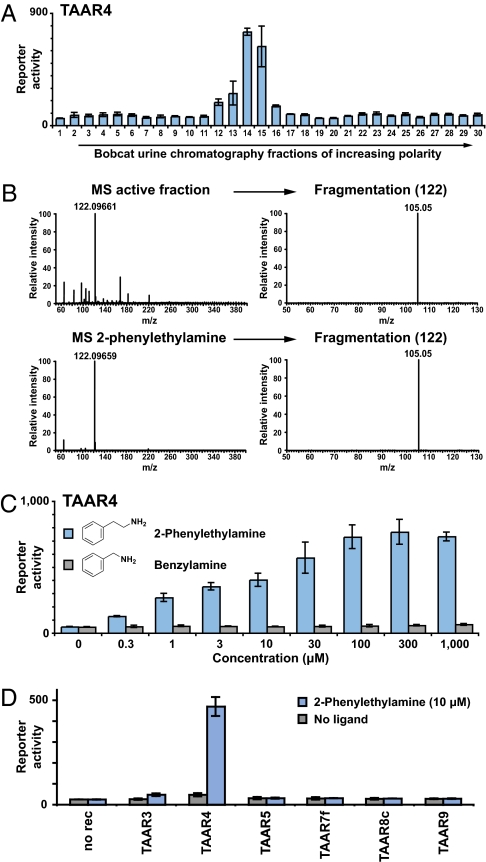
2-phenylethylamine is a predator odor in bobcat urine. (A) Bobcat urine was fractionated by silica gel chromatography, and fractions were analyzed for the presence of TAAR4 activator with the reporter gene assay (triplicates ± SD). (B) An ion with the same mass and fragmentation pattern of 2-phenylethylamine was observed in a bobcat urine active fraction. (C) Commercial 2-phenylethylamine, but not benzylamine, activated TAAR4 (triplicates ± SD). (D) 2-phenylethylamine (10 μM) activated TAAR4 but did not similarly activate other olfactory TAARs with identified agonists.
Fig. 3.
Fig. 3.
2-phenylethylamine is a component common to many carnivore odors. (A) LC/MS analysis of bobcat urine extracts, graphed as the number of ion counts with m/z = 122 over time, identified a single peak with identical retention time to 2-phenylethylamine. (B) 2-phenylethylamine (PEA) levels were quantified in multiple urine samples (#) from 38 species and 6 orders of mammals, as indicated. Samples were either purchased (p), provided by a zoo (z), or collected (c). (C) Average urinary 2-phenylethylamine levels were >50- to 500-fold higher in carnivores than in other mammalian orders.
Fig. 4.
Fig. 4.
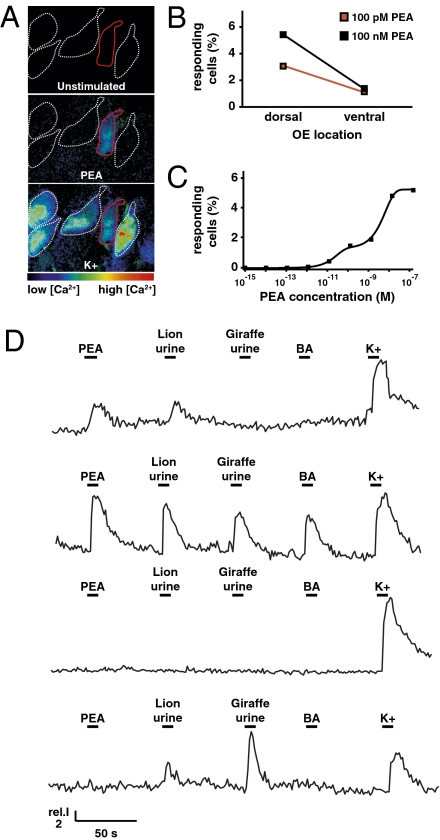
2-phenylethylamine activates rodent olfactory sensory neurons. (A) Representative cytosolic calcium responses of individual olfactory sensory neurons in acute tissue slices. Fluo-4-loaded neurons (defined by contours indicated) were exposed to 2-phenylethylamine and elevated KCl (40 mM). Background-subtracted images of reporter dye intensity are coded in pseudocolors (rainbow spectrum). (B) Percentage of dorsal (n = 804) and ventral (n = 520) olfactory sensory neurons activated by 2-phenylethylamine at concentrations indicated. (C) Percentage of dorsal olfactory sensory neurons (n = 1,747) activated by 2-phenylethylamine at various concentrations. (D) Representative traces of integrated Fluo-4 fluorescence over time in individual dorsal olfactory sensory neurons exposed to test stimuli: 2-phenylethylamine (100 pM), lion urine (Fig. S5; specimen 5, 1:10,000), giraffe urine (Fig. S5; specimen 1, 1:10,000), benzylamine (100 pM), and KCl (40 mM).
Fig. 5.
Fig. 5.
2-phenylethylamine elicits an innate avoidance response in rodents. (A) A cartoon depiction of the experimental arena and ligand structures are shown. Movements of rats in response to test stimuli were recorded automatically by using infrared detectors. (B) 3D surface plots depict the percentage of time 12 rats were in regions of a square arena after exposure to test stimuli (1 mL of water or lion urine, 5 μL of PEA or BA) in the corner indicated (circle). Similar responses were observed when PEA and BA were diluted in 1 mL of water. Color scaling from red to blue indicates increased time spent in a particular region. (C) Mean percentage of time rats were located in the quadrant containing test stimuli was measured (12 animals, ± SEM, **P < 0.01). (D) Mean percentage of time rats occupied the quadrant containing 10% lion urine and 2-phenylethylamine (0, 0.4, 4, and 40 μmol) diluted in water or giraffe urine (1 mL), (12 animals, ± SEM, **P < 0.01). (E) Corticosterone levels in rat plasma determined by radioimmunoassay after exposure to odors indicated (1 mL of water, 2% TMT, 10% PEA, or 10% BA, 30 min, 8–20 animals, ± SEM, *P < 0.05). (F) Responses of wild-type or TrpC2−/− mice to odors indicated (aerosolized from 10 μL) were measured as a change in percentage occupancy of an odor compartment during a 3-min stimulus presentation (n = 5–7, ± SEM, *P < 0.05).
Fig. 6.
Fig. 6.
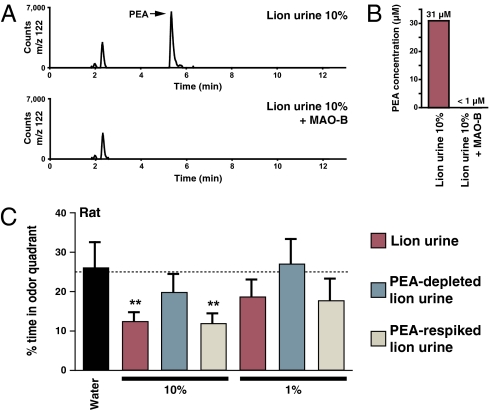
2-phenylethylamine is a key aversive component of a predator odor blend. (A and B) Quantitative LC/MS analysis of lion urine (10%) before and after addition of MAO-B was used to measure PEA concentration. (C) Mean percentage of time rats were located in odor quadrants containing water, 1%, or 10% lion urine, PEA-depleted lion urine, or PEA-respiked lion urine (11 animals, ±SEM, **P < 0.01).

References

    1. Apfelbach R, Blanchard CD, Blanchard RJ, Hayes RA, McGregor IS. The effects of predator odors in mammalian prey species: A review of field and laboratory studies. Neurosci Biobehav Rev. 2005;29:1123–1144. - PubMed
    1. Burger BV. Mammalian semiochemicals. Top Curr Chem. 2005;240:231–278.
    1. Fendt M, Endres T, Lowry CA, Apfelbach R, McGregor IS. TMT-induced autonomic and behavioral changes and the neural basis of its processing. Neurosci Biobehav Rev. 2005;29:1145–1156. - PubMed
    1. Kobayakawa K, et al. Innate versus learned odour processing in the mouse olfactory bulb. Nature. 2007;450:503–508. - PubMed
    1. Papes F, Logan DW, Stowers L. The vomeronasal organ mediates interspecies defensive behaviors through detection of protein pheromone homologs. Cell. 2010;141:692–703. - PMC - PubMed

Publication types