


Reduction in the incidence of influenza A but not influenza B associated with use of hand sanitizer and cough hygiene in schools: a randomized controlled trial
- PMID: 21691245
- PMCID: PMC3470868
- DOI: 10.1097/INF.0b013e3182218656
Reduction in the incidence of influenza A but not influenza B associated with use of hand sanitizer and cough hygiene in schools: a randomized controlled trial
Abstract
Background: Laboratory-based evidence is lacking regarding the efficacy of nonpharmaceutical interventions (NPIs) such as alcohol-based hand sanitizer and respiratory hygiene to reduce the spread of influenza.
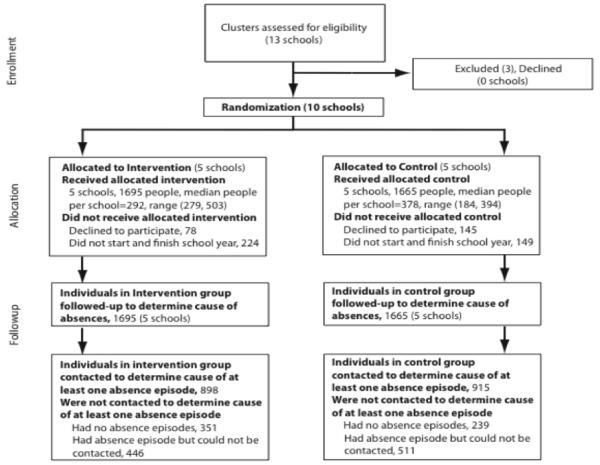
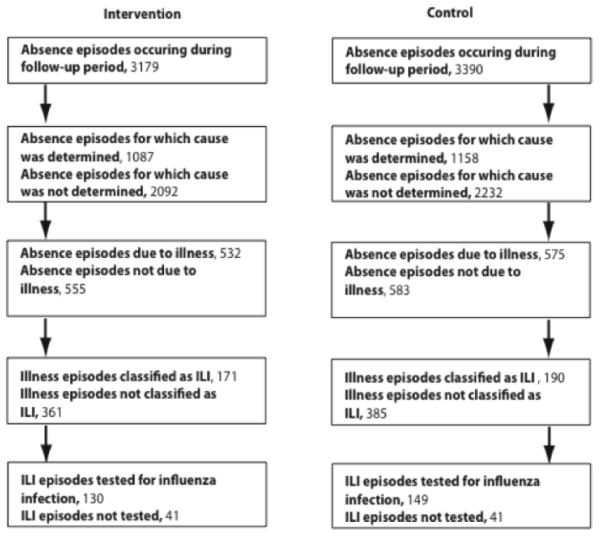
Methods: The Pittsburgh Influenza Prevention Project was a cluster-randomized trial conducted in 10 elementary schools in Pittsburgh, PA, during the 2007 to 2008 influenza season. Children in 5 intervention schools received training in hand and respiratory hygiene, and were provided and encouraged to use hand sanitizer regularly. Children in 5 schools acted as controls. Children with influenza-like illness were tested for influenza A and B by reverse-transcriptase polymerase chain reaction.
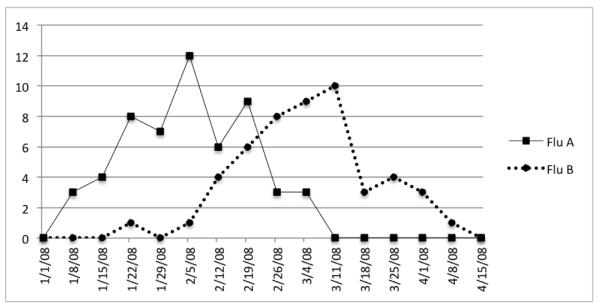
Results: A total of 3360 children participated in this study. Using reverse-transcriptase polymerase chain reaction, 54 cases of influenza A and 50 cases of influenza B were detected. We found no significant effect of the intervention on the primary study outcome of all laboratory-confirmed influenza cases (incidence rate ratio [IRR]: 0.81; 95% confidence interval [CI]: 0.54, 1.23). However, we did find statistically significant differences in protocol-specified ancillary outcomes. Children in intervention schools had significantly fewer laboratory-confirmed influenza A infections than children in control schools, with an adjusted IRR of 0.48 (95% CI: 0.26, 0.87). Total absent episodes were also significantly lower among the intervention group than among the control group; adjusted IRR 0.74 (95% CI: 0.56, 0.97).
Conclusions: NPIs (respiratory hygiene education and the regular use of hand sanitizer) did not reduce total laboratory-confirmed influenza. However, the interventions did reduce school total absence episodes by 26% and laboratory-confirmed influenza A infections by 52%. Our results suggest that NPIs can be an important adjunct to influenza vaccination programs to reduce the number of influenza A infections among children.
Figures
Comment in
-
Hand sanitizer and cough hygiene can reduce the number of influenza A infections in school children.J Pediatr. 2012 May;160(5):881-2. doi: 10.1016/j.jpeds.2012.01.061. J Pediatr. 2012. PMID: 22516329 No abstract available.
References
-
- Munayco CV, Gomez J, Laguna-Torres VA, et al. Epidemiological and transmissibility analysis of influenza A(H1N1)v in a southern hemisphere setting: Peru. Euro Surveill. 2009;14 - PubMed
-
- Glezen WP. Emerging infections: Pandemic influenza. Epidemiologic Reviews. 1996;18:64–76. - PubMed
-
- Glezen WP, Couch RB. Interpandemic influenza in the Houston area, 1974-76. N Engl J Med. 1978;298:587–92. - PubMed
-
- Cowling BJ, Chan KH, Fang VJ, et al. Facemasks and hand hygiene to prevent influenza transmission in households: a cluster randomized trial. Ann Intern Med. 2009;151:437–46. - PubMed
Publication types
MeSH terms
Substances
Grants and funding
LinkOut - more resources
Full Text Sources
Medical
