


Genomewide linkage analysis in Costa Rican families implicates chromosome 15q14 as a candidate region for OCD
- PMID: 21691774
- PMCID: PMC4442699
- DOI: 10.1007/s00439-011-1033-6
Genomewide linkage analysis in Costa Rican families implicates chromosome 15q14 as a candidate region for OCD
Abstract
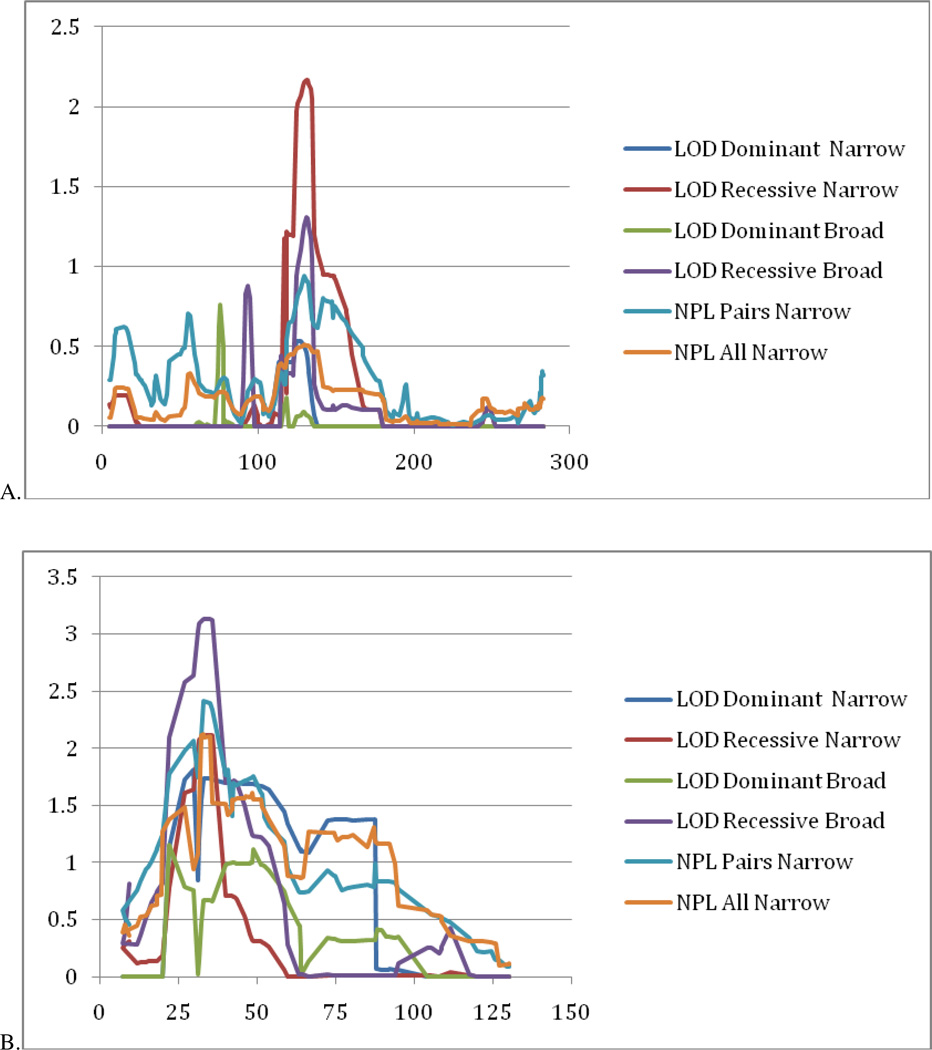
Obsessive compulsive disorder (OCD) has a complex etiology that encompasses both genetic and environmental factors. However, to date, despite the identification of several promising candidate genes and linkage regions, the genetic causes of OCD are largely unknown. The objective of this study was to conduct linkage studies of childhood-onset OCD, which is thought to have the strongest genetic etiology, in several OCD-affected families from the genetically isolated population of the Central Valley of Costa Rica (CVCR). The authors used parametric and non-parametric approaches to conduct genome-wide linkage analyses using 5,786 single nucleotide repeat polymorphisms (SNPs) in three CVCR families with multiple childhood-onset OCD-affected individuals. We identified areas of suggestive linkage (LOD score ≥ 2) on chromosomes 1p21, 15q14, 16q24, and 17p12. The strongest evidence for linkage was on chromosome 15q14 (LOD = 3.13), identified using parametric linkage analysis with a recessive model, and overlapping a region identified in a prior linkage study using a Caucasian population. Each CVCR family had a haplotype that co-segregated with OCD across a ~7 Mbp interval within this region, which contains 18 identified brain expressed genes, several of which are potentially relevant to OCD. Exonic sequencing of the strongest candidate gene in this region, the ryanodine receptor 3 (RYR3), identified several genetic variants of potential interest, although none co-segregated with OCD in all three families. These findings provide evidence that chromosome 15q14 is linked to OCD in families from the CVCR, and supports previous findings to suggest that this region may contain one or more OCD susceptibility loci.
Figures



References
-
- Abecasis GR, Cherny SS, Cookson WO, Cardon LR. Merlin--rapid analysis of dense genetic maps using sparse gene flow trees. Nat Genet. 2002;30(1):97–101. doi:10.1038/ng786 ng786 [pii] - PubMed
-
- Adasme T, Haeger P, Paula-Lima AC, Espinoza I, Casas-Alarcon MM, Carrasco MA, Hidalgo C. Involvement of ryanodine receptors in neurotrophin-induced hippocampal synaptic plasticity and spatial memory formation. Proc Natl Acad Sci U S A. 2011;108(7):3029–3034. doi:1013580108 [pii] 10.1073/pnas.1013580108. - PMC - PubMed
-
- Allen Brain Atlas Resources. Allen Institute for Brain Science. [Accessed 2/25/2011];2009 http://www.brain-map.org/. 2011.
-
- Arnold PD, Sicard T, Burroughs E, Richter MA, Kennedy JL. Glutamate transporter gene SLC1A1 associated with obsessive-compulsive disorder. Arch Gen Psychiatry. 2006;63(7):769–776. - PubMed
-
- Bacanu SA. Robust estimation of critical values for genome scans to detect linkage. Genet Epidemiol. 2005;28(1):24–32. - PubMed
Publication types
MeSH terms
Substances
Grants and funding
LinkOut - more resources
Full Text Sources
Medical
Miscellaneous
