. 2011 Jul 28;54(14):5195-204.
doi: 10.1021/jm200461m. Epub 2011 Jun 30.

A vaccine strategy that induces protective immunity against heroin

Affiliations

A vaccine strategy that induces protective immunity against heroin

G Neil Stowe et al. J Med Chem. .

Abstract

Heroin addiction is a wide-reaching problem with a spectrum of damaging social consequences. A vaccine capable of blocking heroin's effects could provide a long-lasting and sustainable adjunct to heroin addiction therapy. Heroin, however, presents a particularly challenging immunotherapeutic target, as it is metabolized to multiple psychoactive molecules. To reconcile this dilemma, we examined the idea of a singular vaccine with the potential to display multiple drug-like antigens; thus two haptens were synthesized, one heroin-like and another morphine-like in chemical structure. A key feature in this approach is that immunopresentation with the heroin-like hapten is thought to be immunochemically dynamic such that multiple haptens are simultaneously presented to the immune system. We demonstrate the significance of this approach through the extremely rapid generation of robust polyclonal antibody titers with remarkable specificity. Importantly, both the antinociceptive effects of heroin and acquisition of heroin self-administration were blocked in rats vaccinated using the heroin-like hapten.


Figures
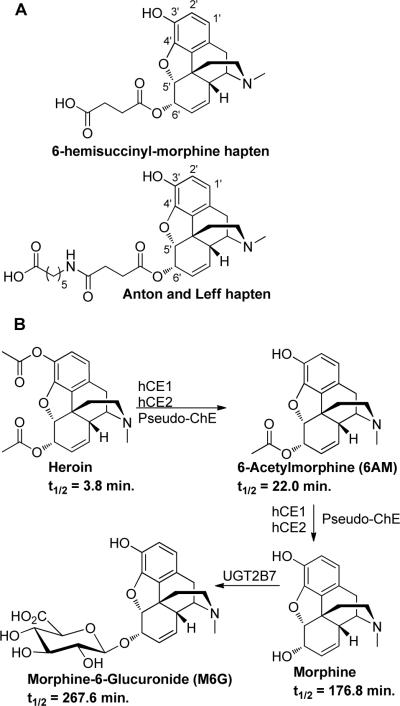
Figure 1
Figure 1
A) 6-hemisuccinyl morphine hapten used by Wainer et al. and linker extended hapten of Anton and Leff. B) Metabolic pathways of heroin (including isozyme abbreviations) and metabolite half lives in humans.
Figure 2
Figure 2
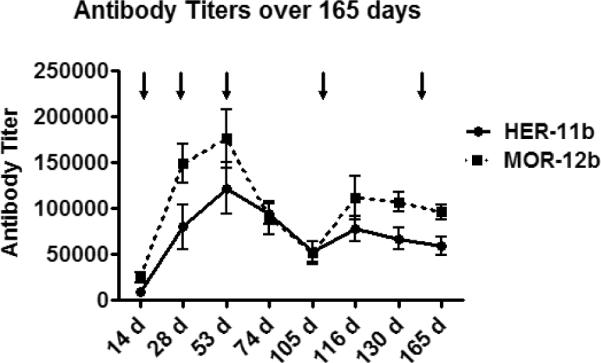
Vaccine titer levels over the course of 165 days. Vertical arrows represent booster injections at t = 14, 28, 53, 108 and 151 days. Data represented are the pooled sera mean value ± SEM.
Figure 3A–D
Figure 3A–D
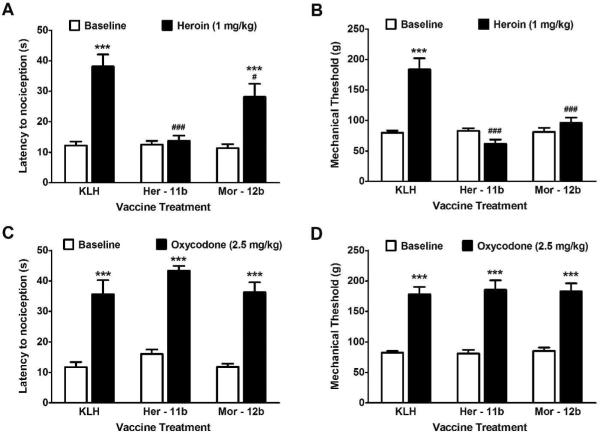
Vaccination selectively blocks the thermal and mechanical antinociceptive effects of heroin. (A and B) Systemic injection of heroin (1 mg/kg, s.c.) produced robust decreases in both thermal (A) nociceptive sensitivity as measured by hot plate, and mechanical sensitivity (B) as measured by von Frey filament testing. This was fully reversed in the heroin-like vaccine (Her-11b) group. The morphine-like vaccine (Mor-12b) significantly blunted the thermal nociceptive effects of heroin compared to control, but was still significantly elevated from baseline and did not alter mechanical sensitivity. (C and D) Injection of the structurally similar opiate oxycodone produced similar thermal and mechanical insensitivity as seen with heroin. Neither the heroin-like (Her-11b) nor morphine-like (Mor-12b) vaccine altered antinociceptive responses to oxycodone. N = 7–8 per group, ***p < 0.001, 30 min post-drug versus baseline; #p < 0.05, ###p < 0.001, versus KLH response post-drug.
Figure 4A–D
Figure 4A–D
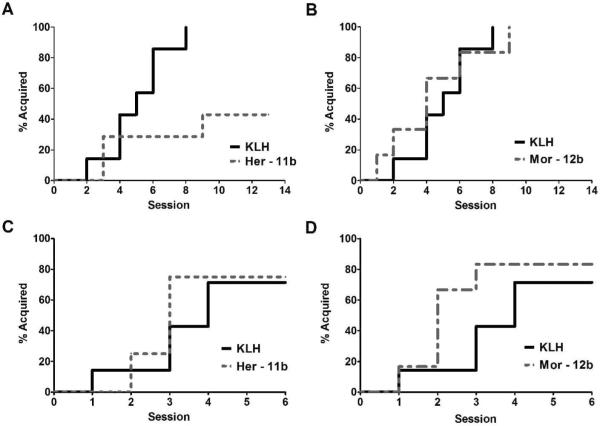
(A and B) Acquisition of heroin self-administration is prevented in a subset of rats vaccinated with heroin-like immunoconjugate (Her-11b), but not morphine-like immunoconjugate (Mor-12b). The percentage of animals that obtain the acquisition criteria, maintaining at least 3 consecutive sessions of 3 infusions (60 μg/kg/infusion) or more, is significantly lower in a group of rats receiving heroin-like (Her-11b) vaccination compared to KLH controls (p < 0.05). Only 3 of 7 rats receiving Her-11b achieved criteria. Conversely, the morphine-like (Mor-12b) vaccine did not alter acquisition of heroin self-administration (p = 0.96). (C and D) Heroin- (Her-11b) and morphine-like (Mor-12b) vaccines do not alter the acquisition of self-administration of a natural reward. Animals were trained to press on an active for 0.1 ml of sweetened solution containing 0.125% w/v saccharine and 3% w/v glucose. When examining the percentage of animals that acquired the response criteria for the sweetened solution, defined as consecutive days of at least 30 or more responses, survival analysis revealed no significant differences based on vaccination treatment (Her-11b: p = 0.63, Mor-12b: p = 0.22 vs KLH control). N = 7–8 per group.
Scheme 1
Scheme 1
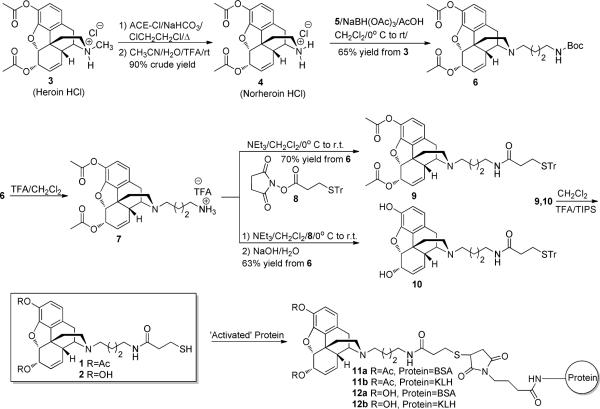
Synthesis of haptens 1–2 and conjugation to KLH carrier protein.

References

    1. Aceijas C, Stimson G, Hickman M, Rhodes T. Global overview of injection drug use and HIV infection among injection drug users. AIDS. 2004;18:2296–2303. - PubMed
    1. The DASIS Report Substance Abuse and Mental Health Services Administration, Office of Applied Studies. Jun 21, 2002. Treatment admissions for injection drug abuse.
    1. Mark TL, Woody GE, Juday T, Kleber HD. The economic costs of heroin addiction in the United States. Drug Alcohol Depend. 2001;61:195–206. - PubMed
    1. United Nations general assembly special session on HIV/AIDS. 2001. UN, June 25–27 Declaration of Commitment on HIV/AIDS.
    1. Gillies P, Tolley K, Wostenholme J. Is AIDS a disease of poverty? AIDS Care. 1996;8:351–363. - PubMed
    2. Tawil O, Verster A, O'Reilly K. Enabling approaches for HIV/AIDS prevention: can we modify the environment and minimize the risk? AIDS. 1995;9:1299–1306. - PubMed

Publication types

MeSH terms