


Hepatocyte viability and adenosine triphosphate content decrease linearly over time during conventional cold storage of rat liver grafts
- PMID: 21693222
- PMCID: PMC3121302
- DOI: 10.1016/j.transproceed.2010.12.066
Hepatocyte viability and adenosine triphosphate content decrease linearly over time during conventional cold storage of rat liver grafts
Abstract
Introduction: The gold standard in organ preservation is static cold storage (SCS) using University of Wisconsin solution (UW). Although it is well-known that there is a finite limit to SCS preservation, and that there is a correlation between the adenosine triphosphate (ATP) levels and organ function post-preservation, a quantitative relationship has not been established, which is important in understanding the fundamental limitations to preservation, minimizing cold ischemic injury, and hence maximizing use of the donor organ pool.
Aim: This study determines the time limits of cellular viability and metabolic function during SCS, and characterizes the relationship between cellular viability and energetic state using clinically relevant techniques in organ preservation.
Methods: Rat livers were procured and stored using conventional storage in UW solution at 4 °C. Viability was assessed by determining the amount of viable hepatocytes and intracellular ATP content after 0, 24, 48, 72, and 120 hours of storage.
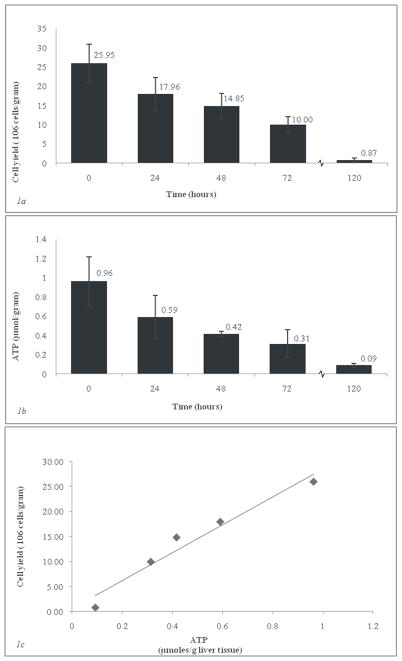
Results: Numbers of viable hepatocytes that were isolated from these livers decreased steadily during SCS. After 5 days, viable hepatocytes decreased from 25.95 × 10(6) to 0.87 × 10(6) cells/gram tissue. Intracellular ATP content decreased from 9.63 to 0.93 moles/g tissue. Statistical analysis of variance established a linear relation for both parameters as a function of time (P < .05).
Conclusion: The linear correlation between hepatocyte viability, ATP content, and storage time suggests a shared physiological foundation. These findings confirm ATP as direct predictor for organ quality in the context of liver preservation, which will aid quantitative assessment of donor organs for various applications.
Copyright © 2011 Elsevier Inc. All rights reserved.
Figures
References
-
- St Peter SD, Imber, Friend PJ. Liver and kidney preservation by perfusion. The Lancet. 2002;359:604–13. - PubMed
-
- Xu H, Lee CY, Clemens MG, Zhang JX. Pronlonged hypothermic machine perfusion preserves hepatocellular function but potentiates endothelial cell dysfunction in rat livers. Transplantation. 2004;77:1676–82. - PubMed
-
- Brockmann J, Reddy S, Coussios C, et al. Normothermic perfusion: a new paradigm for organ preservation. Ann Surg. 2009;250:1–6. - PubMed
Publication types
MeSH terms
Substances
Grants and funding
LinkOut - more resources
Full Text Sources
Other Literature Sources
Medical
