. 2011 Jun 21:7:499.
doi: 10.1038/msb.2011.31.

Cross-species discovery of syncretic drug combinations that potentiate the antifungal fluconazole

Affiliations

Cross-species discovery of syncretic drug combinations that potentiate the antifungal fluconazole

Michaela Spitzer et al. Mol Syst Biol. .

Abstract

Resistance to widely used fungistatic drugs, particularly to the ergosterol biosynthesis inhibitor fluconazole, threatens millions of immunocompromised patients susceptible to invasive fungal infections. The dense network structure of synthetic lethal genetic interactions in yeast suggests that combinatorial network inhibition may afford increased drug efficacy and specificity. We carried out systematic screens with a bioactive library enriched for off-patent drugs to identify compounds that potentiate fluconazole action in pathogenic Candida and Cryptococcus strains and the model yeast Saccharomyces. Many compounds exhibited species- or genus-specific synergism, and often improved fluconazole from fungistatic to fungicidal activity. Mode of action studies revealed two classes of synergistic compound, which either perturbed membrane permeability or inhibited sphingolipid biosynthesis. Synergistic drug interactions were rationalized by global genetic interaction networks and, notably, higher order drug combinations further potentiated the activity of fluconazole. Synergistic combinations were active against fluconazole-resistant clinical isolates and an in vivo model of Cryptococcus infection. The systematic repurposing of approved drugs against a spectrum of pathogens thus identifies network vulnerabilities that may be exploited to increase the activity and repertoire of antifungal agents.


Conflict of interest statement

The authors declare that they have no conflict of interest.

Figures
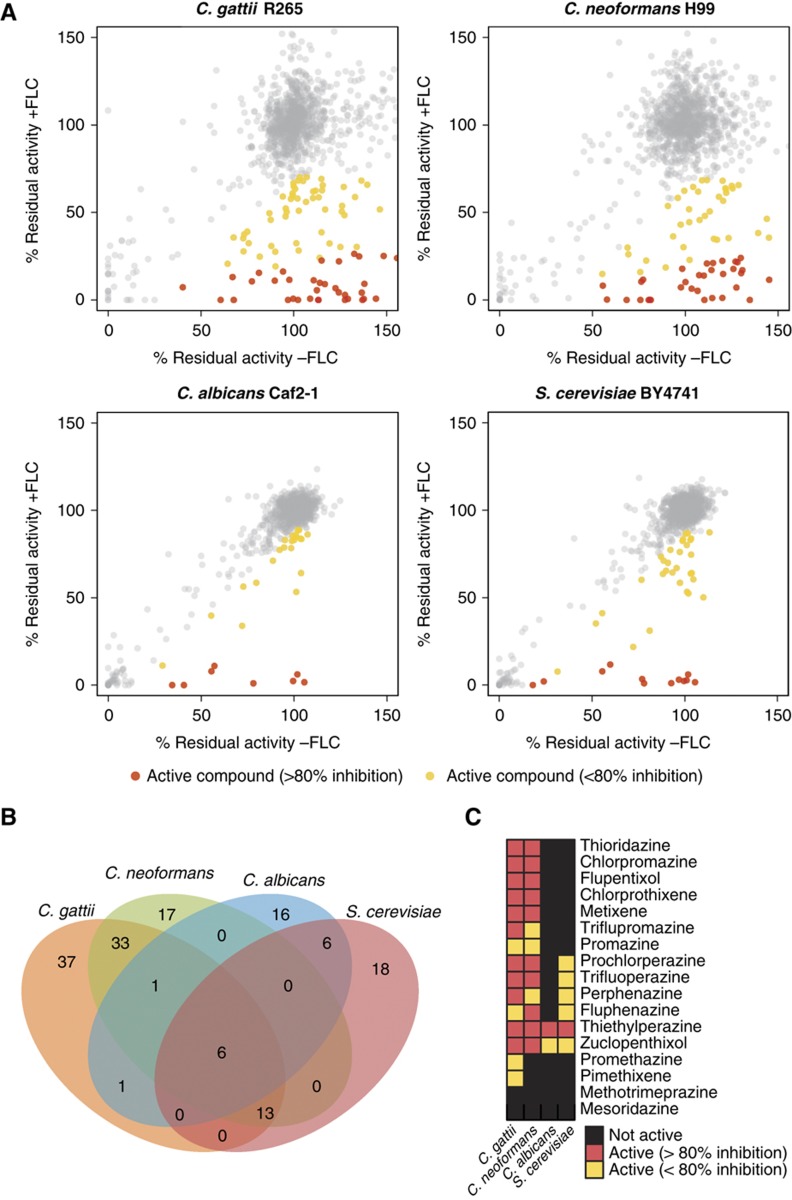
Figure 1
Figure 1
Unbiased screens for bioactive compounds that potentiate the antifungal activity of fluconazole. (A) Scatter plots for Prestwick library screens for four fungal species. Growth inhibition caused by compounds in the absence (x axis) and presence of fluconazole (y axis) is represented by residual activity after treatment. Yellow and red filled circles indicate compounds that were classified as active (2 median absolute deviations below the diagonal). Compounds that inhibited growth in the presence of fluconazole by at least 80% compared with the effect of that compound alone are highlighted in red; FLC, fluconazole. (B) Overlap of hits between different fungal species. (C) Activity of 17 phenothiazine/thioxathene compounds in different fungal species.
Figure 2
Figure 2
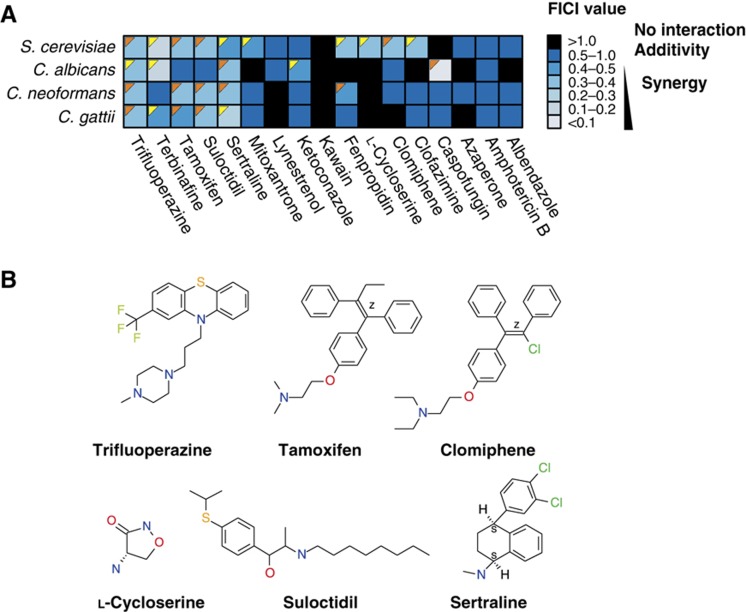
Synergistic drug interactions with fluconazole. (A) Heat map of drug interactions with fluconazole in each species. Dark blue indicates additive effects (FICI of 0.5–1); lighter shades of blue represent synergy (FICI <0.5). Orange triangles indicate fungicidal drug combinations; yellow triangles indicate fungistatic drug combinations. (B) Chemical structures of the six drugs chosen for detailed mode of action studies. Source data is available for this figure at www.nature.com/msb.
Figure 3
Figure 3
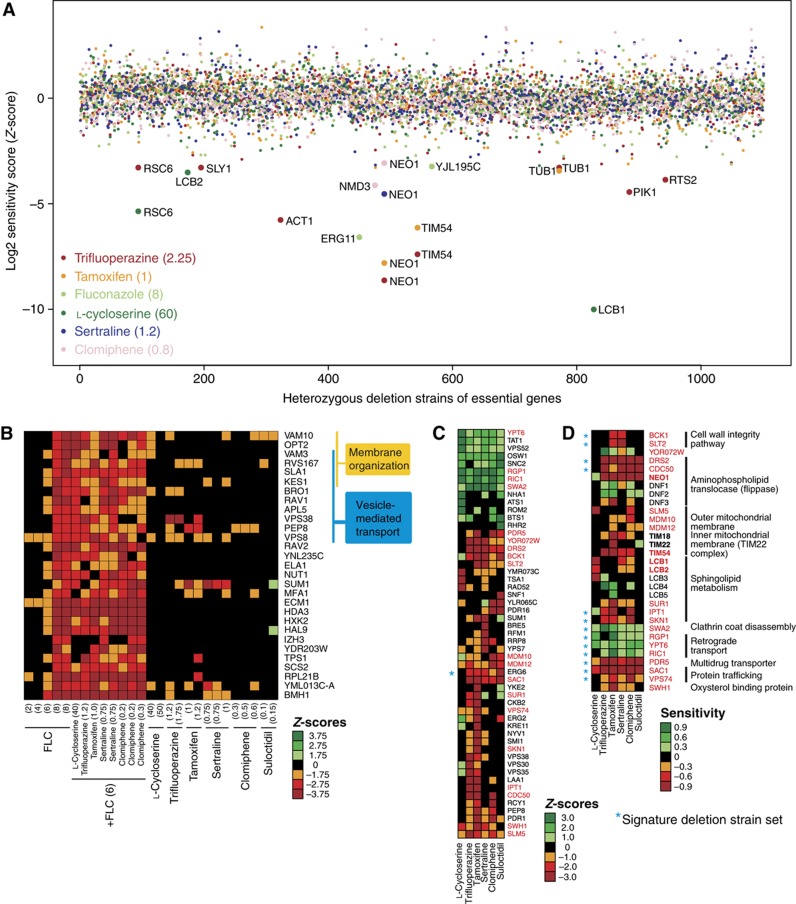
Chemical–genetic interactions of six syncretic synergizers. (A) Sensitivity of heterozygous essential deletion strains to five different syncretic drugs and fluconazole, as assessed by barcode microarray hybridization. (B) Core set of haploid deletion strains that are sensitive to fluconazole, as assessed by barcode microarray hybridization. Several concentrations of fluconazole were tested to correlate the signature with MIC. The effect of the six syncretic drugs on the core fluconazole profile was examined in the presence or absence of a threshold concentration of fluconazole (6 μg/ml). Genes implicated in membrane organization and vesicle-mediated transport are indicated. (C) Main cluster of haploid deletion strain sensitivities to the six syncretic drugs in the absence of fluconazole, as assessed by barcode microarray hybridization. Strains that have a Z-score more significant than ±3 for at least one of the drugs in duplicate profiles are shown. Gene names in red indicate deletion strains that were chosen for verification by quantitative growth curve assays. (D) Log-ratio scores calculated from individual growth curve assays to confirm chemical–genetic interactions of the six syncretic drugs. Gene names in bold indicate heterozygous deletion strains for essential genes. Values in parentheses indicate drug concentration in μg/ml. Negative Z-scores and log-ratios indicate sensitivity of a strain to a given drug, whereas positive scores represent resistance. Asterisks indicate 14 deletion strains that comprise the core signature set for membrane active compounds. Source data is available for this figure at www.nature.com/msb.
Figure 4
Figure 4
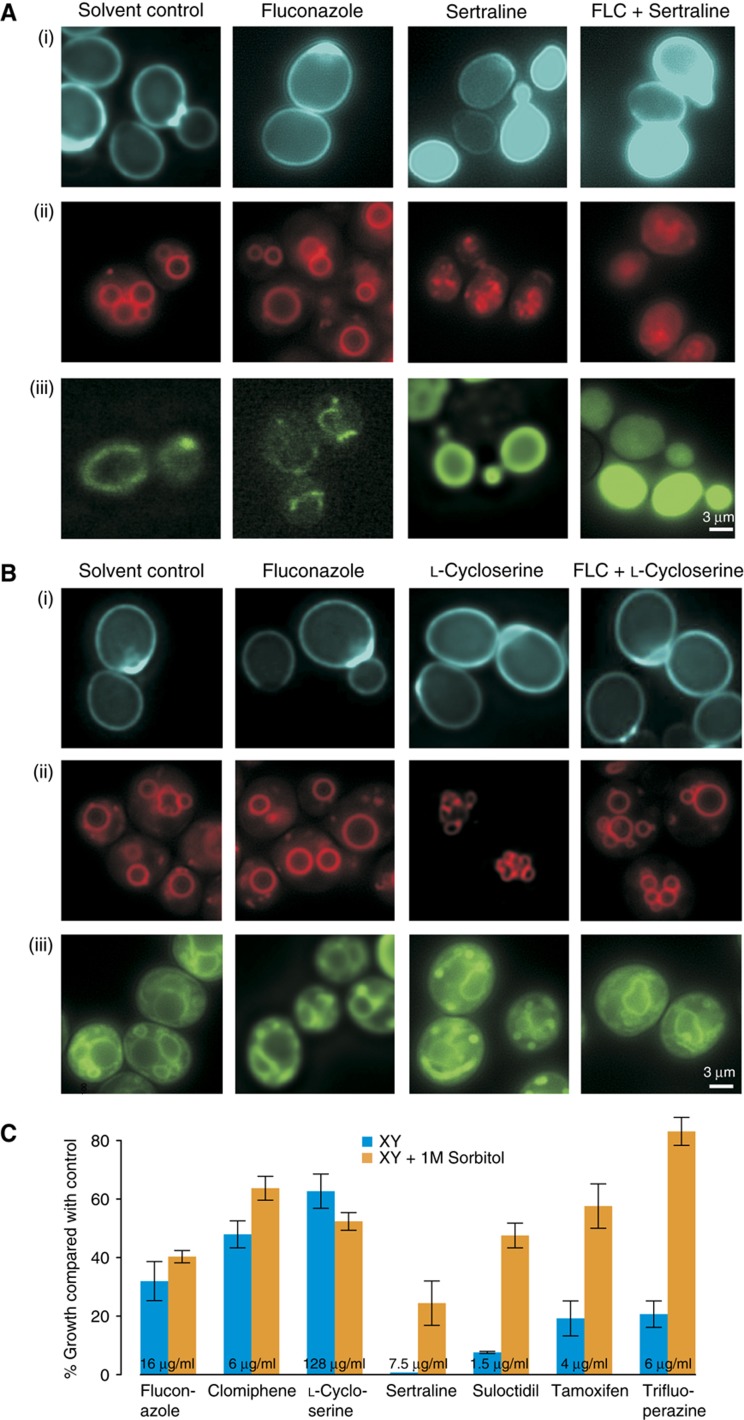
Effects of syncretic drugs on membrane integrity. A wild-type S. cerevisiae strain was grown in the presence of the indicated drugs and stained with (i) Calcofluor White M2R, (ii) FM4-64 and (iii) Mitotracker Green FM, and imaged by fluorescence microscopy. (A) Sertraline (128 μg/ml) in the presence and absence of fluconazole (64 μg/ml). (B) L-Cycloserine (128 μg/ml) in the presence and absence of fluconazole (128 μg/ml). (C) Growth of wild-type S. cerevisiae compared with control wells in the presence of the indicated drugs with and without 1 M sorbitol. The mean of four independent measurements is shown; error bars represent standard error. Source data is available for this figure at www.nature.com/msb.
Figure 5
Figure 5
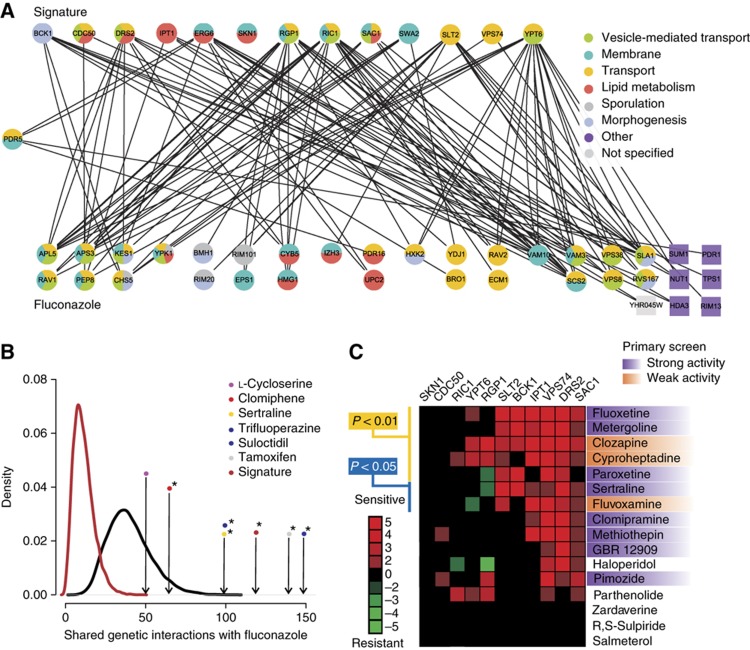
Rationalization of synergistic interactions by integration of chemical–genetic and genetic interaction networks. (A) Bipartite graph of genetic interactions between top 50 chemical–genetic interactors of fluconazole and the signature deletion strains sensitive to the five membrane active compounds. As PDR5 was a member of both sets, it is positioned midway between the two sets. Enriched Gene Ontology (GO) SLIM biological processes are indicated (adjusted P-value <0.05). GO enrichment was calculated and visualized using GOlorize (Garcia et al, 2007). (B) Chemical–genetic space (CGS) simulation with the 50 most sensitive deletion strains for each of the synergistic drugs as well as the signature deletion strain set. Arrows indicate the number of actual genetic interactions for the different drugs; black curve represents the background distribution of genetic interactions between two random sample sets of 50 non-essential deletion strains chosen from 1143 strains that respond to a variety of different chemicals and drugs (Hillenmeyer et al, 2008); dark red curve depicts the same background distribution except that the second sample set size was chosen to match the size of signature deletion set. Asterisks indicate a P-value <0.05. (C) Drug sensitivity of 11 of the 14 signature deletion strains identified in this study for 16 previously profiled psychiatric drugs present in the Prestwick library (Ericson et al, 2008). Strong activity refers to compounds that were hits in the primary screens, that is, at least 2 MAD away from the diagonal, whereas weak activity refers to compounds that showed at least 20% growth inhibition and were >1 MAD away from the diagonal. Source data is available for this figure at www.nature.com/msb.
Figure 6
Figure 6
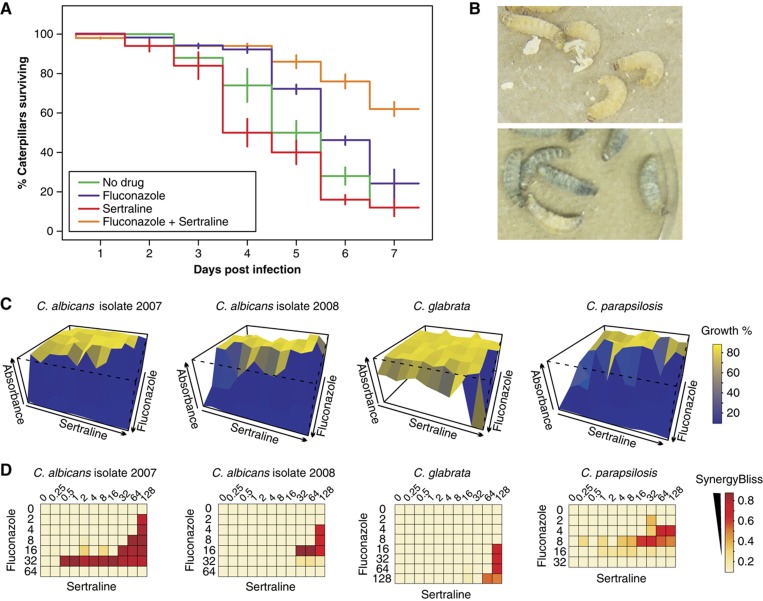
Synergistic activity of sertraline and fluconazole in an in vivo infection model and against clinical isolates. (A) G. mellonella caterpillars were injected with 8 × 10³ cfu C. neoformans H99 on day 0 and drugs alone or in combination (1 μg fluconazole; 26 μg sertraline) on the first day and incubated for 1 week at 37°C. Values are mean of three independent experiments; error bars indicate standard deviation of the mean. (B) Uninfected G. mellonella caterpillars (top); melanization of infected G. mellonella caterpillars without drug treatment (bottom). (C) Combination matrix assays against drug-resistant Candida strains. Residual growth was plotted as a function of combinations of two-fold dilutions of each drug. (D) Bliss synergy analysis for combination assays shown in panel (C). The apparent absence of synergy at the highest fluconazole concentrations for C. albicans and C. parapsilosis is due to growth inhibition caused by fluconazole alone. Drug concentrations are in μg/ml. Source data is available for this figure at www.nature.com/msb.

References

    1. Agoston V, Csermely P, Pongor S (2005) Multiple weak hits confuse complex systems: a transcriptional regulatory network as an example. Phys Rev E Stat Nonlin Soft Matter Phys 71: 051909. - PubMed
    1. Arendrup MC, Fisher BT, Zaoutis TE (2009) Invasive fungal infections in the paediatric and neonatal population: diagnostics and management issues. Clin Microbiol Infect 15: 613–624 - PubMed
    1. Baddley JW, Stroud TP, Salzman D, Pappas PG (2001) Invasive mold infections in allogeneic bone marrow transplant recipients. Clin Infect Dis 32: 1319–1324 - PubMed
    1. Borisy AA, Elliott PJ, Hurst NW, Lee MS, Lehar J, Price ER, Serbedzija G, Zimmermann GR, Foley MA, Stockwell BR, Keith CT (2003) Systematic discovery of multicomponent therapeutics. Proc Natl Acad Sci USA 100: 7977–7982 - PMC - PubMed
    1. Breitkreutz BJ, Stark C, Reguly T, Boucher L, Breitkreutz A, Livstone M, Oughtred R, Lackner DH, Bahler J, Wood V, Dolinski K, Tyers M (2008) The BioGRID Interaction Database: 2008 update. Nucleic Acids Res 36: D637–D640 - PMC - PubMed

Publication types

MeSH terms