


Fat in the skin: Triacylglycerol metabolism in keratinocytes and its role in the development of neutral lipid storage disease
- PMID: 21695016
- PMCID: PMC3117006
- DOI: 10.4161/derm.3.2.15472
Fat in the skin: Triacylglycerol metabolism in keratinocytes and its role in the development of neutral lipid storage disease
Abstract
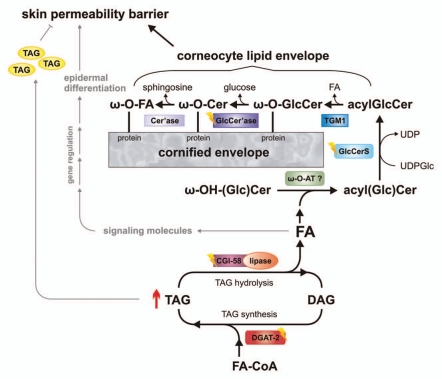
Keratinocyte differentiation is essential for skin development and the formation of the skin permeability barrier. This process involves an orchestrated remodeling of lipids. The cleavage of precursor lipids from lamellar bodies by β-glucocerebrosidase, sphingomyelinase, phospholipases and sterol sulfatase generates ceramides, non-esterified fatty acids and cholesterol for the lipid-containing extracellular matrix, the lamellar membranes in the stratum corneum. The importance of triacylglycerol (TAG) hydrolysis for the formation of a functional permeability barrier was only recently appreciated. Mice with defects in TAG synthesis (acyl-CoA:diacylglycerol acyltransferase-2-knock-out) or TAG catabolism (comparative gene identification-58, -CGI-58-knock-out) develop severe permeability barrier defects and die soon after birth because of desiccation. In humans, mutations in the CGI-58 gene also cause (non-lethal) neutral lipid storage disease with ichthyosis. As a result of defective TAG synthesis or catabolism, humans and mice lack ω-(O)-acylceramides, which are essential lipid precursors for the formation of the corneocyte lipid envelope. This structure plays an important role in linking the lipid-enriched lamellar membranes to highly cross-linked corneocyte proteins. This review focuses on the current knowledge of biochemical mechanisms that are essential for epidermal neutral lipid metabolism and the formation of a functional skin permeability barrier.
Keywords: ABHD5; ATGL; CGI-58; ceramide; ichthyosis; keratinocyte; lipids; triacylglycerol.
Figures
References
-
- Nemes Z, Steinert PM. Bricks and mortar of the epidermal barri. Exp Mol Med. 1999;31:5–19. - PubMed
-
- Kalinin AE, Kajava AV, Steinert PM. Epithelial barrier function: assembly and structural features of the cornified cell envelope. Bioessays. 2002;24:789–800. - PubMed
-
- Madison KC. Barrier function of the skin: “la raison d'etre” of the epidermis. J Invest Dermatol. 2003;121:231–241. - PubMed
-
- Proksch E, Brandner JM, Jensen JM. The skin: an indispensable barrier. Exp Dermatol. 2008;17:1063–1072. - PubMed
-
- Jensen JM, Proksch E. The skin's barrier. G Ital Dermatol Venereol. 2009;144:689–700. - PubMed
Grants and funding
LinkOut - more resources
Full Text Sources