. 2011;6(6):e20169.
doi: 10.1371/journal.pone.0020169. Epub 2011 Jun 14.

Humanized Rag1-/- γc-/- mice support multilineage hematopoiesis and are susceptible to HIV-1 infection via systemic and vaginal routes

Affiliations

Humanized Rag1-/- γc-/- mice support multilineage hematopoiesis and are susceptible to HIV-1 infection via systemic and vaginal routes

Ramesh Akkina et al. PLoS One. 2011.

Abstract

Several new immunodeficient mouse models for human cell engraftment have recently been introduced that include the Rag2(-/-)γc(-/-), NOD/SCID, NOD/SCIDγc(-/-) and NOD/SCIDβ2m(-/-) strains. Transplantation of these mice with CD34(+) human hematopoietic stem cells leads to prolonged engraftment, multilineage hematopoiesis and the capacity to generate human immune responses against a variety of antigens. However, the various mouse strains used and different methods of engrafting human cells are beginning to illustrate strain specific variations in engraftment levels, duration and longevity of mouse life span. In these proof-of-concept studies we evaluated the Balb/c-Rag1(-/-)γ(-/-) strain for engraftment by human fetal liver derived CD34(+) hematopoietic cells using the same protocol found to be effective for Balb/c-Rag2(-/-)γc(-/-) mice. We demonstrate that these mice can be efficiently engrafted and show multilineage human hematopoiesis with human cells populating different lymphoid organs. Generation of human cells continues beyond a year and production of human immunoglobulins is noted. Infection with HIV-1 leads to chronic viremia with a resultant CD4 T cell loss. To mimic the predominant sexual viral transmission, we challenged humanized Rag1(-/-)γc(-/-) mice with HIV-1 via vaginal route which also resulted in chronic viremia and helper T cell loss. Thus these mice can be further exploited for studying human pathogens that infect the human hematopoietic system in an in vivo setting.


Conflict of interest statement

Competing Interests: The authors have declared that no competing interests exist.

Figures

Figure 1
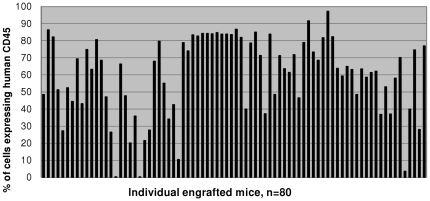
Figure 1. Human CD45 cell engraftment levels in humanized Rag1−/−γc−/− mice.
Human CD34 cell reconstituted mice were bled at 12 weeks post-engraftment. RBCs were lysed and the white blood cell fraction was stained for human panleukocyte CD45 marker and FACS analyzed. The level of human cell engraftment for each mouse is depicted.
Figure 2
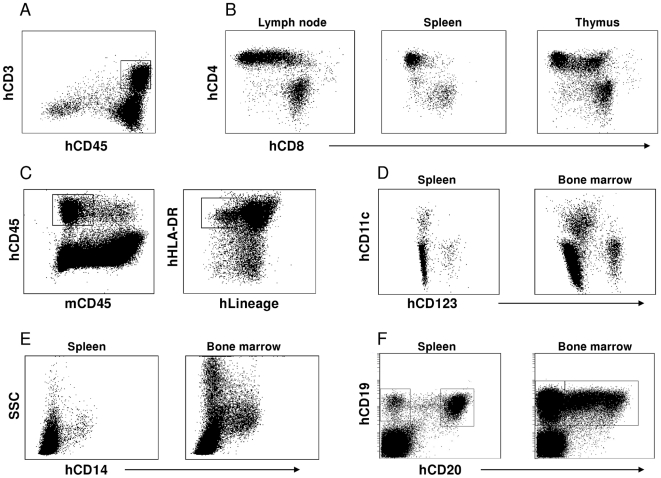
Figure 2. FACS analysis of multilineage human hematopoiesis in humanized Rag1−/−γc−/− mice.
Single cell suspensions were made from spleen, bone marrow, lymph node and thymus of humanized Rag1−/−γc−/− mice and were stained with different antibodies to detect human hematopoietic cell sub-sets. Human anti-CD45 antibody was used to define human leukocytes. From this population human CD3+ T cells (A) as well as CD4+ and CD8+ T cell subsets were identified in the lymph node, spleen and thymus (B). Dendritic cells were identified by their lack of lineage staining (CD3, CD19, CD14, CD16, CD20 and CD56) and expression of HLA DR (C). Both myeloid (CD11c) and plasmacytoid (CD123) dendritic cells (D) were identified in lymphoid organs as were CD14 expressing monocytes (E) and two subsets of CD19 and CD20 expressing B cells (F).
Figure 3
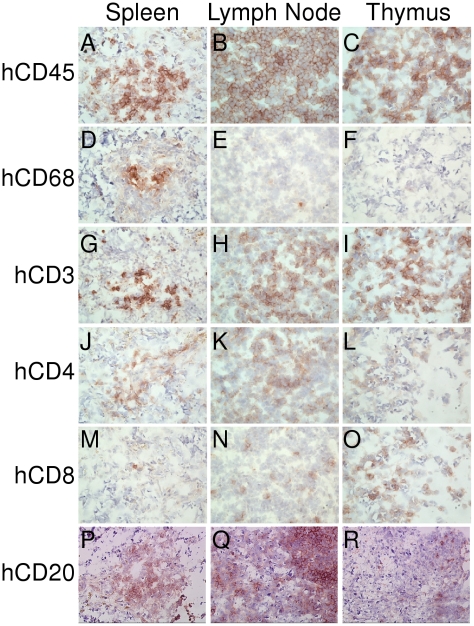
Figure 3. Immunohistochemical staining of human hematopoietic cells in lymphoid organs.
Tissue sections of lymphoid organs (spleen, lymph node, and thymus) from humanized Rag1−/−γc−/− mice were stained for the presence of human leukocytes. CD45+ leukocytes (A,B,C), CD68+ macrophages/dendritic cells (D,E,F), CD3+ T cells (G,H,I), CD4+ helper T cells (J,K,L), CD8+ cytotoxic T cells (M,N,O) and CD20+ B cells (P,Q,R) were detected in each of the organs assayed.
Figure 4
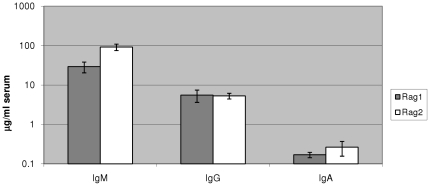
Figure 4. Human antibody production in humanized Rag1−/−γc−/− mice.
Blood was drawn at 16 weeks post human CD34 cell engraftment and sera were analyzed by ELISA to detect different human immunoglobulin classes.
Figure 5
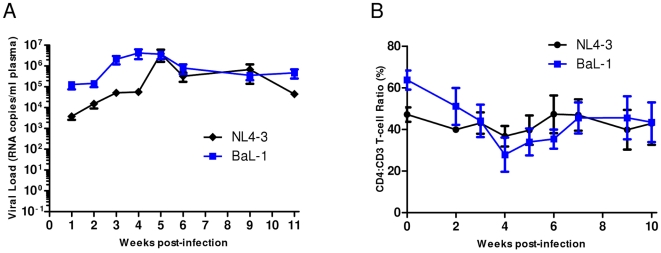
Figure 5. Humanized Rag1−/−γc−/− mice are susceptible to HIV-1 infection by i/p route and show CD4 T cell decline.
Mice were infected by i/p route with either X4 or R5 HIV-1. Blood was collected weekly and viral RNA extracted from the plasma fraction. Viral RNA loads were determined by Q-RT-PCR as described in methods. Levels of CD4 T cells were monitored on a weekly basis by FACS to determine their decline. Baseline values for each of the mice were established prior to infection as described in Methods. A. RNA viral loads. B. CD4 T cell levels.
Figure 6
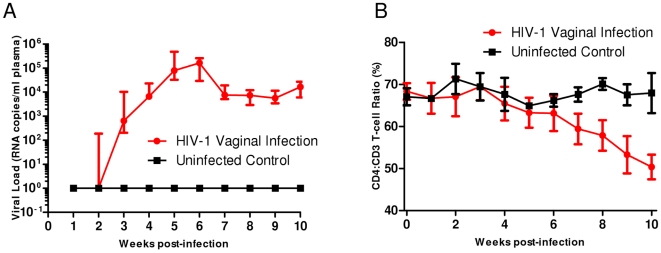
Figure 6. Humanized Rag1−/−γc−/− mice are permissive to HIV-1 infection by vaginal route and show CD4 T cell decline.
Mice were infected by vaginal route with R5 BaL HIV-1. Blood was collected weekly and viral RNA extracted from the plasma fraction. Viral RNA loads were determined by Q-RT-PCR as described in methods. Levels of CD4 T cells were monitored on a weekly basis by FACS to determine their decline. Baseline values for each of the mice were established prior to infection as described in Methods. A. RNA viral loads. B. CD4 T cell levels.

References

    1. Shultz LD, Ishikawa F, Greiner DL. Humanized mice in translational biomedical research. Nat Rev Immunol. 2007;7:118–130. - PubMed
    1. Van Duyne R, Pedati C, Guendel I, Carpio L, Kehn-Hall K, et al. The utilization of humanized mouse models for the study of human retroviral infections. Retrovirology. 2009;6:76. - PMC - PubMed
    1. Legrand N, Ploss A, Balling R, Becker PD, Borsotti C, et al. Humanized mice for modeling human infectious disease: challenges, progress, and outlook. Cell Host Microbe. 2009;6:5–9. - PMC - PubMed
    1. McCune JM, Namikawa R, Kaneshima H, Shultz LD, Lieberman M, et al. The SCID-hu mouse: murine model for the analysis of human hematolymphoid differentiation and function. Science. 1988;241:1632–1639. - PubMed
    1. Mosier DE, Gulizia RJ, Baird SM, Wilson DB. Transfer of a functional human immune system to mice with severe combined immunodeficiency. Nature. 1988;335:256–259. - PubMed

Publication types

MeSH terms