


Deletion of insulin-degrading enzyme elicits antipodal, age-dependent effects on glucose and insulin tolerance
- PMID: 21695259
- PMCID: PMC3111440
- DOI: 10.1371/journal.pone.0020818
Deletion of insulin-degrading enzyme elicits antipodal, age-dependent effects on glucose and insulin tolerance
Abstract
Background: Insulin-degrading enzyme (IDE) is widely recognized as the principal protease responsible for the clearance and inactivation of insulin, but its role in glycemic control in vivo is poorly understood. We present here the first longitudinal characterization, to our knowledge, of glucose regulation in mice with pancellular deletion of the IDE gene (IDE-KO mice).
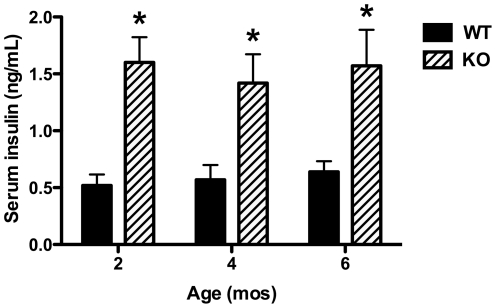
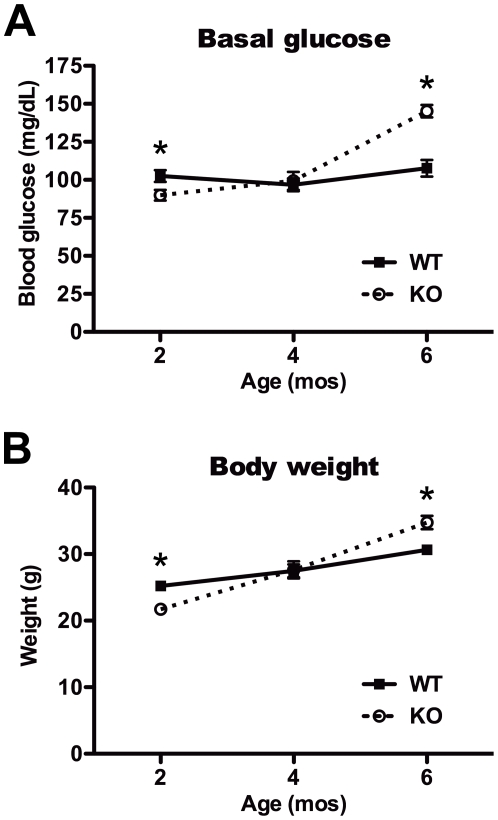
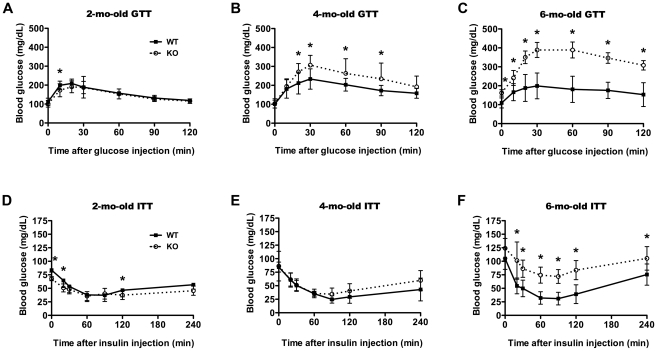
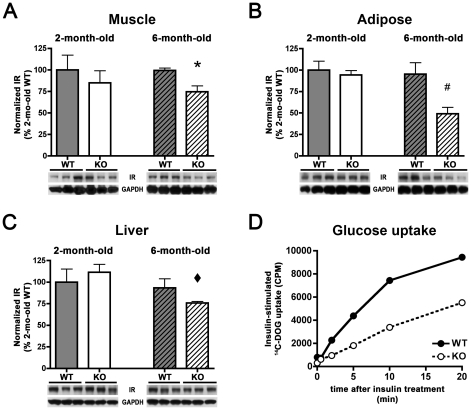
Methodology: IDE-KO mice and wild-type (WT) littermates were characterized at 2, 4, and 6 months of age in terms of body weight, basal glucose and insulin levels, and insulin and glucose tolerance. Consistent with a functional role for IDE in insulin clearance, fasting serum insulin levels in IDE-KO mice were found to be ∼3-fold higher than those in wild-type (WT) controls at all ages examined. In agreement with previous observations, 6-mo-old IDE-KO mice exhibited a severe diabetic phenotype characterized by increased body weight and pronounced glucose and insulin intolerance. In marked contrast, 2-mo-old IDE-KO mice exhibited multiple signs of improved glycemic control, including lower fasting glucose levels, lower body mass, and modestly enhanced insulin and glucose tolerance relative to WT controls. Biochemically, the emergence of the diabetic phenotype in IDE-KO mice correlated with age-dependent reductions in insulin receptor (IR) levels in muscle, adipose, and liver tissue. Primary adipocytes harvested from 6-mo-old IDE-KO mice also showed functional impairments in insulin-stimulated glucose uptake.
Conclusions: Our results indicate that the diabetic phenotype in IDE-KO mice is not a primary consequence of IDE deficiency, but is instead an emergent compensatory response to chronic hyperinsulinemia resulting from complete deletion of IDE in all tissues throughout life. Significantly, our findings provide new evidence to support the idea that partial and/or transient inhibition of IDE may constitute a valid approach to the treatment of diabetes.
Conflict of interest statement
Figures
References
-
- Duckworth WC, Hamel FG, Peavy DE, Liepnieks JJ, Ryan MP, et al. Degradation products of insulin generated by hepatocytes and by insulin protease. J Biol Chem. 1988;263:1826–1833. - PubMed
-
- Authier F, Posner BI, Bergeron JJ. Insulin-degrading enzyme. Clin Invest Med. 1996;19:149–160. - PubMed
-
- Duckworth WC, Bennett RG, Hamel FG. Insulin degradation: progress and potential. Endocr Rev. 1998;19:608–624. - PubMed
-
- Mirsky IA. Insulinase, insulinase-inhibitors, and diabetes mellitus. Recent Prog Horm Res. 1957;13:429–465; discussion 465–471. - PubMed
Publication types
MeSH terms
Substances
Grants and funding
LinkOut - more resources
Full Text Sources
Other Literature Sources
Medical
Molecular Biology Databases
Research Materials
