


Failure of fixation of trochanteric femur fractures: Clinical recommendations for avoiding Z-effect and reverse Z-effect type complications
- PMID: 21696626
- PMCID: PMC3142479
- DOI: 10.1186/1754-9493-5-17
Failure of fixation of trochanteric femur fractures: Clinical recommendations for avoiding Z-effect and reverse Z-effect type complications
Abstract
Background: Z-effect and reverse Z-effect are complications that arise from the surgical treatment of pertrochanteric fractures of the femur with proximal femoral nails (PFN) comprising two interlocking head screws. Such complications are induced by the migration of screws in opposite directions, which may lead to failure of the osteosynthesis.
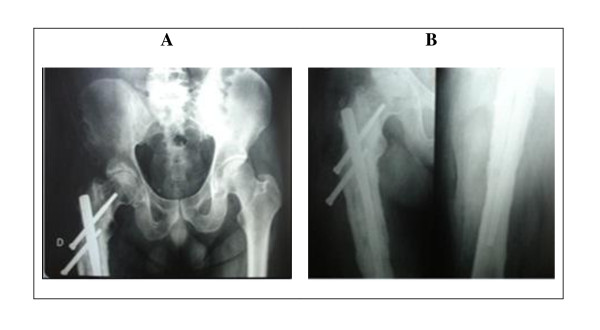
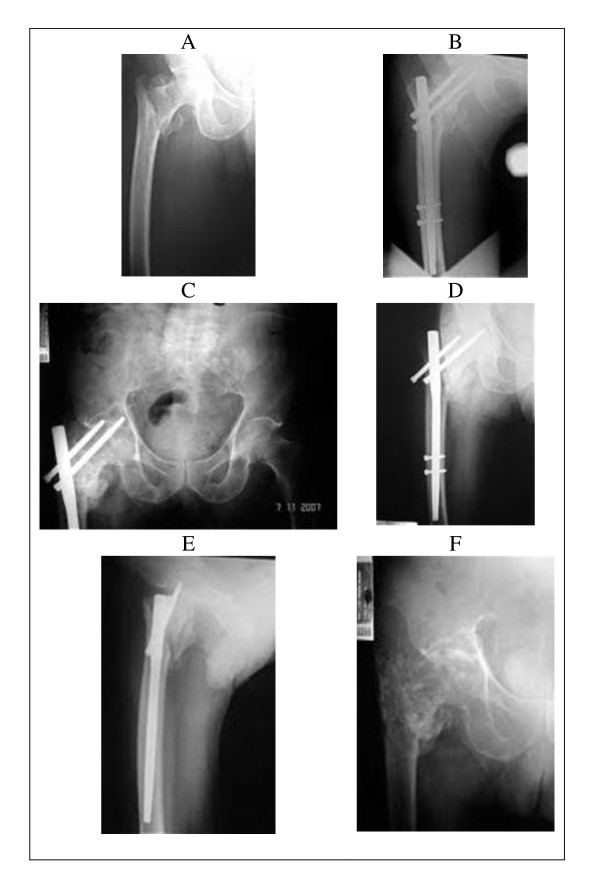
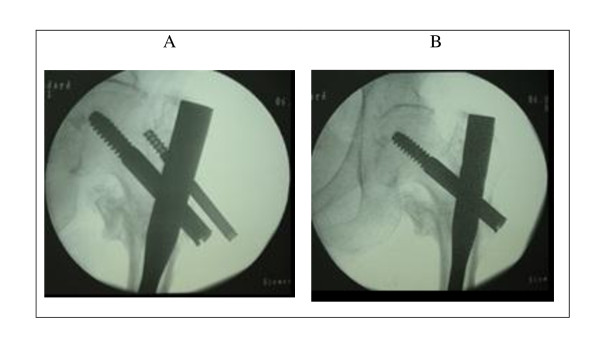
Findings: The paper describes three cases of pertrochanteric fractures that were treated with PFN with two interlocking screws that evolved to either Z-effect or reverse Z-effect. Literature-based explanations for this phenomenon are provided together with recommendations of how to avoid such complications.
Conclusions: Although intramedullary fixation is an established method of treatment of femoral intertrochanteric and subtrochanteric fractures, the evolution of the procedure may include complications associated with the migration of the interlocking head screws. The occurrence of Z-effect and reverse Z-effect has not been completely elucidated, but the main causes of such complications are probably fracture fixation in varus position, severe medial comminution, inappropriate entry point of the nail and poor bone quality.
Figures
References
-
- Guimarães JAM, Guimarães ACA, Franco JS. Avaliação do emprego da haste femoral curta na fratura transtrocantérica instável do fêmur. Rev Bras Ortop. 2008;43:406–417.
-
- Tyllianakis M, Panagopoulos A, Papadopoulos A, Papasmos S, Mousafiris. Treatment of extracapsular hip fractures with the proximal femoral nail (PFN): Long term results in 45 patients. Acta Orthop Belg. 2004;70:444–454. - PubMed
-
- Davis TRC, Sher JL, Horsman A, Simpson M, Porter BB, Checketts RG. Intertrochanteric femoral fractures. Mechanical failure after internal fixation. J Bone Joint Surgery Br. 1990;72:26–31. - PubMed
LinkOut - more resources
Full Text Sources
