


Diet, environmental factors, and lifestyle underlie the high prevalence of vitamin D deficiency in healthy adults in Scotland, and supplementation reduces the proportion that are severely deficient
- PMID: 21697298
- PMCID: PMC3361015
- DOI: 10.3945/jn.111.140012
Diet, environmental factors, and lifestyle underlie the high prevalence of vitamin D deficiency in healthy adults in Scotland, and supplementation reduces the proportion that are severely deficient
Abstract
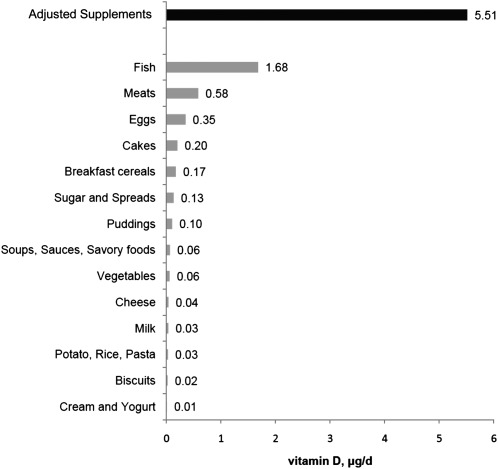
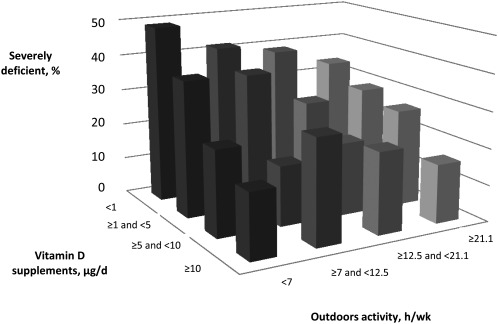
Vitamin D deficiency has recently been implicated as a possible risk factor in the etiology of numerous diseases, including nonskeletal conditions. In humans, skin synthesis following exposure to UVB is a potent source of vitamin D, but in regions with low UVB, individuals are at risk of vitamin D deficiency. Our objectives were to describe the prevalence of vitamin D deficiency and to investigate determinants of plasma 25-hydroxyvitamin D (25-OHD) concentrations in a high northern latitude country. Detailed dietary, lifestyle, and demographic data were collected for 2235 healthy adults (21-82 y) from Scotland. Plasma 25-OHD was measured by liquid chromatography-tandem MS. Among study participants, 34.5% were severely deficient (25-OHD <25 nmol/L) and 28.9% were at high risk of deficiency (25-40 nmol/L). Only 36.6% of participants were at low risk of vitamin D deficiency or had adequate levels (>40 nmol/L). Among participants who were taking supplements, 21.3% had a May-standardized 25-OHD concentration >50 nmol/L, 54.2% had 25-50 nmol/L, and 24.5% had <25 nmol/L, whereas this was 15.6, 43.3, and 41%, respectively, among those who did not take supplements (P < 0.0001). The most important sources of vitamin D were supplements and fish consumption. Vitamin D deficiency in Scotland is highly prevalent due to a combination of insufficient exposure to UVB and insufficient dietary intake. Higher dietary vitamin D intake modestly improved the plasma 25-OHD concentration (P = 0.02) and reduced the proportion of severely deficient individuals (P < 0.0001). In regions with low UVB exposure, dietary and supplement intake may be much more important than previously thought and consideration should be given to increasing the current recommended dietary allowance of 0-10 μg/d for adults in Scotland.
Conflict of interest statement
Author disclosures: L. Zgaga, E. Theodoratou, S. M. Farrington, F. Agakov, A. Tenesa, M. Walker, S. Knox, A. M. Wallace, R. Cetnarskyj, G. McNeill, J. Kyle, M. E. Porteous, M. G. Dunlop, and H. Campbell, no conflicts of interest.
Figures


References
-
- Holick MF. Vitamin D deficiency. N Engl J Med. 2007;357:266–81 - PubMed
-
- Dobnig H, Pilz S, Scharnagl H, Renner W, Seelhorst U, Wellnitz B, Kinkeldei J, Boehm BO, Weihrauch G, et al. Independent association of low serum 25-hydroxyvitamin D and 1,25-dihydroxyvitamin D levels with all-cause and cardiovascular mortality. Arch Intern Med. 2008;168:1340–9 - PubMed
-
- Giovannucci E, Liu Y, Rimm EB, Hollis BW, Fuchs CS, Stampfer MJ, Willett WC. Prospective study of predictors of vitamin D status and cancer incidence and mortality in men. J Natl Cancer Inst. 2006;98:451–9 - PubMed
Publication types
MeSH terms
Substances
Grants and funding
LinkOut - more resources
Full Text Sources
Medical
