Comparative Study
. 2011 Sep;106(3):1537-44.
doi: 10.1152/jn.00153.2011. Epub 2011 Jun 22.

Nucleus accumbens shell, but not core, tracks motivational value of salt

Affiliations
Comparative Study

Nucleus accumbens shell, but not core, tracks motivational value of salt

Amy L Loriaux et al. J Neurophysiol. 2011 Sep.

Abstract

To appropriately respond to an affective stimulus, we must be able to track its value across changes in both the external and internal environment. The nucleus accumbens (NAc) is a critical component of reward circuitry, but recent work suggests that the NAc encodes aversion as well as reward. It remains unknown whether differential NAc activity reflects flexible changes in stimulus value when it is altered due to a change in physiological state. We measured the activity of individual NAc neurons when rats were given intraoral infusions of a hypertonic salt solution (0.45 M NaCl) across multiple sessions in which motivational state was manipulated. This normally nonpreferred taste was made rewarding via sodium depletion, which resulted in a strong motivation to seek out and consume salt. Recordings were made in three conditions: while sodium replete (REP), during acute sodium depletion (DEP), and following replenishment of salt to normal sodium balance (POST). We found that NAc neurons in the shell and core subregions responded differently across the three conditions. In the shell, we observed overall increases in NAc activity when the salt solution was nonpreferred (REP) but decreases when the salt solution was preferred (DEP). In the core, overall activity was significantly altered only after sodium balance was restored (POST). The results lend further support to the selective encoding of affective stimuli by the NAc and suggest that NAc shell is particularly involved in flexibly encoding stimulus value based on motivational state.


Figures
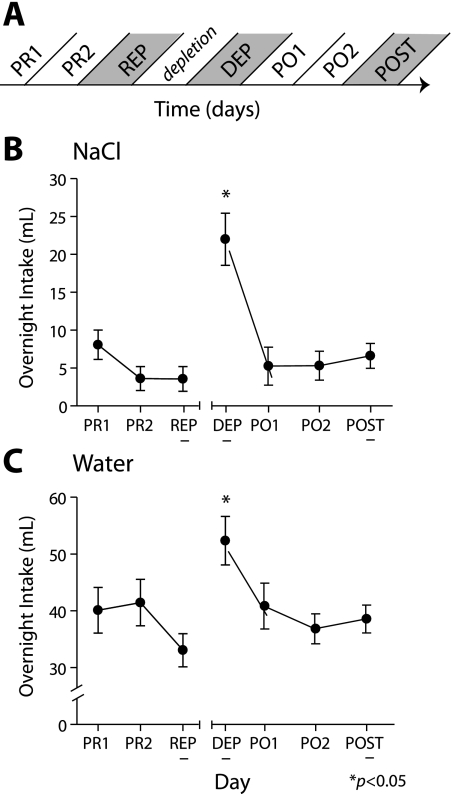
Fig. 1.
Fig. 1.
Time course of experimental procedures and behavioral results. A: over the course of the experiment, 2-bottle preference tests were conducted to measure free consumption of 0.45 M NaCl and distilled water daily from 5:00 PM to 10:00 AM. Tests were administered on the 2 nights before (PR1 and PR2) the first recording session; the night after the first, sodium-replete (REP) recording session; the night after the second, sodium-deplete (DEP) recording session; and for 3 days after the DEP session (PO1, PO2, and POST). Recording sessions were run in the afternoons (∼12:00 PM) on the REP, DEP, and POST days (shaded). B: intake of 0.45 M NaCl increased following diuretic treatment (all days n = 14, except PO1, n = 10, and PO2, n = 13). C: intake of water was also elevated following diuretic treatment. Asterisks indicate significantly higher intake on the DEP day than any other day for both NaCl and water.
Fig. 2.
Fig. 2.
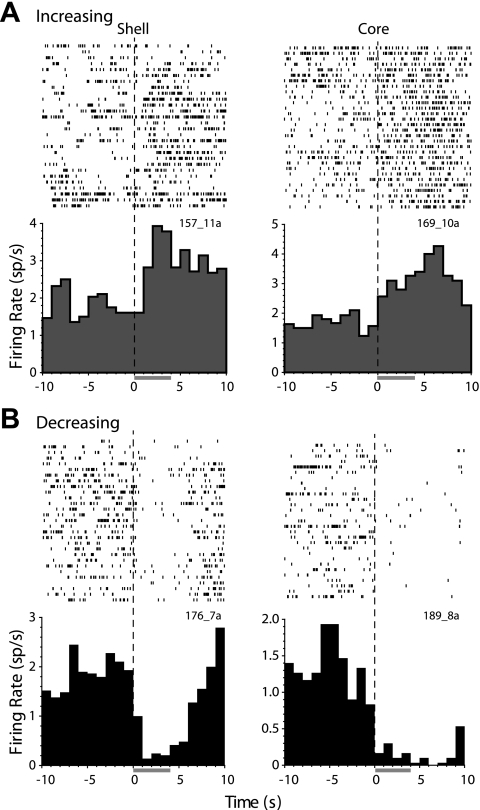
Examples of individual nucleus accumbens (NAc) shell and core neurons with phasic responses to taste infusions of 0.45 M NaCl. A: phasic increasing (INC) responses. Top: plots of the time of each action potential relative to the onset of the intraoral (IO) infusion (dashed vertical line, time 0) for each trial. Activity is shown for the baseline (−10 to 0 s), infusion (0–4 s, shaded horizontal bar), and postinfusion epochs (4–10 s). Bottom: peri-event histograms show the average response across trials in 1-s bins. B: phasic decreasing (DEC) responses (same conventions as in A).
Fig. 3.
Fig. 3.
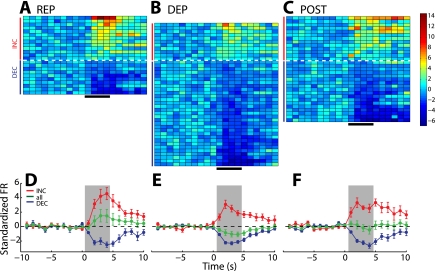
NAc shell population response tracks the hedonic value of NaCl taste across different physiological states. Each row of the color plots represents the average standardized response of 1 phasic neuron across 30 infusion trials in the REP (A), DEP (B), and POST (C) conditions. For each plot, activity is shown from 10 s before to 10 s after the onset of the infusion (in 1-s bins; black horizontal bar at bottom marks 4-s infusion period). Color indicates standardized firing rate for each neuron relative to 10-s baseline, as indicated by the legend at right. INC neurons are plotted above the dashed white line (red vertical bars) and DEC below (blue vertical bars). On the DEP day, there was a greater proportion of DEC neurons (31/42) compared with the REP (10/23) and POST (18/31) sessions. The graphs plot the average standardized firing rate across neurons in the REP (D), DEP (E), and POST (F) conditions. For each day, average standardized firing rate is shown for INC neurons (red, corresponding to those marked by red vertical bars in A–C) and DEC neurons (blue, corresponding to those marked by blue vertical bars) separately. The overall response average across all phasic neurons (INC and DEC together) is shown in green. Time scale is the same as in A–C, with the 4-s infusion period indicated by the gray shaded background.
Fig. 4.
Fig. 4.
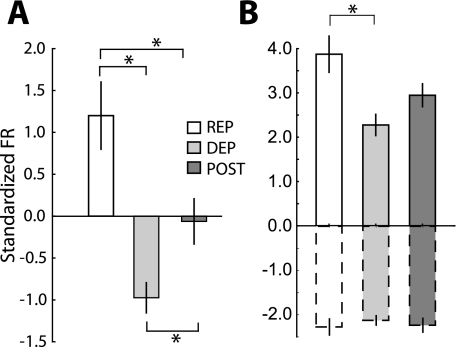
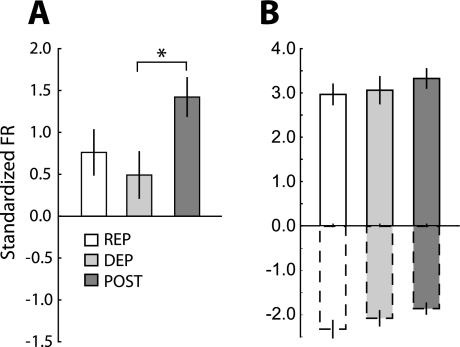
Magnitude of NAc shell responses during the 4-s infusion period in each condition. A: average standardized firing rate across all phasic neurons (INC and DEC). Values are averages of the firing rates shown by the green lines in Fig. 4, D–F (gray shading). Across all phasic neurons, the overall average response shifted from an increase in activity on the REP day (n = 23) to a decrease on the DEP day (n = 42) and an intermediate response on the POST day (n = 31). Asterisks indicate significant differences between conditions (P < 0.05). B: across the 3 sessions, the magnitude of the INC neurons (bars with solid outline) and DEC neurons (bars with dashed outline) separately. Values are averages of the firing rates shown by the red and blue lines (INC and DEC, respectively) in Fig. 4. D–F (gray shading). Asterisk indicates a higher magnitude in the INC response on the REP day compared with DEP. There were no differences in the magnitude in DEC responses.
Fig. 5.
Fig. 5.
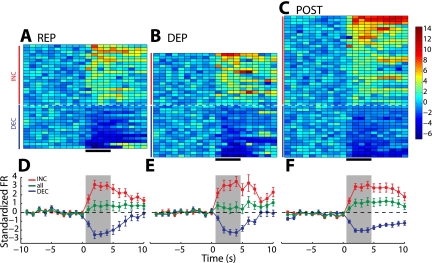
NAc core population response to NaCl taste shows different pattern from NAc shell across physiological states. Neurons in NAc core show INC responses to the taste of NaCl in 21/37 neurons on the REP day (A), 18/36 neurons on the DEP day (B), and 31/49 neurons on the POST day (C). The graphs plot the average standardized firing rate across neurons in the REP (D), DEP (E), and POST (F) conditions (same conventions as in Fig. 3).
Fig. 6.
Fig. 6.
Magnitude of NAc core responses during the 4-s infusion period in each condition. A: average standardized firing rate across all phasic neurons (INC and DEC). Asterisk indicates a larger increase in the overall response on the POST day (n = 49) compared with the DEP day (n = 36). Average response on the REP day (n = 36) did not differ from the other sessions. B: there were no differences in the magnitudes of INC or DEC responses separately across the 3 sessions (same conventions as in Fig. 4).

References

    1. Berridge KC, Flynn FW, Schulkin J, Grill HJ. Sodium depletion enhances salt palatability in rats. Behav Neurosci 98: 652–660, 1984 - PubMed
    1. Breslin PA, Kaplan JM, Spector AC, Zambito CM, Grill HJ. Lick rate analysis of sodium taste-state combinations. Am J Physiol Regul Integr Comp Physiol 264: R312–R318, 1993 - PubMed
    1. Cardinal RN, Parkinson JA, Lachenal G, Halkerston KM, Rudarakanchana N, Hall J, Morrison CH, Howes SR, Robbins TW, Everitt BJ. Effects of selective excitotoxic lesions of the nucleus accumbens core, anterior cingulate cortex, and central nucleus of the amygdala on autoshaping performance in rats. Behav Neurosci 116: 553–567, 2002 - PubMed
    1. Carelli RM. Nucleus accumbens cell firing during goal-directed behaviors for cocaine vs. ‘natural’ reinforcement. Physiol Behav 76: 379–387, 2002 - PubMed
    1. Carlezon WA, Jr, Thomas MJ. Biological substrates of reward and aversion: a nucleus accumbens activity hypothesis. Neuropharmacology 56, Suppl 1: 122–132, 2009 - PMC - PubMed

Publication types

Substances