


Dimorphism in methane seep-dwelling ecotypes of the largest known bacteria
- PMID: 21697959
- PMCID: PMC3223306
- DOI: 10.1038/ismej.2011.66
Dimorphism in methane seep-dwelling ecotypes of the largest known bacteria
Abstract
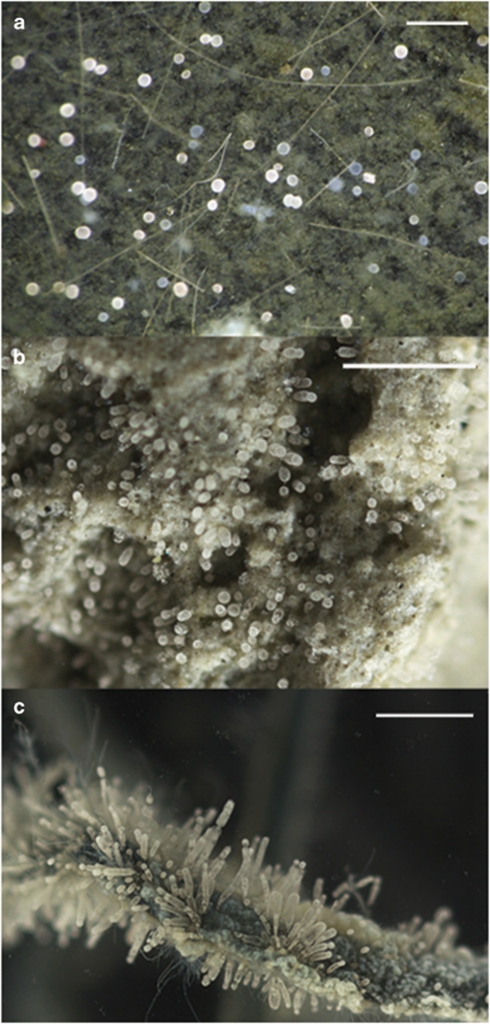
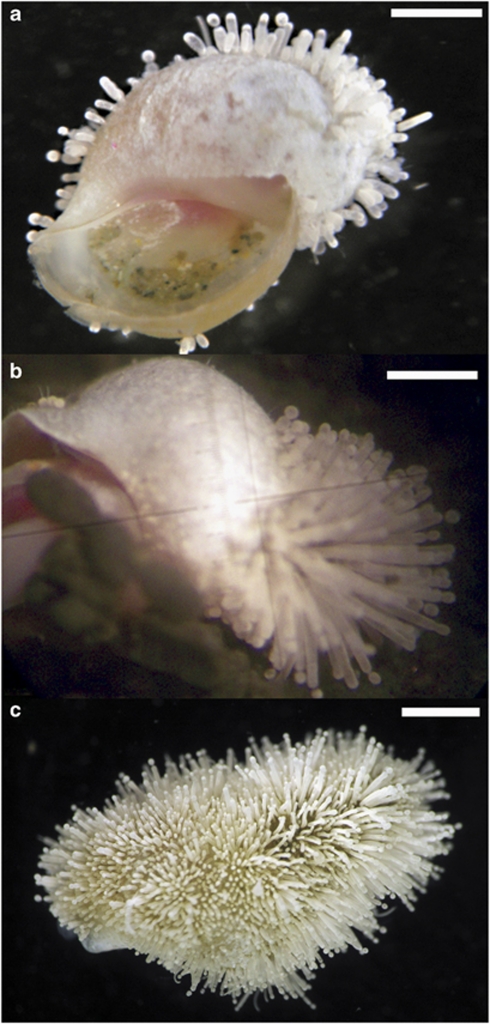
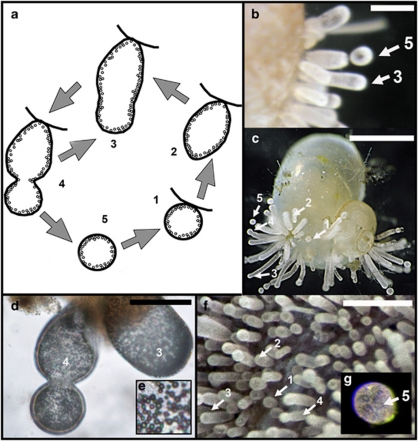
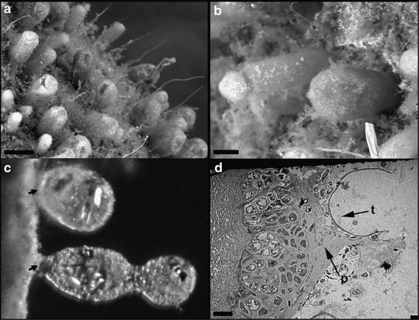
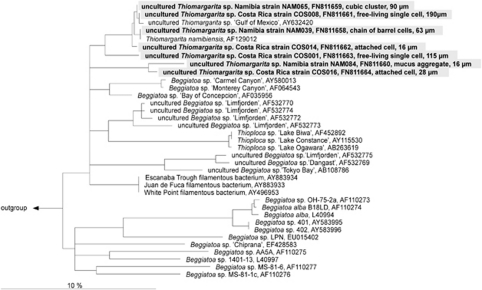
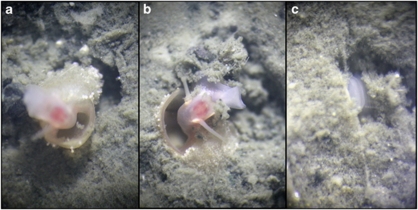
We present evidence for a dimorphic life cycle in the vacuolate sulfide-oxidizing bacteria that appears to involve the attachment of a spherical Thiomargarita-like cell to the exteriors of invertebrate integuments and other benthic substrates at methane seeps. The attached cell elongates to produce a stalk-like form before budding off spherical daughter cells resembling free-living Thiomargarita that are abundant in surrounding sulfidic seep sediments. The relationship between the attached parent cell and free-living daughter cell is reminiscent of the dimorphic life modes of the prosthecate Alphaproteobacteria, but on a grand scale, with individual elongate cells reaching nearly a millimeter in length. Abundant growth of attached Thiomargarita-like bacteria on the integuments of gastropods and other seep fauna provides not only a novel ecological niche for these giant bacteria, but also for animals that may benefit from epibiont colonization.
Figures
References
-
- Alain K, Olagnon M, Desbruyères D, Pagé A, Barbier G, Juniper SK, et al. Phylogenetic characterization of the bacterial assemblage associated with mucous secretions of the hydrothermal vent polychaete Paralvinella palmiformis. FEMS Microbiol Ecol. 2002;42:463–476. - PubMed
-
- Angert ER. Alternatives to binary fission in bacteria. Nat Rev Microbiol. 2005;3:214–224. - PubMed
-
- Bailey JV, Joye SB, Kalanetra KM, Flood BE, Corsetti FA. Evidence of giant sulphur bacteria in Neoproterozoic phosphorites. Nature. 2007;445:198–201. - PubMed
-
- Bohrmann G, Heeschen K, Jung C, Weinrebe W, Baranov B, Cailleau B, et al. Widespread fluid expulsion along the seafloor of the Costa Rica convergent margin. Terra Nova. 2002;14:69–79.
-
- Brun YV, Janakiraman R.2000The dimorphic life cycle of Caulobacter and stalked bacteriaIn: Brun YV and Shimkets LJ (eds).Prokaryotic Development American Society for Microbiology: Washington, DC; 297–317.
