Recurrent chromosome 16p13.1 duplications are a risk factor for aortic dissections
- PMID: 21698135
- PMCID: PMC3116911
- DOI: 10.1371/journal.pgen.1002118
Recurrent chromosome 16p13.1 duplications are a risk factor for aortic dissections
Abstract
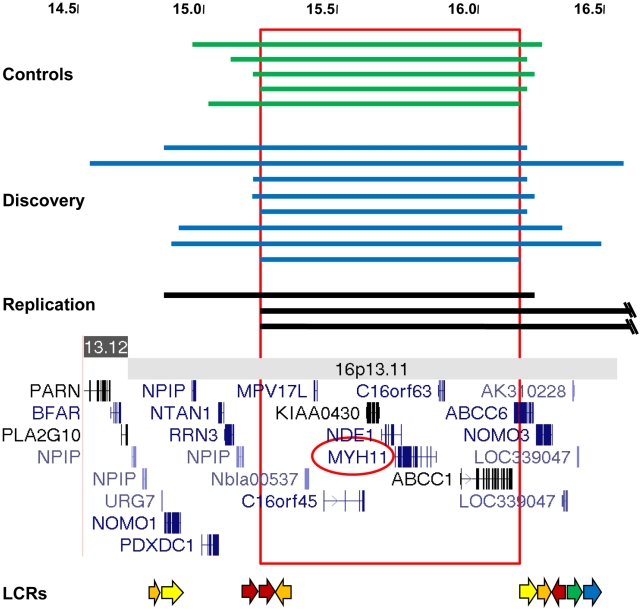
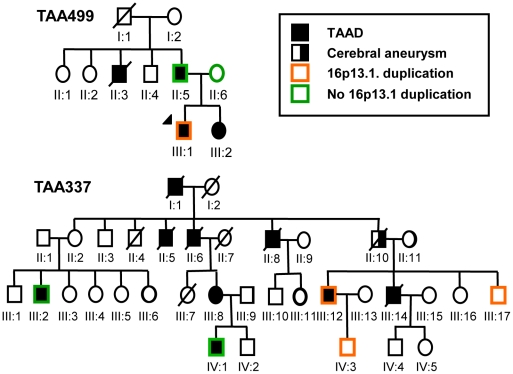
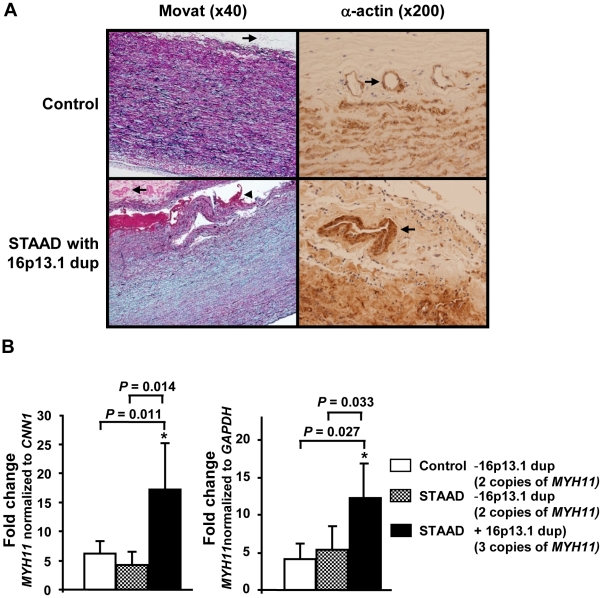
Chromosomal deletions or reciprocal duplications of the 16p13.1 region have been implicated in a variety of neuropsychiatric disorders such as autism, schizophrenia, epilepsies, and attention-deficit hyperactivity disorder (ADHD). In this study, we investigated the association of recurrent genomic copy number variants (CNVs) with thoracic aortic aneurysms and dissections (TAAD). By using SNP arrays to screen and comparative genomic hybridization microarrays to validate, we identified 16p13.1 duplications in 8 out of 765 patients of European descent with adult-onset TAAD compared with 4 of 4,569 controls matched for ethnicity (P = 5.0 × 10⁻⁵, OR = 12.2). The findings were replicated in an independent cohort of 467 patients of European descent with TAAD (P = 0.005, OR = 14.7). Patients with 16p13.1 duplications were more likely to harbor a second rare CNV (P = 0.012) and to present with aortic dissections (P = 0.010) than patients without duplications. Duplications of 16p13.1 were identified in 2 of 130 patients with familial TAAD, but the duplications did not segregate with TAAD in the families. MYH11, a gene known to predispose to TAAD, lies in the duplicated region of 16p13.1, and increased MYH11 expression was found in aortic tissues from TAAD patients with 16p13.1 duplications compared with control aortas. These data suggest chromosome 16p13.1 duplications confer a risk for TAAD in addition to the established risk for neuropsychiatric disorders. It also indicates that recurrent CNVs may predispose to disorders involving more than one organ system, an observation critical to the understanding of the role of recurrent CNVs in human disease and a finding that may be common to other recurrent CNVs involving multiple genes.
Conflict of interest statement
The authors have declared that no competing interests exist.
Figures
References
-
- Sharp AJ, Hansen S, Selzer RR, Cheng Z, Regan R, et al. Discovery of previously unidentified genomic disorders from the duplication architecture of the human genome. Nat Genet. 2006;38:1038–1042. - PubMed
-
- Symmons O, Varadi A, Aranyi T. How segmental duplications shape our genome: recent evolution of ABCC6 and PKD1 Mendelian disease genes. Mol Biol Evol. 2008;25:2601–2613. - PubMed
-
- Ullmann R, Turner G, Kirchhoff M, Chen W, Tonge B, et al. Array CGH identifies reciprocal 16p13.1 duplications and deletions that predispose to autism and/or mental retardation. Hum Mutat. 2007;28:674–682. - PubMed
Publication types
MeSH terms
Substances
Grants and funding
LinkOut - more resources
Full Text Sources
Medical