Review
. 2011 Nov;52(4):413-35.
doi: 10.1007/s13353-011-0057-x. Epub 2011 Jun 23.

Sequencing technologies and genome sequencing

Affiliations
Review

Sequencing technologies and genome sequencing

Chandra Shekhar Pareek et al. J Appl Genet. 2011 Nov.

Abstract

The high-throughput - next generation sequencing (HT-NGS) technologies are currently the hottest topic in the field of human and animals genomics researches, which can produce over 100 times more data compared to the most sophisticated capillary sequencers based on the Sanger method. With the ongoing developments of high throughput sequencing machines and advancement of modern bioinformatics tools at unprecedented pace, the target goal of sequencing individual genomes of living organism at a cost of $1,000 each is seemed to be realistically feasible in the near future. In the relatively short time frame since 2005, the HT-NGS technologies are revolutionizing the human and animal genome researches by analysis of chromatin immunoprecipitation coupled to DNA microarray (ChIP-chip) or sequencing (ChIP-seq), RNA sequencing (RNA-seq), whole genome genotyping, genome wide structural variation, de novo assembling and re-assembling of genome, mutation detection and carrier screening, detection of inherited disorders and complex human diseases, DNA library preparation, paired ends and genomic captures, sequencing of mitochondrial genome and personal genomics. In this review, we addressed the important features of HT-NGS like, first generation DNA sequencers, birth of HT-NGS, second generation HT-NGS platforms, third generation HT-NGS platforms: including single molecule Heliscope™, SMRT™ and RNAP sequencers, Nanopore, Archon Genomics X PRIZE foundation, comparison of second and third HT-NGS platforms, applications, advances and future perspectives of sequencing technologies on human and animal genome research.


Figures
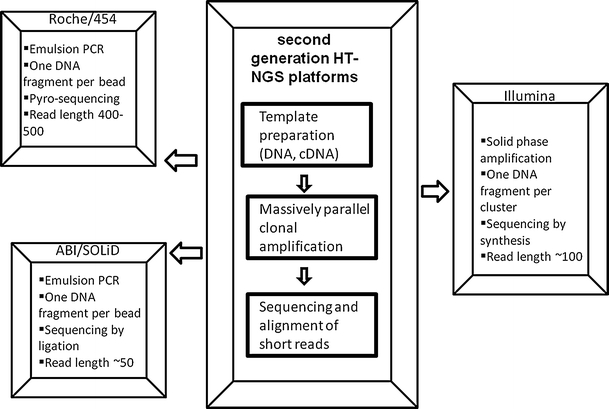
Fig. 1
Fig. 1
Advanced technological features of three leading second generation HT-NGS platforms
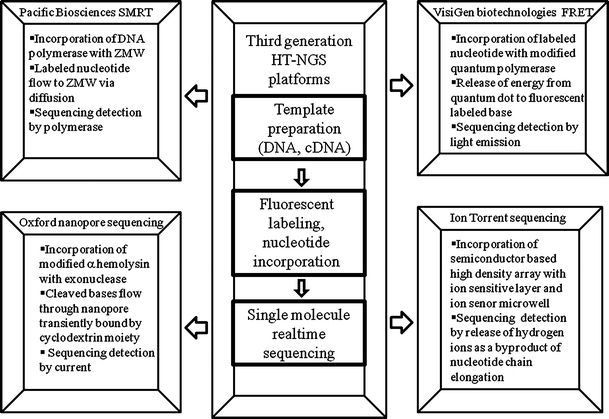
Fig. 2
Fig. 2
Advanced technological features of four leading third generation HT-NGS platforms
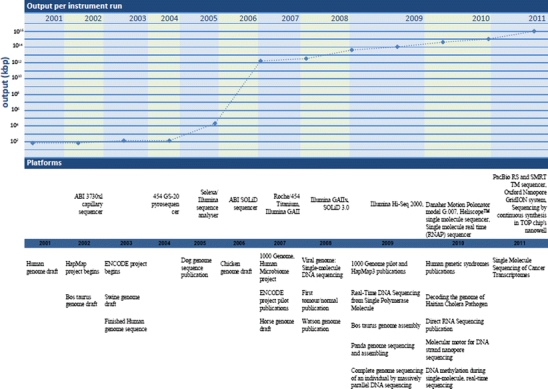
Fig. 3
Fig. 3
Changes in instrument capacity over the past decade, and the timing of major sequencing projects (Figure updated from Madris, 2011). On top: increasing scale of data output per run plotted on a logarithmic scale. At middle: timeline representing major milestones in massively parallel sequencing platform introduction and instrument revisions. On bottom: the time lines of several projects, milestones and publications citing different sequencing technologies
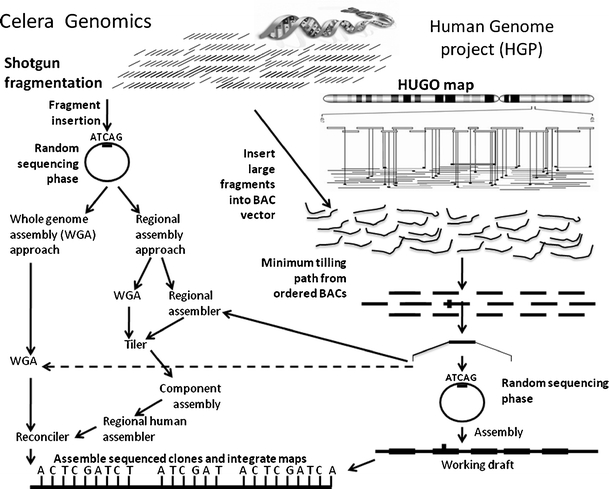
Fig. 4
Fig. 4
Two strategies for generating the first complete human genome sequence: On right, the Human Genome Project (HGP) map-based strategy (Lander et al. 2001) showing the localizing bacterial artificial chromosomes (BACs) containing large fragments of human DNA within the framework of a landmark-based physical map. On left, the Celera’s strategy (Venter et al. 2001) showing the whole genome shotgun sequencing approach

References

    1. Ahn SM, Kim TH, Lee S, Kim D, Ghang H, Kim DS, et al. The first Korean genome sequence and analysis: full genome sequencing for a socio-ethnic group. Genome Res. 2009;19:1622–1629. doi: 10.1101/gr.092197.109. - DOI - PMC - PubMed
    1. Amaral AJ, Megens HJ, Kerstens HH, Heuven HC, Dibbits B, Crooijmans RP, den Dunnen JT, Groenen MA. Application of massive parallel sequencing to whole genome SNP discovery in the porcine genome. BMC Genomics. 2009;10:374. doi: 10.1186/1471-2164-10-374. - DOI - PMC - PubMed
    1. Amstutz U, Andrey-Zürcher G, Suciu D, Jaggi R, Häberle J, Largiadèr CR. Sequence capture and next-generation resequencing of multiple tagged nucleic acid samples for mutation screening of urea cycle disorders. Clin Chem. 2011;57:102–111. doi: 10.1373/clinchem.2010.150706. - DOI - PubMed
    1. Andersson L, Haley CS, Ellegren H, Knott SA, et al. Genetic mapping of quantitative trait loci for growth and fatness in pigs. Science. 1994;263:1771–1774. doi: 10.1126/science.8134840. - DOI - PubMed
    1. Ansorge W, et al. A non-radioactive automated method for DNA sequence determination. J Biochem Biophys Methods. 1986;13:315–323. doi: 10.1016/0165-022X(86)90038-2. - DOI - PubMed

Substances

LinkOut - more resources