


Comment
doi: 10.1172/JCI57671.
Epub 2011 Jun 23.
PON-dering differences in HDL function in coronary artery disease
Affiliations
- PMID: 21701074
- PMCID: PMC3223844
- DOI: 10.1172/JCI57671
Item in Clipboard
Comment
PON-dering differences in HDL function in coronary artery disease
J Clin Invest.
2011 Jul.
Abstract
HDL cholesterol activates endothelial cell production of the atheroprotective signaling molecule NO, and it promotes endothelial repair. In this issue of the JCI, Besler et al. provide new data indicating that HDL from stable coronary artery disease (CAD) or acute coronary syndrome patients inhibits rather than stimulates endothelial NO synthesis and endothelial repair. This may be related to decreased HDL-associated paraoxonase 1 (PON1) activity. These observations support the concept that the cardiovascular impact of HDL is not simply related to its abundance, and the translation of the present findings to prospective studies of CAD risk and to evaluations of HDL-targeted therapeutics is a logical future goal.
Figures
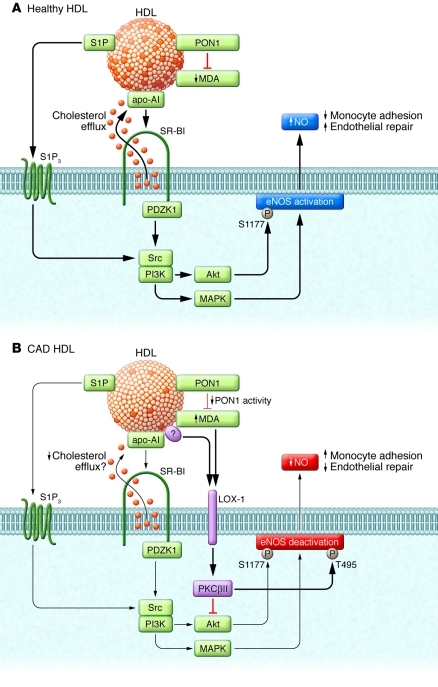
(A) HDLHealthy stimulates eNOS through multiple mechanisms. HDL binding to SR-BI via apoA-I causes cholesterol efflux (orange circles) that is sensed by SR-BI, leading to PDZK1-dependent activation of Src family kinase(s), PI3K, and Akt, which phosphorylates eNOS Ser1177 and thereby increases enzyme activity. SR-BI–, Src-, and PI3K-dependent Erk MAPK activation is also required for eNOS activation by HDL. HDL-associated S1P and related molecules may activate the lysophospholipid receptor S1P3 to stimulate eNOS. HDLHealthy contains active PON1, which suppresses the formation of oxidized lipids and lipoproteins such as MDA. The net effect of eNOS activation by HDLHealthy is to blunt endothelial cell–monocyte adhesion and promote endothelial repair. (B) HDLCAD activates inhibitory signaling that suppresses eNOS activation. HDLCAD has reduced PON1 activity that potentially leads to greater formation of MDA, which activates LOX-1 and thereby stimulates PKCβ. PKCβ inhibits stimulatory Akt and eNOS phosphorylation events, and it enhances the inhibitory phosphorylation of eNOS at Thr495. As a result, HDLCAD has an impaired capacity to favorably influence endothelial cell–monocyte adhesion or endothelial repair. It is unknown whether the loss in PON1 activity leads to alterations in other HDL constituents besides MDA that activate LOX-1. Whether HDLCAD has decreased capacity to evoke cholesterol efflux from endothelial cells — possibly via MDA-related modification of apoA-I, resulting in attenuated SR-BI–dependent signaling — is also unknown. In addition, it is unknown whether endothelial cell signaling activated by cargo molecules such as S1P is altered in HDLCAD.
Comment on
-
Mechanisms underlying adverse effects of HDL on eNOS-activating pathways in patients with coronary artery disease.J Clin Invest. 2011 Jul;121(7):2693-708. doi: 10.1172/JCI42946. Epub 2011 Jun 23. J Clin Invest. 2011. PMID: 21701070 Free PMC article.
References
-
- Hughes SD, Verstuyft J, Rubin EM. HDL deficiency in genetically engineered mice requires elevated LDL to accelerate atherogenesis. Arterioscler Thromb Vasc Biol. 1997;17(9):1725–1729. - PubMed
Publication types
MeSH terms
Substances
Grants and funding
LinkOut - more resources
Full Text Sources
Medical
Miscellaneous
