


Global diversity of Ascidiacea
- PMID: 21701684
- PMCID: PMC3119061
- DOI: 10.1371/journal.pone.0020657
Global diversity of Ascidiacea
Abstract
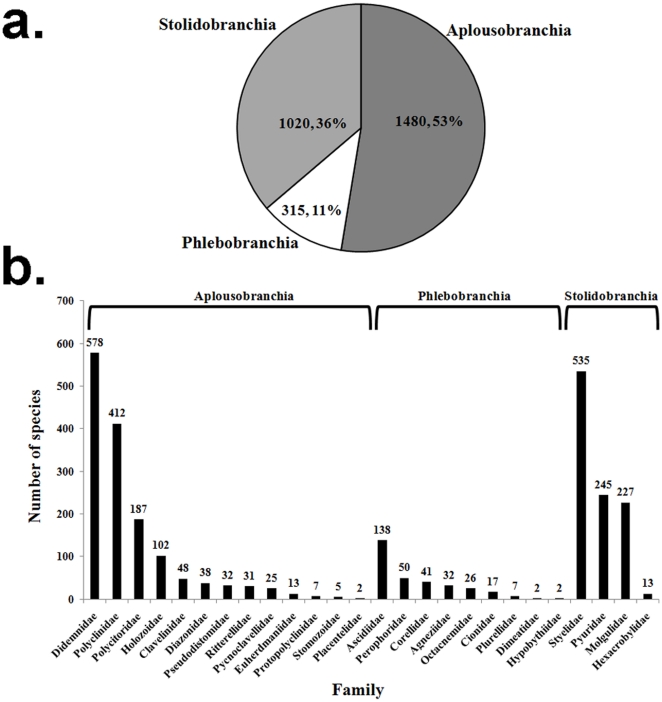
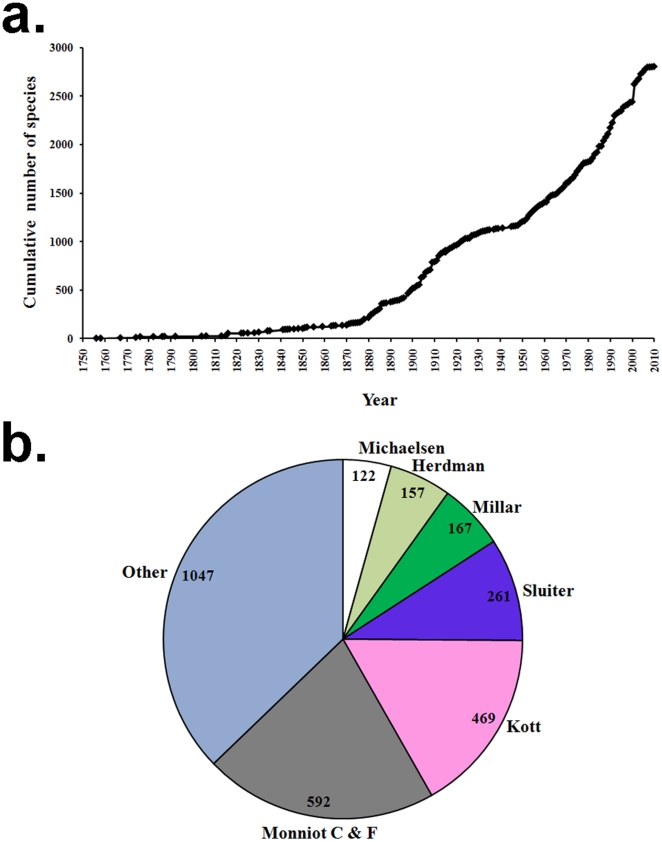
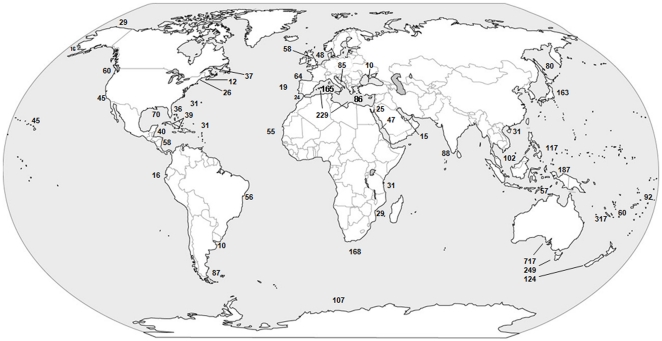
The class Ascidiacea presents fundamental opportunities for research in the fields of development, evolution, ecology, natural products and more. This review provides a comprehensive overview of the current knowledge regarding the global biodiversity of the class Ascidiacea, focusing in their taxonomy, main regions of biodiversity, and distribution patterns. Based on analysis of the literature and the species registered in the online World Register of Marine Species, we assembled a list of 2815 described species. The highest number of species and families is found in the order Aplousobranchia. Didemnidae and Styelidae families have the highest number of species with more than 500 within each group. Sixty percent of described species are colonial. Species richness is highest in tropical regions, where colonial species predominate. In higher latitudes solitary species gradually contribute more to the total species richness. We emphasize the strong association between species richness and sampling efforts, and discuss the risks of invasive species. Our inventory is certainly incomplete as the ascidian fauna in many areas around the world is relatively poorly known, and many new species continue to be discovered and described each year.
Conflict of interest statement
Figures
References
-
- Monniot C, Monniot F, Laboute P. Paris: ORSTOM; 1991. Coral Reef Ascidians of New Caledonia.
-
- Kott P. New and little-known species of Didemnidae (Ascidiacea, Tunicata) from Australia (Part 3). J Nat Hist. 2005;39:2409–2497.
-
- Forbes E, Hanley SCT. 4 vols. London: John Van Voorst; 1853. A history of British Mollusca and their shells.
-
- Lamarck JB. Paris: Déterville; 1816. Histoire naturelle des animaux sans vertèbres. Tome III. Tuniciers. pp. 80–130C.
Publication types
MeSH terms
LinkOut - more resources
Full Text Sources
