


Dieting and disordered eating behaviors from adolescence to young adulthood: findings from a 10-year longitudinal study
- PMID: 21703378
- PMCID: PMC3140795
- DOI: 10.1016/j.jada.2011.04.012
Dieting and disordered eating behaviors from adolescence to young adulthood: findings from a 10-year longitudinal study
Abstract
Background: Disordered eating behaviors are prevalent in adolescence and can have harmful consequences. An important question is whether use of these behaviors in adolescence sets the pattern for continued use into young adulthood.
Objective: To examine the prevalence and tracking of dieting, unhealthy and extreme weight control behaviors, and binge eating from adolescence to young adulthood.
Design: Population-based, 10-year longitudinal study (Project EAT-III: Eating Among Teens and Young Adults, 1999-2010).
Participants/setting: The study population included 2,287 young adults (55% girls, 52% nonwhite). The sample included a younger group (mean age 12.8±0.7 years at baseline and 23.2±1.0 years at follow-up) and an older group (mean age 15.9±0.8 at baseline and 26.2±0.9 years at follow-up).
Statistical analyses performed: Longitudinal trends in prevalence of behaviors were tested using generalized estimating equations. Tracking of behaviors were estimated using the relative risk of behaviors at follow-up given presence at baseline.
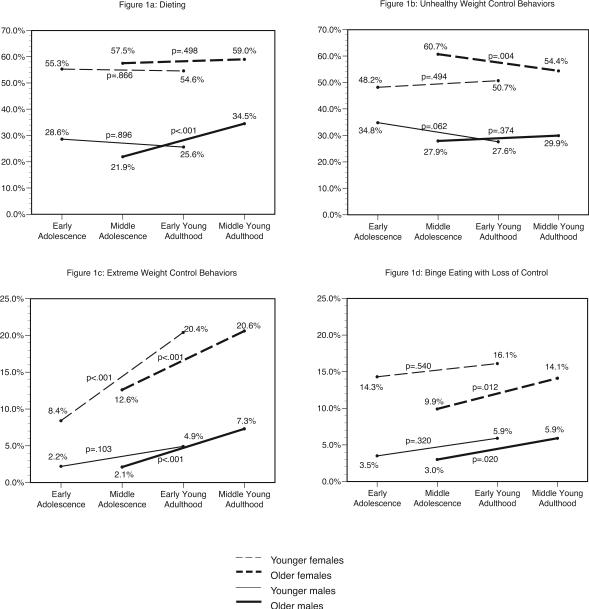
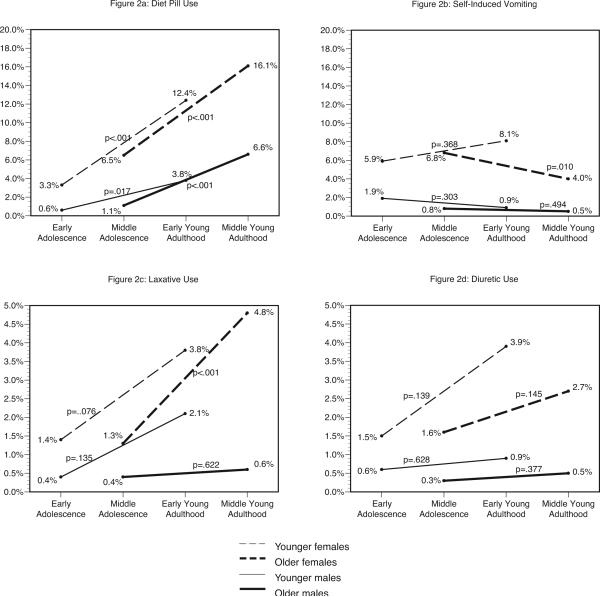
Results: In general, the prevalence of dieting and disordered eating was high and remained constant, or increased, from adolescence to young adulthood. Furthermore, behaviors tended to track within individuals and, in general, participants who engaged in dieting and disordered eating behaviors during adolescence were at increased risk for these behaviors 10 years later. Tracking was particularly consistent for the older girls and boys transitioning from middle adolescence to middle young adulthood.
Conclusions: Study findings indicate that disordered eating behaviors are not just an adolescent problem, but continue to be prevalent among young adults. The tracking of dieting and disordered eating within individuals suggests that early use is likely to set the stage for ongoing use. Findings suggest a need for both early prevention efforts before the onset of harmful behavioral patterns as well as ongoing prevention and treatment interventions to address the high prevalence of disordered eating throughout adolescence and young adulthood.
Copyright © 2011 American Dietetic Association. Published by Elsevier Inc. All rights reserved.
Figures
Comment in
-
Eating disorders in adolescence: when should prevention occur?J Am Diet Assoc. 2011 Jul;111(7):1001-3. doi: 10.1016/j.jada.2011.04.013. J Am Diet Assoc. 2011. PMID: 21703377 No abstract available.
References
-
- Larson NI, Neumark-Sztainer D, Story M. Weight Control Behaviors and Dietary Intake among Adolescents and Young Adults: Longitudinal Findings from Project EAT. J Am Diet Assoc. 2009;109(11):1869–1877. - PubMed
-
- Woodruff SJ, Hanning RM, Lambraki I, Storey KE, McCargar L. Healthy Eating Index-C is compromised among adolescents with body weight concerns, weight loss dieting, and meal skipping. Body Image. 2008 Dec;5(4):404–408. - PubMed
-
- Neumark-Sztainer D, Hannan PJ, Story M, Perry CL. Weight-control behaviors among adolescent girls and boys: Implications for dietary intake. J Am Diet Assoc. 2004;104:913–920. - PubMed
-
- Field AE, Austin SB, Taylor CB, Malspeis S, Rosner B, Rockett HR, Gillman MW, Colditz GA. Relation between dieting and weight change among preadolescents and adolescents. Pediatrics. 2003;112(4):900–906. - PubMed
-
- Field AE, Aneja P, Austin SB, Shrier LA, de Moor C, Gordon-Larsen P. Race and gender differences in the association of dieting and gains in BMI among young adults. Obesity (Silver Spring) 2007 Feb;15(2):456–464. - PubMed
