. 2011 Oct;32(29):6972-81.
doi: 10.1016/j.biomaterials.2011.05.088. Epub 2011 Jun 23.

The role of engineered tendon matrix in the stemness of tendon stem cells in vitro and the promotion of tendon-like tissue formation in vivo

Affiliations

The role of engineered tendon matrix in the stemness of tendon stem cells in vitro and the promotion of tendon-like tissue formation in vivo

Jianying Zhang et al. Biomaterials. 2011 Oct.

Abstract

When injured, tendons tend to heal but with poor structure and compromised function. Tissue engineering is a promising approach to enhancing the quality of healing tendons. Our group and others have identified tendon stem cells (TSCs), a type of tendon-specific stem cells which may be optimal for cellular interventions seeking to restore normal structure and function to injured tendons. However, in vitro expanding of TSCs on regular plastic cell culture dishes only yields a limited number of TSCs before they lose the stemness, i.e., the self-renewal capability and multipotency. In this study, we developed a substrate material for TSCs, engineered tendon matrix (ETM) from decellularized tendon tissues. We showed that ETM in vitro was able to stimulate TSC proliferation and better preserve the stemness of TSCs than plastic culture surfaces. In vivo, implantation of ETM-TSC composite promoted tendon-like tissue formation whereas implantation of TSCs alone led to little such tissue formation. Together, the findings of this study indicate that ETM may be used to effectively expand TSCs in vitro and with TSCs, to enhance repair of injured tendons in vivo.


Figures

Fig. 1
Fig. 1
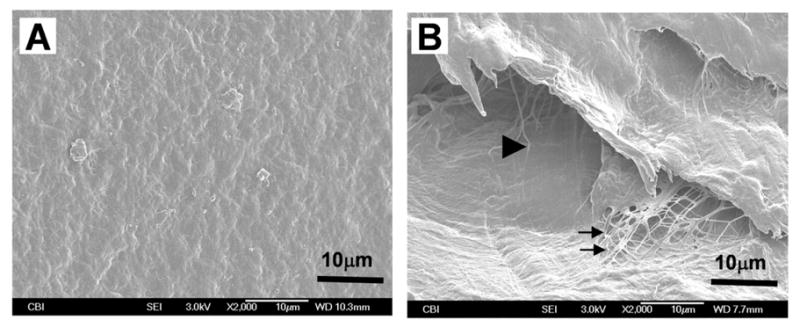
SEM images of ETM film and gel. The ETM was fabricated from rabbit patellar tendons. Note that ETM film (A) contains rough textures of matrix components on its surface and that ETM gel (B) consists of collagen fibrils (arrows) and interconnected pores (triangle).
Fig. 2
Fig. 2
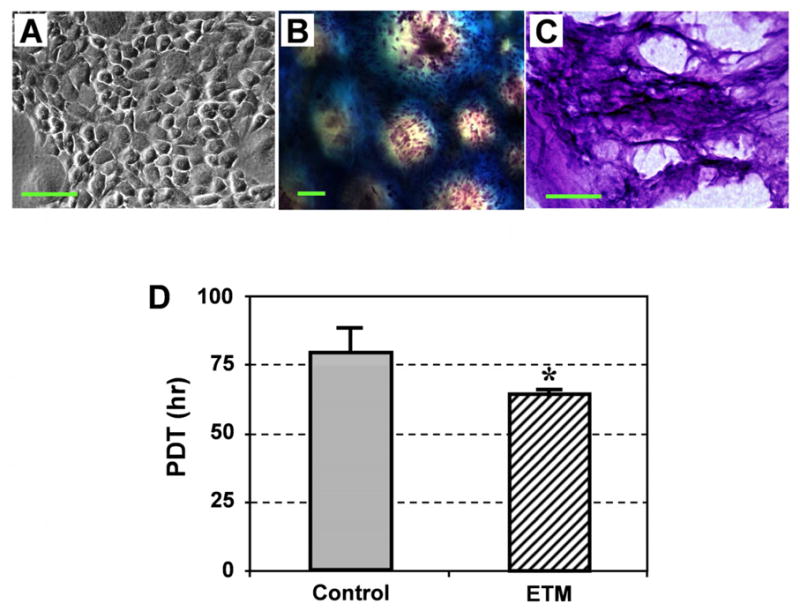
The effects of ETM film and ETM gel on rPTSCs. Colonies of rPTSCs were formed on the ETM film (A), and rPTSCs were also highly proliferated in the ETM gel, as shown by numerous cells identified by H&E staining (B). Frozen section results showed that rPTSCs have migrated into the inside of ETM (C). The population doubling time (PDT) of rPTSCs on ETM films was significantly lower than that of the same cells on control plastic surfaces, indicating that ETM enhanced rPTSC proliferation (D, * p < 0.05). Bar: 100 μm.
Fig. 3
Fig. 3
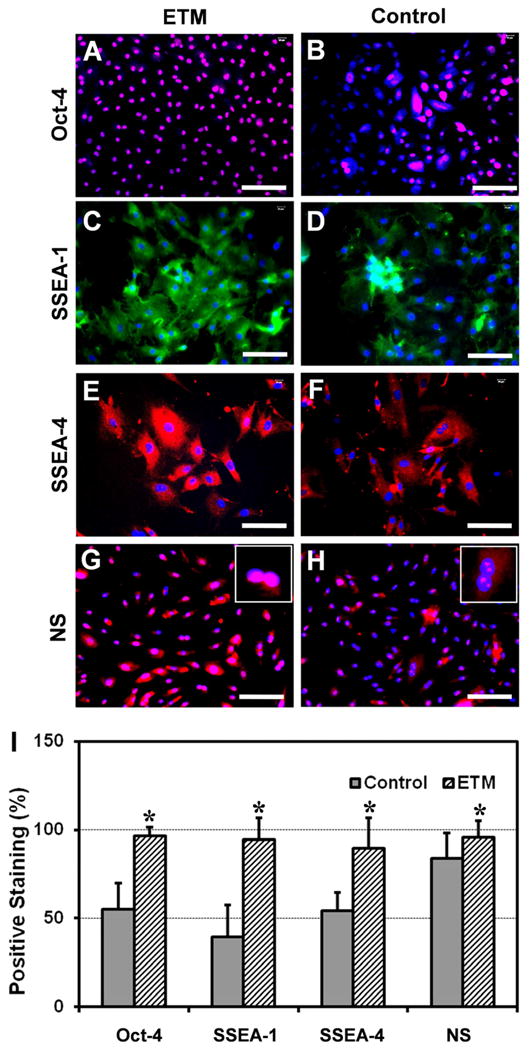
The expression of stem cell markers for rPTSCs grown on ETM and control plastic surfaces. All four stem cell markers, i.e. Oct-4, SSEA-1, SSEA-4, and nucleostemin (NS), were more extensively expressed in rPTSCs grown on ETM films (A, C, E, and G) than those grown on plastic surfaces (B, D, F, and H). The semi-quantitative results of stem cell marker expression are given (I, * p < 0.05 with respect to each own control). Bar: 100 μm.
Fig. 4
Fig. 4
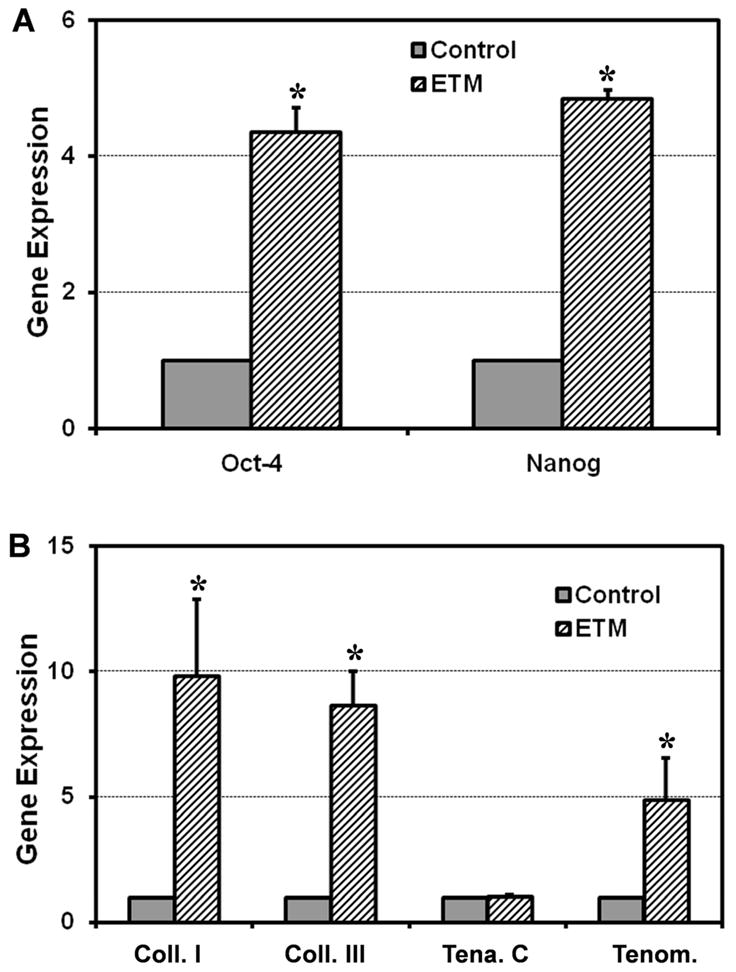
The expression of stem cell and tenocyte related genes in rPTSCs on ETM films and control plastic surfaces. The cells on ETM films expressed markedly higher levels of both stem cell genes (Oct-4 and Nanog) (A). Except tenascin C, tenocyte-related genes (collagen types I and III, and tenomodulin) in rPTSCs on ETM films were also highly expressed than those on control plastic surfaces (B). (* p < 0.05 with respect to each own control. Note that the gene expression levels were normalized with respect to own controls).
Fig. 5
Fig. 5
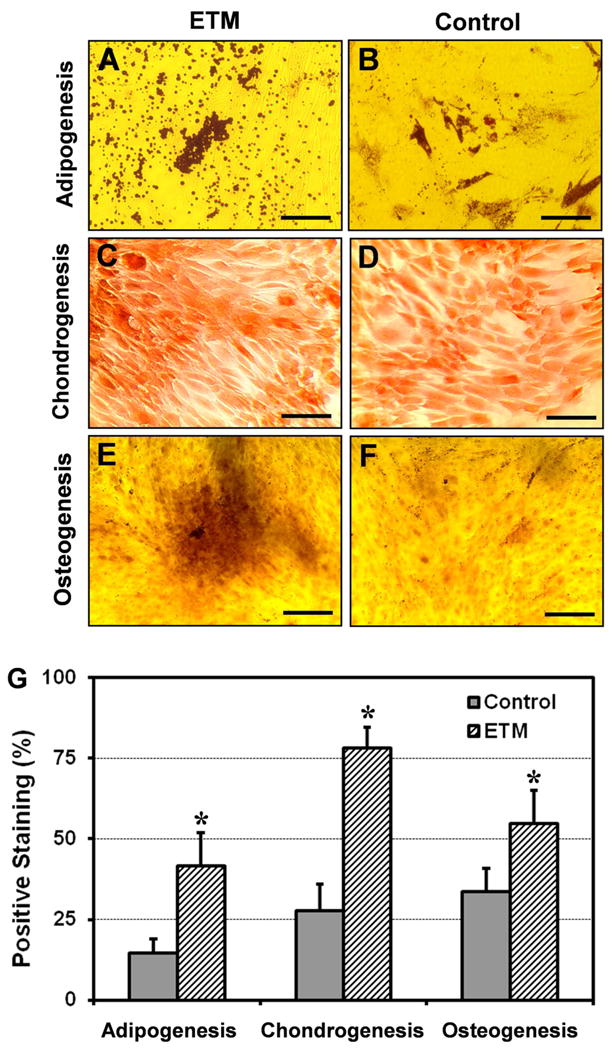
The multi-differentiation potential of rPTSCs on ETM films and control plastic surfaces. When cultured in respective induction media, more extensive adipocytes, chondrocytes, and osteocytes of RPTSCs were found on ETM films (A, C, and E) than on plastic surfaces (B, D, and F). (G) The semi-quantitative analysis of staining results; * p < 0.05 with respect to each own control). Bar: 100 μm.
Fig. 6
Fig. 6
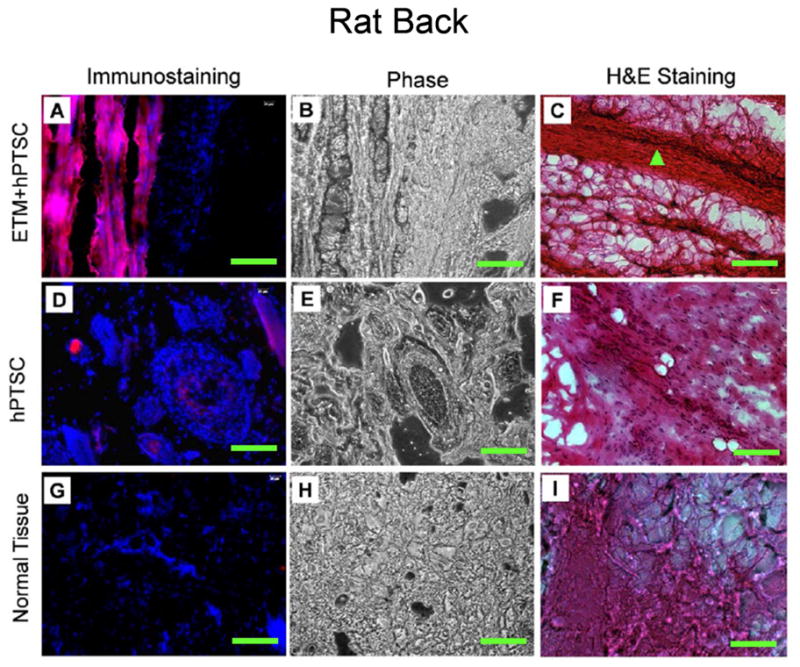
Tissue formation after implantation of hPTSCs with and without ETM into the back of nude rats. The cells were implanted with ETM (A–C) or without ETM (D–F). Normal tendon tissues of the same rats were used as control (G–I). It is seen that the implantation of hPTSCs with ETM resulted in newly formed, tendon-like tissues, as shown by immunostaining for human collagen type I (A, red bands) and H&E staining for collagen bundles (C, triangle). In contrast, implantation of hPTSCs alone did not result in the formation of tendon-like tissues (D). Bar: 100 μm.
Fig. 7
Fig. 7
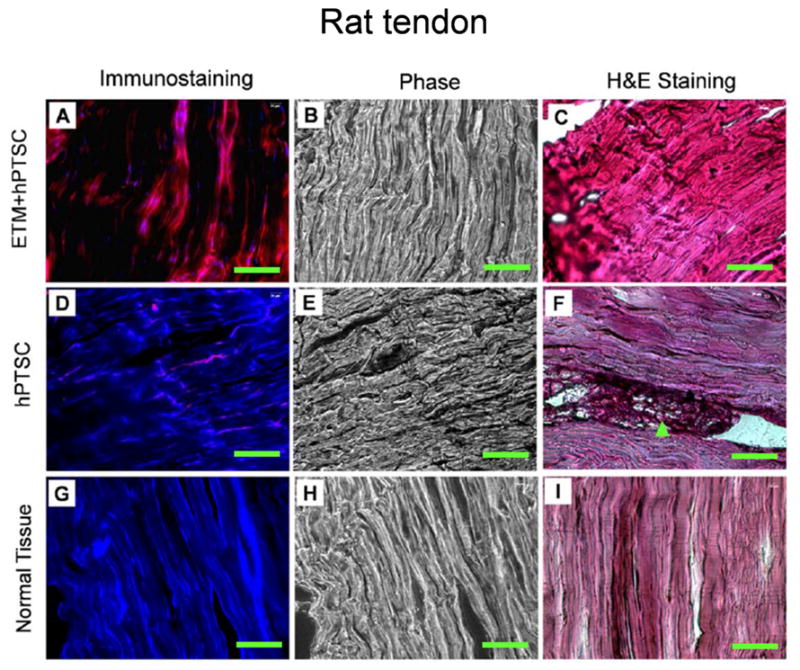
Tissue formation after implantation of hPTSCs with and without ETM into rat patellar tendons. The cells were implanted with ETM (A–C), without ETM (D–F). Normal tendon tissues of the same rats were used as control (G–I). Similar to the implantation into the back of rats, implantation of hPTSCs together with ETM resulted in newly formed, human tendon-like tissues (A, red bands). However, implantation of hPTSCs without ETM resulted in poor tissue formation (F, arrow). Bar: 100 μm.

References

    1. Butler DL, Juncosa N, Dressler MR. Functional efficacy of tendon repair processes. Annu Rev Biomed Eng. 2004;6:303–29. - PubMed
    1. Bagnaninchi PO, Yang Y, El Haj AJ, Maffulli N. Tissue engineering for tendon repair. Br J Sports Med. 2007;41:e10. discussion e. - PMC - PubMed
    1. Butler DL, Juncosa-Melvin N, Boivin GP, Galloway MT, Shearn JT, Gooch C, et al. Functional tissue engineering for tendon repair: A multidisciplinary strategy using mesenchymal stem cells, bioscaffolds, and mechanical stimulation. J Orthop Res. 2008;26:1–9. - PubMed
    1. Chen X, Zou XH, Yin GL, Ouyang HW. Tendon tissue engineering with mesenchymal stem cells and biografts: an option for large tendon defects? Front Biosci (Schol Ed) 2009;1:23–32. - PubMed
    1. Kuo CK, Marturano JE, Tuan RS. Novel strategies in tendon and ligament tissue engineering: Advanced biomaterials and regeneration motifs. Sports Med Arthrosc Rehabil Ther Technol. 2010;2:20. - PMC - PubMed

Publication types

MeSH terms