


Inflammation and mesenchymal stem cell aging
- PMID: 21703839
- PMCID: PMC3167021
- DOI: 10.1016/j.coi.2011.05.007
Inflammation and mesenchymal stem cell aging
Abstract
In adults, mesenchymal stromal cells contain tissue-specific multipotent stem cells, MSC, which can be found throughout the body. With advancing age, tight controls of regulatory networks, which guide MSC biology, gradually deteriorate. Aberrations within the MSC microenvironment such as chronic inflammation eventually lead to adverse manifestations, such as the accumulation of fat deposits in bone and muscles, impaired healing and fibrosis after severe injury, or altered hematopoiesis and autoimmunity. MSC can also specifically interact with a large variety of immune cells, and in doing so, they secrete cytoprotective and immunoregulatory molecules, which together with intercellular contacts mediate immune modulatory processes. This review comprehends the current knowledge regarding molecular mechanisms and cellular interactions that occur in stem cell niches, which are jointly shared between MSC and hematopoietic stem and progenitor cells, as well as those intracellular interdependences taking place between mesenchymal and a wide variety of hematopoietic progeny in particular T lymphocytes, which eventually perturb tissue homeostasis and immunology at advanced age.
Copyright © 2011 Elsevier Ltd. All rights reserved.
Figures
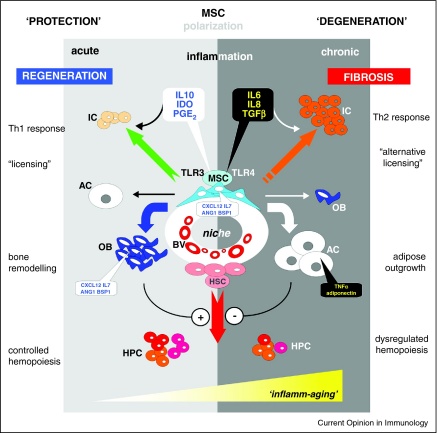
- (i)
secrete indoleamine 2,3-dioxygenase (IDO), interleukin 6 (IL6), interleukin 8 (IL8), interleukin 10 (IL10), prostaglandin E-2 (PGE2), transforming growth factor beta (TGFβ) after activation of toll-like receptors 3 or 4 (TLR3, TLR4) to act on immune cells (IC) to trigger specific T helper (Th) cell responses;
- (ii)
to convey under low or transient inflammatory stimuli the differentiation of osteoblasts (OB) while at the same time checking progression of adipogenic cells (AC); contrastingly within a chronically inflamed periphery, the osteogenic fate of MSC progeny is stalled and adipogenic differentiation upholstered; the latter further propagate an inflammatory milieu through further excretion of tumor necrosis factor alpha (TNFα) or adiponectin;
- (iii)
to support the emergence and diversity of hematopoietic precursor cells (HPC) through strong osseous structures in a protected environment while stem cell proximities destined to degenerate by adipose outgrowth hinder the advent of HPC formation.
References
-
- Mendez-Ferrer S., Michurina T.V., Ferraro F., Mazloom A.R., Macarthur B.D., Lira S.A., Scadden D.T., Ma’ayan A., Enikolopov G.N., Frenette P.S. Mesenchymal and haematopoietic stem cells form a unique bone marrow niche. Nature. 2010;466:829–834. - PMC - PubMed
-
MSC could be indentified in mouse owing to nestin expression. In bone this cell population constitutes an essential HSC niche component, as nestin(+) MSCs are spatially associated with HSC and adrenergic nerve fibres, and express HSC maintenance genes. The results presented in this article are indicative of a unique niche in the bone marrow made of heterotypic stem-cell pairs.
-
- da Silva Meirelles L., Caplan A.I., Nardi N.B. In search of the in vivo identity of mesenchymal stem cells. Stem Cells. 2008;26:2287–2299. - PubMed
-
- Crisan M., Yap S., Casteilla L., Chen C.W., Corselli M., Park T.S., Andriolo G., Sun B., Zheng B., Zhang L. A perivascular origin for mesenchymal stem cells in multiple human organs. Cell Stem Cell. 2008;3:301–313. - PubMed
-
Perivascular cells contain multipotential progenitor cells being myogenic in culture and in vivo, yet also exhibit osteogenic, chondrogenic, and adipogenic potentials. Native, noncultured perivascular cells carry MSC-specific surface markers, conclusively blood vessel walls harbor a reserve of progenitor cells closely related to MSC.
-
- Le Blanc K., Frassoni F., Ball L., Locatelli F., Roelofs H., Lewis I., Lanino E., Sundberg B., Bernardo M.E., Remberger M. Mesenchymal stem cells for treatment of steroid-resistant, severe, acute graft-versus-host disease: a phase II study. Lancet. 2008;371:1579–1586. - PubMed
Publication types
MeSH terms
Substances
LinkOut - more resources
Full Text Sources
Medical
