


The street cost of drugs and drug use patterns: relationships with sex work income in an urban Canadian setting
- PMID: 21704461
- PMCID: PMC3392208
- DOI: 10.1016/j.drugalcdep.2011.05.005
The street cost of drugs and drug use patterns: relationships with sex work income in an urban Canadian setting
Abstract
Background: This study investigated the relationship between drug use and sex work patterns and sex work income earned among street-based female sex workers (FSWs) in Vancouver, Canada.
Methods: We used data from a sample of 129 FSWs who used drugs in a prospective cohort (2007-2008), for a total of 210 observations. Bivariate and multivariable linear regression using generalized estimating equations was used to model the relationship between explanatory factors and sex work income. Sex work income was log-transformed to account for skewed data.
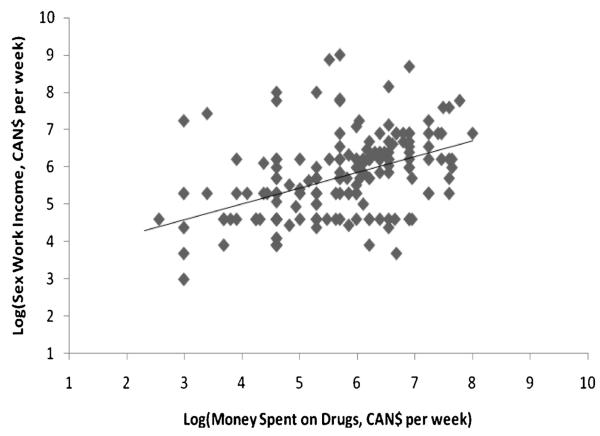
Results: The median age of the sample at first visit was 37 years (interquartile range[IQR]: 30-43), with 46.5% identifying as Caucasian, 48.1% as Aboriginal and 5.4% as another visible minority. The median weekly sex work income and amount spent on drugs was $300 (IQR=$100-$560) and $400 (IQR=$150-$780), respectively. In multivariable analysis, for a 10% increase in money spent on drugs, sex work income increased by 1.9% (coeff: 0.20, 95% CIs: 0.04-0.36). FSWs who injected heroin, FSWs with higher numbers of clients and youth compared to older women (<25 versus 25+ years) also had significantly higher sex work income.
Conclusions: This study highlights the important role that drug use plays in contributing to increased dependency on sex work for income among street-based FSWs in an urban Canadian setting, including a positive dose-response relationship between money spent on drugs and sex work income. These findings indicate a crucial need to scale up access and availability of evidence-based harm reduction and treatment approaches, including policy reforms, improved social support and economic choice for vulnerable women.
Copyright © 2011. Published by Elsevier Ireland Ltd.
Figures
References
-
- FAQ . How do I interpret a regression model when some variables are log transformed? Academic Technology Services, Statistical Consulting Group; UCLA: 2010. n.d. http://www.ats.ucla.edu/stat/mult_pkg/faq/general/log_transformed_regres..., accessed on.
-
- Aral SO, St. Lawrence JS. The Ecology of Sex Work and Drug Use in Saratov Oblast, Russia. Sexually Transmitted Diseases. 2002;29:798–805. - PubMed
-
- Blanchard JF, O’Neil J, Ramesh BM, Bhattacharjee P, Orchard T, Moses S. Understanding the Social and Cultural Contexts of Female Sex Workers in Karnataka, India: Implications for Prevention of HIV Infection. Journal of Infectious Diseases. 2005;191:S139–S146. - PubMed
-
- Cameron S, Collins A. Estimates of a model of male participation in the market for female heterosexual prostitution services. European Journal of Law and Economics. 2003;16:277–288.
Publication types
MeSH terms
Substances
Grants and funding
LinkOut - more resources
Full Text Sources
