Review
. 2011 Oct;14(5):519-29.
doi: 10.1016/j.pbi.2011.05.006. Epub 2011 Jun 23.

Protein kinase signaling networks in plant innate immunity

Affiliations
Review

Protein kinase signaling networks in plant innate immunity

Guillaume Tena et al. Curr Opin Plant Biol. 2011 Oct.

Abstract

In plants and animals, innate immunity is triggered through pattern recognition receptors (PRRs) in response to microbe-associated molecular patterns (MAMPs) to provide the first line of inducible defense. Plant receptor protein kinases (RPKs) represent the main plasma membrane PRRs perceiving diverse MAMPs. RPKs also recognize secondary danger-inducible plant peptides and cell-wall signals. Both types of RPKs trigger rapid and convergent downstream signaling networks controlled by calcium-activated PKs and mitogen-activated PK (MAPK) cascades. These PK signaling networks serve specific and overlapping roles in controlling the activities and synthesis of a plethora of transcription factors (TFs), enzymes, hormones, peptides and antimicrobial chemicals, contributing to resistance against bacteria, oomycetes and fungi.


Figures

Figure 1
Figure 1
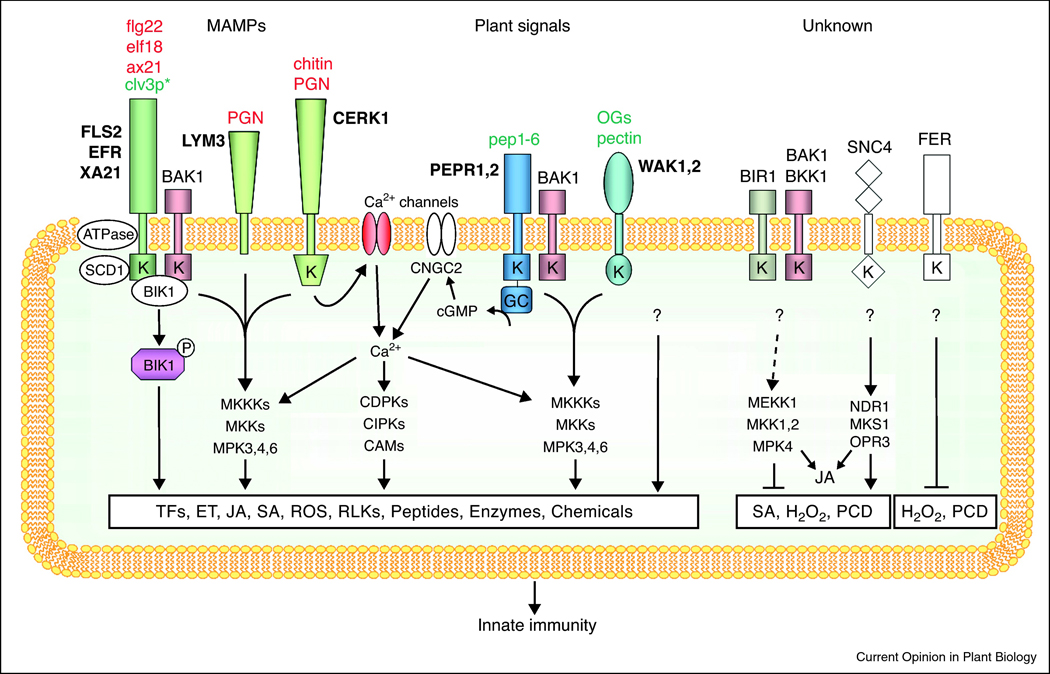
RPK network signaling in innate immunity. RPKs perceive MAMPs (red), secondary plant (green) and unknown signals, and activate conserved and convergent Ca2+ signaling and MAPK cascades to control the activities and synthesis of a plethora of transcription factors (TFs), enzymes, hormones, ROS, PCD, peptides and antimicrobial chemicals, contributing to plant immunity.
Figure 2
Figure 2
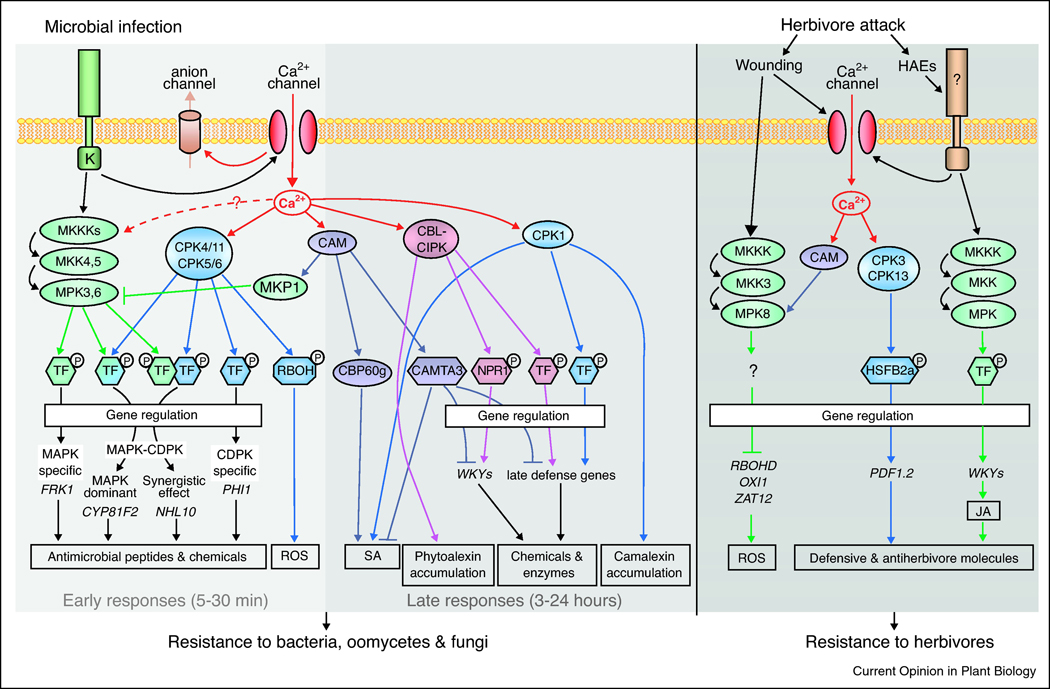
Ca2+ signaling network through multiple PKs in plant immunity. Microbial perception quickly activates Ca2+ influx that regulates early signaling events occurring within minutes, including anion efflux, ROS production and gene expression involved in the biosynthesis of antimicrobial chemicals and peptides. These responses mainly mediated through CDPKs are co-regulated by MAPK cascades, that can be further modulated by CAM. Ca2+ rise also regulates late responses within hours and days, including the production of SA, phytoalexin, camalexin and other defense compounds through gene regulation. These responses are modulated positively or negatively by CAM, CBL-CIPKs and CDPKs. Most PK substrates are unknown, except the key SA-signaling activator NPR1 which is phosphorylated by Arabidopsis CIPK11. Herbivores can be sensed through wounding and herbivore-associated elicitors (HAEs) through unknown receptors to activate MAPK cascades and Ca2+ influx. Wounding-activated MPK8 through CAM and MKK3 represses genes to limit H2O2 propagation. Other MAPKs, CPK3 and CPK13 induce gene expression to produce antiherbivore molecules in JA-dependent and JA–independent pathways. This complex and fine-tuned Ca2+ signaling network contributes to plant resistance to bacteria, oomycetes, fungi and herbivores.
Figure 3
Figure 3
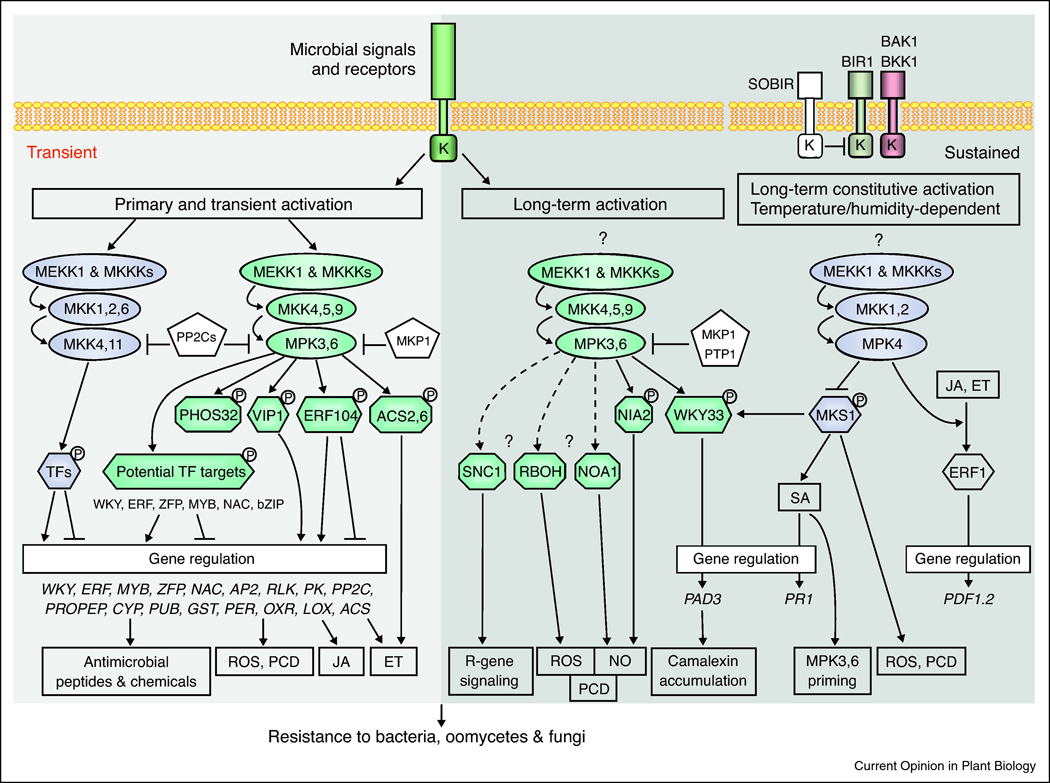
MAPK networks in MAMP perception downstream of receptors. Fast and transient activation of at least two MAPK cascades induces primary responses (left). Direct targets, phosphorylated in minutes, have been identified for MPK3,6. Modulation of transcription factor (TF) activity by MAPKs induces a massive gene expression reprogramming, ultimately leading to increased resistance to pathogens through various biological responses such as synthesis of antimicrobial peptides and chemicals, programmed cell death (PCD), and production of reactive oxygen species (ROS), nitric oxide (NO) and stress hormones. A long-term activation of MAPKs (center) by microbes also induces biological responses, most notably the accumulation of camalexin through release and direct phosphorylation of WKY33 and modulation of PAD3 gene in leaves. A continuously active MAPK cascade, consisting of MEKK1 and other MKKKs, MKK1/2 and MPK4 (right), has a sustained requirement to control salicylic acid (SA), PCD, ROS and PR1 gene levels through the direct phosphorylation of MKS1, and to allow JA and ET responses, independently of MAMP perception. Abbreviations: PP2C, protein phosphatase 2C; CYP, cytochrome P450; PUB, plant U-box E3-ligase; GST, glutathione-S-transferase ; PER, peroxidase; OXR, FAD-binding oxidoreductase; LOX, lipoxygenase.

References

    1. Dodds PN, Rathjen JP. Plant immunity: towards an integrated view of plant-pathogen interactions. Nat Rev Genet. 2010;11:539–548. - PubMed
    1. Boller T, Felix G. A Renaissance of Elicitors: Perception of Microbe-Associated Molecular Patterns and Danger Signals by Pattern-Recognition Receptors. Annu Rev Plant Biol. 2009;60:379–406. This is a comprehensive review on MAMPs and PRRs with a special emphasis on the time course of events following PRR activation. The model on defense syndrome nicely summaries plant perceptions of distinct microbial and plant damage-associated signals in evolutionary context and innate immunity.

    1. Ronald PC, Beutler B. Plant and Animal Sensors of Conserved Microbial Signatures. Science. 2010;330:1061–1064. - PubMed
    1. Lacombe S, Rougon-Cardoso A, Sherwood E, Peeters N, Dahlbeck D, van Esse HP, Smoker M, Rallapalli G, Thomma BPHJ, Staskawicz B, et al. Interfamily transfer of a plant pattern-recognition receptor confers broad-spectrum bacterial resistance. Nat Biotech. 2010;28:365–369. This work provides the most compelling evidence that the activity of a PRR can be transferred among plant families and confers broad-spectrum bacterial resistance in important crops.

    1. He P, Shan L, Lin N-C, Martin GB, Kemmerling B, Nürnberger T, Sheen J. Specific Bacterial Suppressors of MAMP Signaling Upstream of MAPKKK in Arabidopsis Innate Immunity. Cell. 2006;125:563–575. - PubMed

Publication types