. 2011:3:737-42.
doi: 10.1093/gbe/evr048. Epub 2011 Jun 24.

Viruses with more than 1,000 genes: Mamavirus, a new Acanthamoeba polyphaga mimivirus strain, and reannotation of Mimivirus genes

Affiliations

Viruses with more than 1,000 genes: Mamavirus, a new Acanthamoeba polyphaga mimivirus strain, and reannotation of Mimivirus genes

Philippe Colson et al. Genome Biol Evol. 2011.

Abstract

The genome sequence of the Mamavirus, a new Acanthamoeba polyphaga mimivirus strain, is reported. With 1,191,693 nt in length and 1,023 predicted protein-coding genes, the Mamavirus has the largest genome among the known viruses. The genomes of the Mamavirus and the previously described Mimivirus are highly similar in both the protein-coding genes and the intergenic regions. However, the Mamavirus contains an extra 5'-terminal segment that encompasses primarily disrupted duplicates of genes present elsewhere in the genome. The Mamavirus also has several unique genes including a small regulatory polyA polymerase subunit that is shared with poxviruses. Detailed analysis of the protein sequences of the two Mimiviruses led to a substantial amendment of the functional annotation of the viral genomes.


Figures
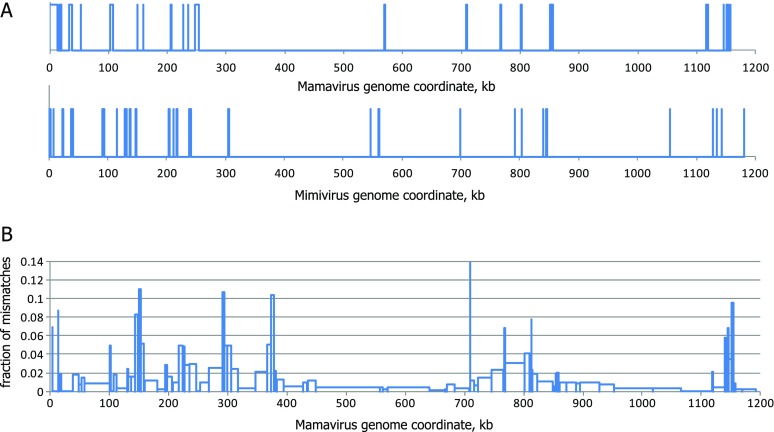
F<sc>IG</sc>. 1.—
FIG. 1.—
Schematic representation of the genome alignment of the Mamavirus and APMV. (A) The distributions of unaligned regions (longer than 200 nt, >20 nt gaps) in the Mamavirus and Mimivirus genomes. (B) The mean fraction of mismatches in aligned regions.
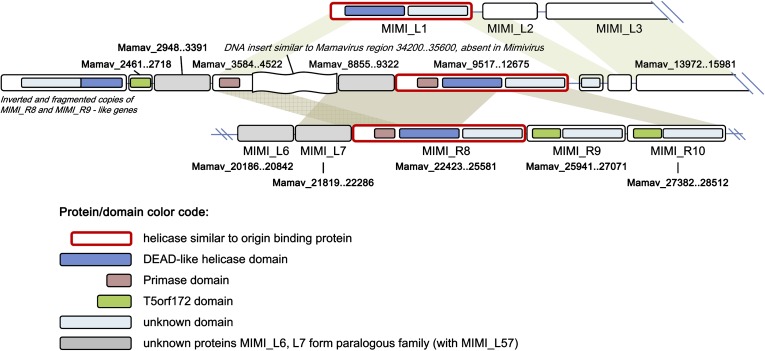
F<sc>IG</sc>. 2.—
FIG. 2.—
The unique 5′-terminal fragment of the Mamavirus genome: genome rearrangements and duplications. The figure shows a comparison of the 5′-end of the Mamavirus genome (middle) with the 5′-end of the APMV genome (top) and a downstream region that is conserved in both genomes (bottom; Mimivirus genomic positions 9500–18000). The genomic coordinates for all Mimivirus genes are shown. Shading shows homology between Mamavirus and APMV genes or domains.
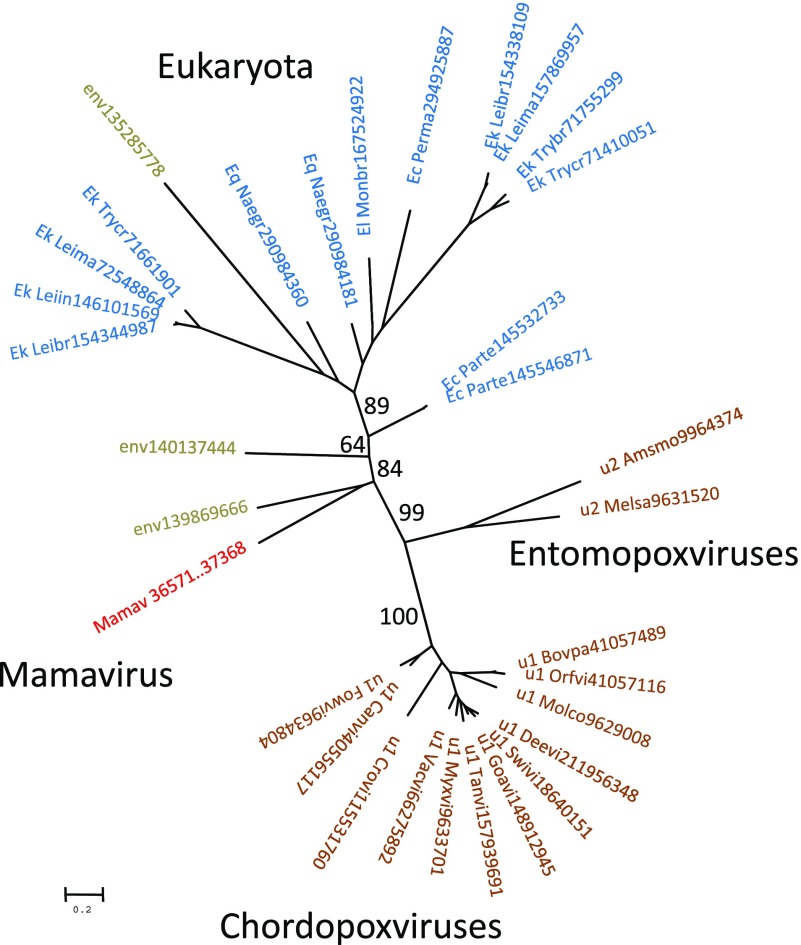
F<sc>IG</sc>. 3.—
FIG. 3.—
Phylogenetic tree of the small regulatory subunit of polyA polymerase. The maximum-likelihood tree was constructed using TreeFinder (WAG matrix,G[Optimum]:4, 1,000 replicates, Search Depth 2; Jobb et al. 2004). The bootstrap support (expected-likelihood Weights) is shown for selected branches (percent). For each sequence, the species name abbreviation and the gene identification numbers are indicated; env stands for “marine metagenome.” Species abbreviations: Ec_Parte, Paramecium tetraurelia strain d4-2; Ec_Perma, Perkinsus marinus ATCC 50983; Ek_Leibr, Leishmania braziliensis MHOM/BR/75/M2904; Ek_Leiin, Leishmania infantum; Ek_Leima, Leishmania major strain Friedlin; Ek_Trybr, Trypanosoma brucei TREU927; Ek_Trycr, Trypanosoma cruzi strain CL Brener; El_Monbr, Monosiga brevicollis MX1; Eq_Naegr, Naegleria gruberi; u1_Bovpa, Bovine papular stomatitis virus; u1_Canvi, Canarypox virus; u1_Crovi, Crocodilepox virus; u1_Deevi, Deerpox virus W-1170-84; u1_Fowvi, Fowlpox virus; u1_Goavi, Goatpox virus Pellor; u1_Molco, Molluscum contagiosum virus subtype 1; u1_Myxvi, Myxoma virus; u1_Orfvi, Orf virus; u1_Swivi, Swinepox virus; u1_Tanvi, Tanapox virus; u1_Vacvi, Vaccinia virus; u2_Amsmo, Amsacta moorei entomopoxvirus “L”; u2_Melsa, Melanoplus sanguinipes entomopoxvirus.

References

    1. Altschul SF, et al. Gapped BLAST and PSI-BLAST: a new generation of protein database search programs. Nucleic Acids Res. 1997;25:3389–3402. - PMC - PubMed
    1. Azza S, Cambillau C, Raoult D, Suzan-Monti M. Revised Mimivirus major capsid protein sequence reveals intron-containing gene structure and extra domain. BMC Mol Biol. 2009;10:39. - PMC - PubMed
    1. Byrne D, et al. The polyadenylation site of Mimivirus transcripts obeys a stringent ‘hairpin rule’. Genome Res. 2009;19:1233–1242. - PMC - PubMed
    1. Colson P, Raoult D. Gene repertoire of amoeba-associated giant viruses. Intervirology. 2010;53:330–343. - PubMed
    1. Gruber AR, Findeiß S, Washietl S, Hofacker IL, Stadler PF. RNAZ 2.0: Improved noncoding RNA detection. Pac Symp Biocomput. 2010;15:69–79. - PubMed

Publication types

Substances