


doi: 10.1038/nn.2840.
Preventing interference between different memory tasks
Affiliations
- PMID: 21706019
- PMCID: PMC3144999
- DOI: 10.1038/nn.2840
Item in Clipboard
Preventing interference between different memory tasks
Nat Neurosci.
.
Abstract
When learned in quick succession, declarative and motor skill tasks interfere with one another and subsequent recall is impaired. Depending on the order of the tasks, we were able to prevent memory interference in humans by applying transcranial magnetic stimulation to either the dorsolateral prefrontal or the primary motor cortex, and neither memory was impaired. Our observations suggest that distinct mechanisms support the communication between different types of memory processing.
Figures
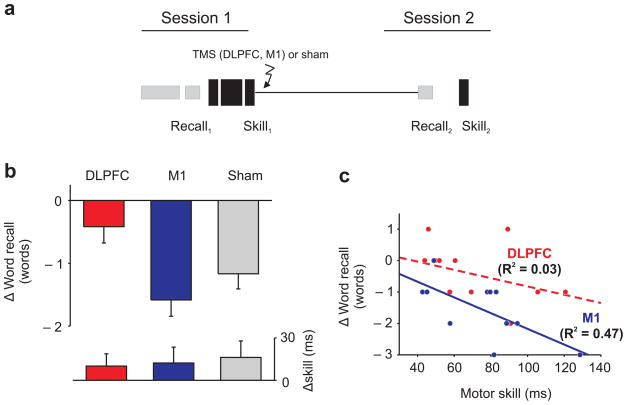
(a.) Participants learned a word-list and a motor skill in quick succession, TMS (to DLPFC or M1) or sham stimulation was applied and twelve hours later participants word recall and motor skill was retested. (b.) Word recall was impaired by the motor skill-learning task despite sham or real stimulation to M1 (box ± s.e.m.). In contrast, applying TMS to the DLPFC prevented the impairment of word recall by the motor skill learning task. Preventing the interference between the tasks was not dependent on disrupting the interfering memory because motor skill changes were not significantly different across the groups (box ± s.e.m.). (c.) The relationship between the tasks was affected by stimulation. There was a significant correlation between the decrease in word recall and initial motor skill following M1 stimulation; whereas, there was no significant correlation following DLPFC stimulation. The correlation following M1 stimulation was significantly greater than the correlation following DLPFC stimulation (see above R2 values).
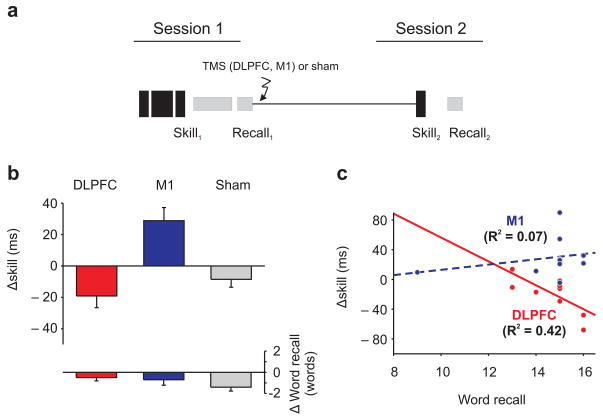
(a.) Participants learned a motor skill and then a word-list in quick succession, TMS (to DLPFC or M1) or sham stimulation was applied and twelve hours later participants motor skill and word recall was retested. (b.) Motor skill was impaired by the word-list learning task after sham or real stimulation to DLPFC (box ± s.e.m.). In contrast, applying TMS to M1 prevented the impairment of motor skill by the word-list learning task. Preventing interference between the tasks was not dependent on disrupting the interfering memory because word recall changes were not significantly different across the groups (box ± s.e.m.). (c.) The relationship between the tasks was affected by stimulation. There was a significant correlation between the decrease in motor skill and initial word recall following DLPFC stimulation; whereas, there was no significant correlation following M1 stimulation. The correlation following DLPFC stimulation was significantly greater than the correlation following M1 stimulation (see above R2 values).
References
-
- Brashers-Krug T, Shadmehr R, Bizzi E. Consolidation in human motor memory. Nature. 1996;382:252. - PubMed
-
- Lechner H, Squire L, Byrne J. 100 years of Consolidation- Remembering Muller and Pilzecker. Learning & Memory. 1999;6:77–87. - PubMed
-
- Walker MP, Brakefield T, Hobson JA, Stickgold R. Dissociable stages of human memory consolidation and reconsolidation. Nature. 2003;425:616–620. - PubMed
Publication types
MeSH terms
Grants and funding
LinkOut - more resources
Full Text Sources
Other Literature Sources
Medical
