. 2012 Feb;201(1):93-101.
doi: 10.1007/s00430-011-0209-y. Epub 2011 Jun 25.

Activation of MAPK/c-Fos induced responses in oral epithelial cells is specific to Candida albicans and Candida dubliniensis hyphae

Affiliations

Activation of MAPK/c-Fos induced responses in oral epithelial cells is specific to Candida albicans and Candida dubliniensis hyphae

David L Moyes et al. Med Microbiol Immunol. 2012 Feb.

Abstract

Oral epithelial cells detect the human pathogenic fungus Candida albicans via NF-κB and a bi-phasic mitogen-activated protein kinase (MAPK) signaling response. However, discrimination between C. albicans yeast and hyphal forms is mediated only by the MAPK pathway, which constitutes activation of the MAPK phosphatase MKP1 and the c-Fos transcription factor and is targeted against the hyphal form. Given that C. albicans is not the only Candida species capable of filamentation or causing mucosal infections, we sought to determine whether this MAPK/MKP1/c-Fos mediated response mechanism was activated by other pathogenic Candida species, including C. dubliniensis, C. tropicalis, C. parapsilosis, C. glabrata and C. krusei. Although all Candida species activated the NF-κB signaling pathway, only C. albicans and C. dubliniensis were capable of inducing MKP1 and c-Fos activation, which directly correlated with hypha formation. However, only C. albicans strongly induced cytokine production (G-CSF, GM-CSF, IL-6 and IL-1α) and cell damage. Candida dubliniensis, C. tropicalis and C. parapsilosis were also capable of inducing IL-1α and this correlated with mild cell damage and was dependent upon fungal burdens. Our data demonstrate that activation of the MAPK/MKP1/c-Fos pathway in oral epithelial cells is specific to C. dubliniensis and C. albicans hyphae.


Figures
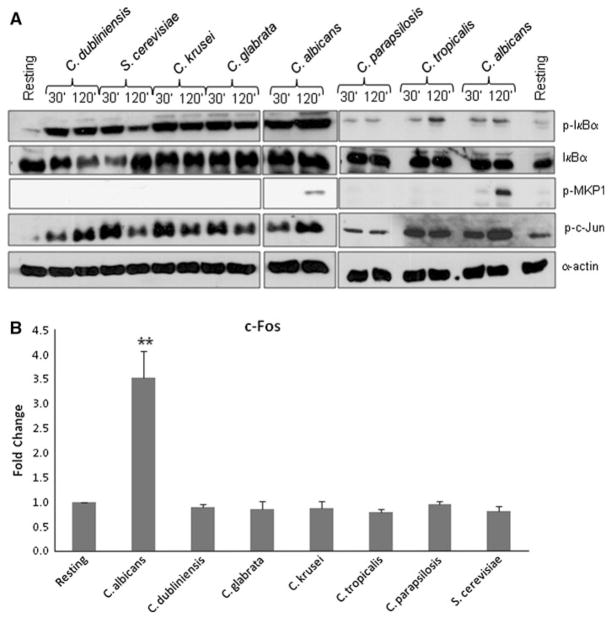
Fig. 1
Fig. 1
Activation of NF-κB and MAPK signaling by different Candida species and S. cerevisiae. Different Candida species and S. cerevisiae were added to TR146 oral epithelial cells under standard culture conditions for 2 h. a Total protein was isolated and phosphorylation of IκB-α and MKP1 and c-Jun assessed as well as production of c-Fos. b Nuclear extracts were isolated and c-Fos DNA binding activity measured by TransAm ELISA. Bands are shown relative to α-actin loading control. A fungal/epithelial cell MOI of 10:1 was used. Data are representative (assembled from different experiments) (a) or mean (b) of three independent experiments ±SEM. **P < 0.01
Fig. 2
Fig. 2
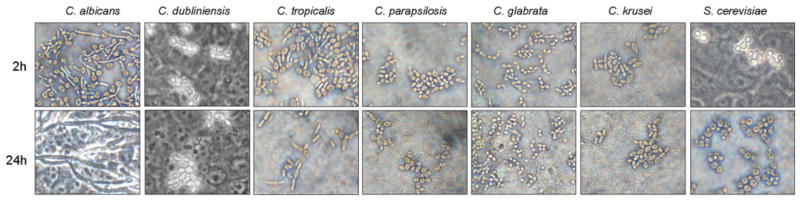
Morphology of different Candida species and S. cerevisiae. Different Candida species and S. cerevisiae were added to TR146 oral epithelial cells for 2 or 24 h and formalin fixed. Morphology was assessed by DIC microscopy at ×400
Fig. 3
Fig. 3
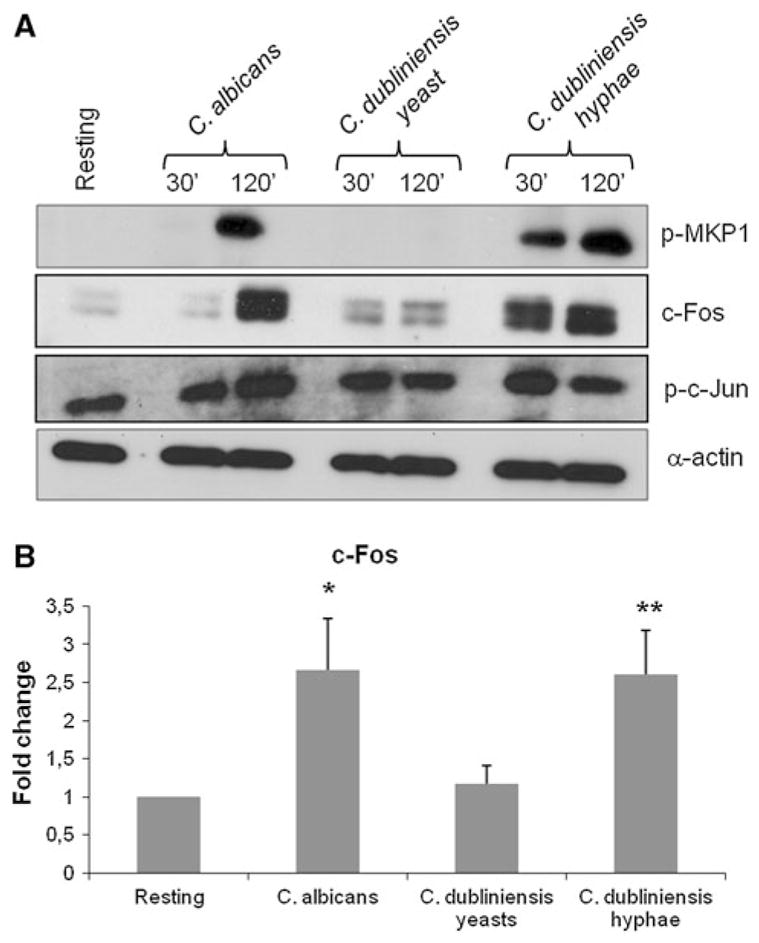
Activation of MKP1 and c-Fos by C. dubliniensis hyphae. Candida dubliniensis was pre-induced to form hyphae in water/10% serum for 3 h at 37°C and added to TR146 cells for 2 h together with control strains (C. dubliniensis and C. albicans in the yeast phase). Total protein and nuclear extracts were isolated and assessed for a MKP1 and c-Jun phosphorylation as well as c-Fos production by Western blot (relative to α-actin loading control) or b c-Fos DNA binding activity by TransAm ELISA. A fungal/epithelial cell MOI of 10:1 was used. Data are representative of three (assembled from different experiments) (a) or the mean of 5 (b) independent experiments (±SEM). *P < 0.05; **P < 0.01
Fig. 4
Fig. 4
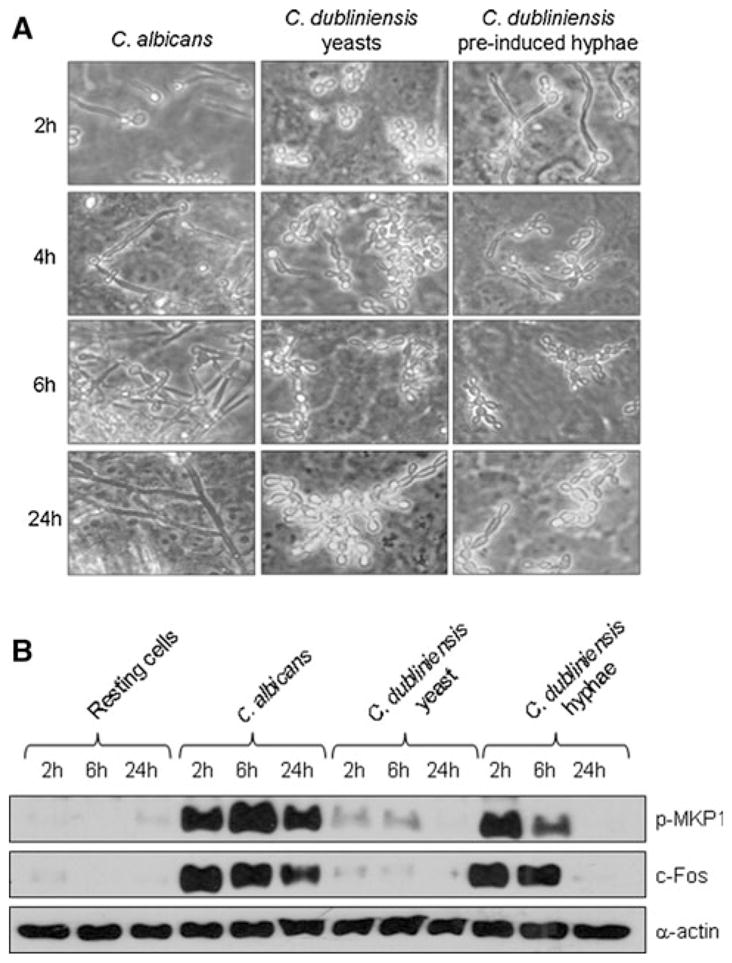
Reduction of MKP1 and c-Fos activation upon reversion of C. dubliniensis hyphae to pseudohyphal/yeast cells. Candida dubliniensis was pre-induced to form hyphae in water/10% serum for 3 h at 37°C and added to TR146 cells. At 2, 6 and 24 h postinfection a the morphology of C. dubliniensis or b MKP1 phosphorylation and c-Fos production was assessed by microscopy or Western blot, respectively. Bands are shown relative to α-actin loading control. A fungal/epithelial cell MOI of 10:1 was used for the 2 and 6 h time points and 0.01 for the 24 h time point. Data are representative of three independent experiments
Fig. 5
Fig. 5
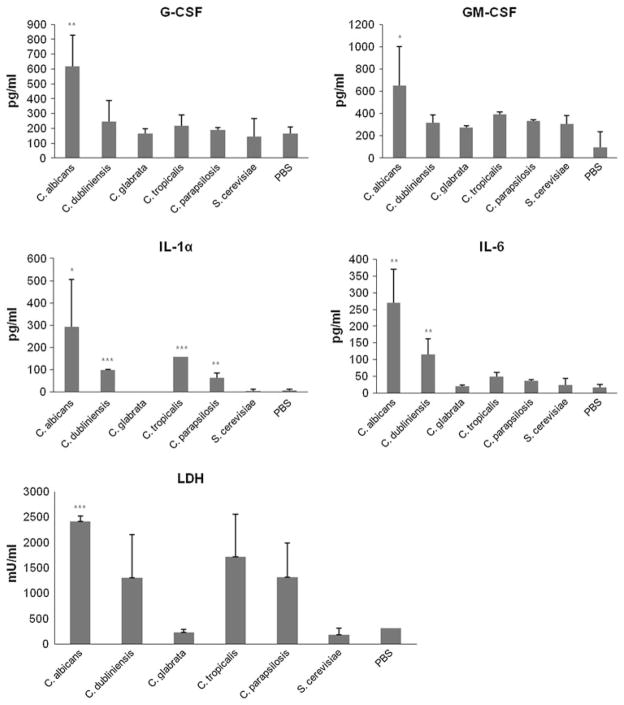
Cytokine activation and cell damage by different Candida species and S. cerevisiae. Different Candida species and S. cerevisiae were added (2 × 10⁶ cfu/ml) to organotypic oral RHE models for 24 h and the cell culture medium collected and assessed for cytokine proteins by multiplex microbead assay (luminex) or cell damage by LDH (lactate dehydrogenase) release. Data are representative of three independent experiments. *P < 0.05; ***P < 0.001 (compared with PBS control)
Fig. 6
Fig. 6
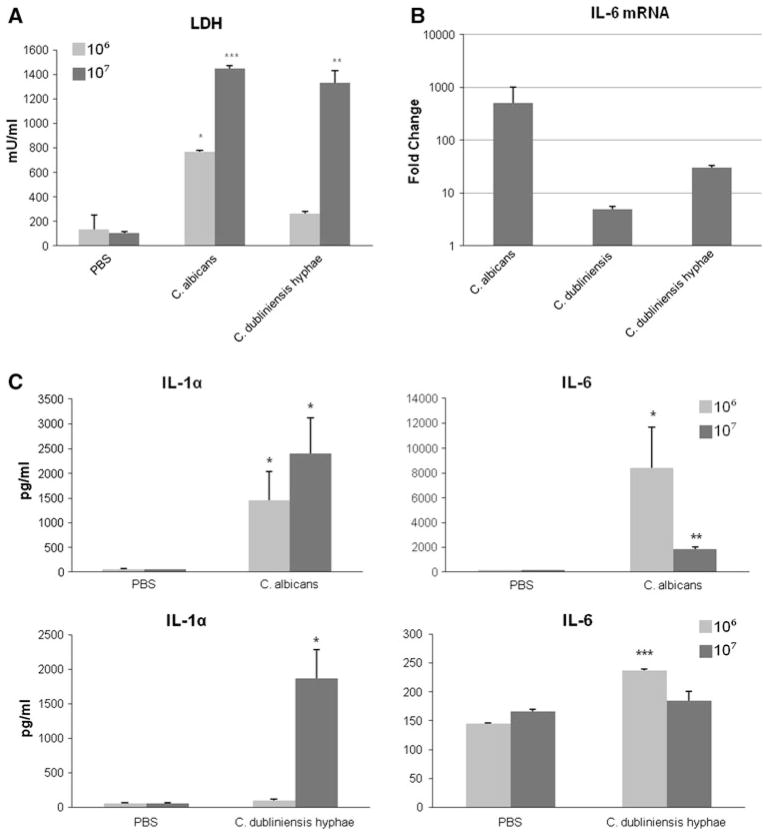
Cytokine activation and cell damage is dependent upon fungal burdens. Increasing concentrations of C. albicans and C. dubliniensis were added to TR146 monolayers and incubated at 37°C. a Cell damage was assessed 24 h postinfection with either C. albicans or pre-induced C. dubliniensis germ tubes (3 h in water:10% serum at 37°C) at 106 or 107 cfu/ml (MOI of 1 and 10, respectively). b IL-6 mRNA production was assessed 6 h postinfection with C. albicans, C. dubliniensis and pre-induced C. dubliniensis germ tubes. Results are expressed as fold change in mRNA transcripts relative to the PBS control. c IL-1α and IL-6 protein production in culture supernatants 24 h postinfection with C. albicans or pre-induced C. dubliniensis germ tubes at 106 or 107 cfu/ml (MOI of 1 and 10, respectively). Data are the mean of two experiments. *P < 0.05; ***P < 0.001 (compared with PBS control)

References

    1. Odds FC. Candida and Candidosis. Bailliere Tindall; Philadelphia: 1988.
    1. Jayatilake J, Samaranayake Y, Samaranayake L. A comparative study of candidal invasion in rabbit tongue mucosal explants and reconstituted human oral epithelium. Mycopathologia. 2008;165:373–380. - PubMed
    1. Jayatilake JAMS, Samaranayake YH, Cheung LK, Samaranayake LP. Quantitative evaluation of tissue invasion by wild type, hyphal and SAP mutants of Candida albicans, and non-albicans Candida species in reconstituted human oral epithelium. J Oral Pathol Med. 2006;35:484–491. - PubMed
    1. Schaller M, Mailhammer R, Grassl G, Sander CA, Hube B, Korting HC. Infection of human oral epithelia with Candida species induces cytokine expression correlated to the degree of virulence. J Invest Dermatol. 2002;118:652–657. - PubMed
    1. Jayatilake JA, Samaranayake LP, Lu Q, Jin LJ. IL-1alpha, IL-1ra and IL-8 are differentially induced by Candida in experimental oral candidiasis. Oral Dis. 2007;13:426–433. - PubMed

Publication types

MeSH terms

LinkOut - more resources