Comment
doi: 10.1242/dmm.008227.
Parkin' control: regulation of PGC-1α through PARIS in Parkinson's disease
Affiliations
- PMID: 21708898
- PMCID: PMC3124045
- DOI: 10.1242/dmm.008227
Item in Clipboard
Comment
Parkin' control: regulation of PGC-1α through PARIS in Parkinson's disease
Dis Model Mech.
2011 Jul.
Abstract
Summary and comment on a recent Cell paper entitled ‘PARIS (ZNF746) repression of PGC-1α contributes to neurodegeneration in Parkinson’s disease’ (Shin et al., 2011).
Figures
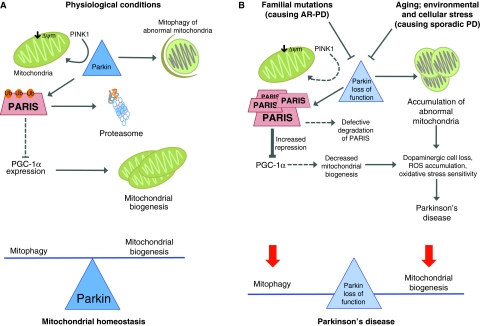
Parkin regulates the proteasomal degradation of PARIS and PGC-1α-dependent mitochondrial biogenesis. (A) Normal physiological conditions that maintain mitochondrial homeostasis: PINK1 recruits parkin to the mitochondria, where these two proteins interact to eliminate abnormal mitochondria through mitophagy. Alterations in mitochondrial membrane potential (ΔΨm; a key indicator of mitochondrial physiology and cell viability) initiate the PINK1-parkin cascade of events that lead to mitophagy. Furthermore, parkin ubiquitylates and thereby promotes proteasomal degradation of PARIS. Because PARIS represses the expression of PGC-1α, degradation of PARIS by parkin allows PGC-1α-dependent gene expression and enables mitochondrial biogenesis. Parkin seems to be an integral regulator of mitochondrial homeostasis, controlling both degradation and biogenesis. (B) Loss of parkin function as a result of familial mutations (in the case of AR-PD) or aging, environmental or cellular stress (in the case of sporadic PD) leads to the accumulation of abnormal mitochondria, owing to faulty mitophagy. In addition, PARIS accumulates and represses PGC-1α, preventing mitochondrial biogenesis. Loss of parkin function does not tip the balance between mitochondrial biogenesis and degradation to either side, but leads to a general breakdown of mitochondrial homeostasis that can ultimately lead to PD.
Comment on
-
PARIS (ZNF746) repression of PGC-1α contributes to neurodegeneration in Parkinson's disease.Cell. 2011 Mar 4;144(5):689-702. doi: 10.1016/j.cell.2011.02.010. Cell. 2011. PMID: 21376232 Free PMC article.
References
-
- Clark I. E., Dodson M. W., Jiang C., Cao J. H., Huh J. R., Seol J. H., Yoo S. J., Hay B. A., Guo M. (2006). Drosophila pink1 is required for mitochondrial function and interacts genetically with parkin. Nature 441, 1162–1166 - PubMed
-
- Kuroda Y., Mitsui T., Kunishige M., Shono M., Akaike M., Azuma H., Matsumoto T. (2006). Parkin enhances mitochondrial biogenesis in proliferating cells. Hum. Mol. Genet. 15, 883–895 - PubMed
Publication types
MeSH terms
Substances
LinkOut - more resources
Full Text Sources
Medical