


Saphenous vein grafts with multiple versus single distal targets in patients undergoing coronary artery bypass surgery: one-year graft failure and five-year outcomes from the Project of Ex-Vivo Vein Graft Engineering via Transfection (PREVENT) IV trial
- PMID: 21709060
- PMCID: PMC5144829
- DOI: 10.1161/CIRCULATIONAHA.110.991299
Saphenous vein grafts with multiple versus single distal targets in patients undergoing coronary artery bypass surgery: one-year graft failure and five-year outcomes from the Project of Ex-Vivo Vein Graft Engineering via Transfection (PREVENT) IV trial
Abstract
Background: Limited information exists on the intermediate-term graft patency and 5-year clinical outcomes of patients receiving saphenous vein grafts with multiple (m-SVG) versus single distal targets (s-SVG) during coronary artery bypass graft (CABG) surgery in the current era.
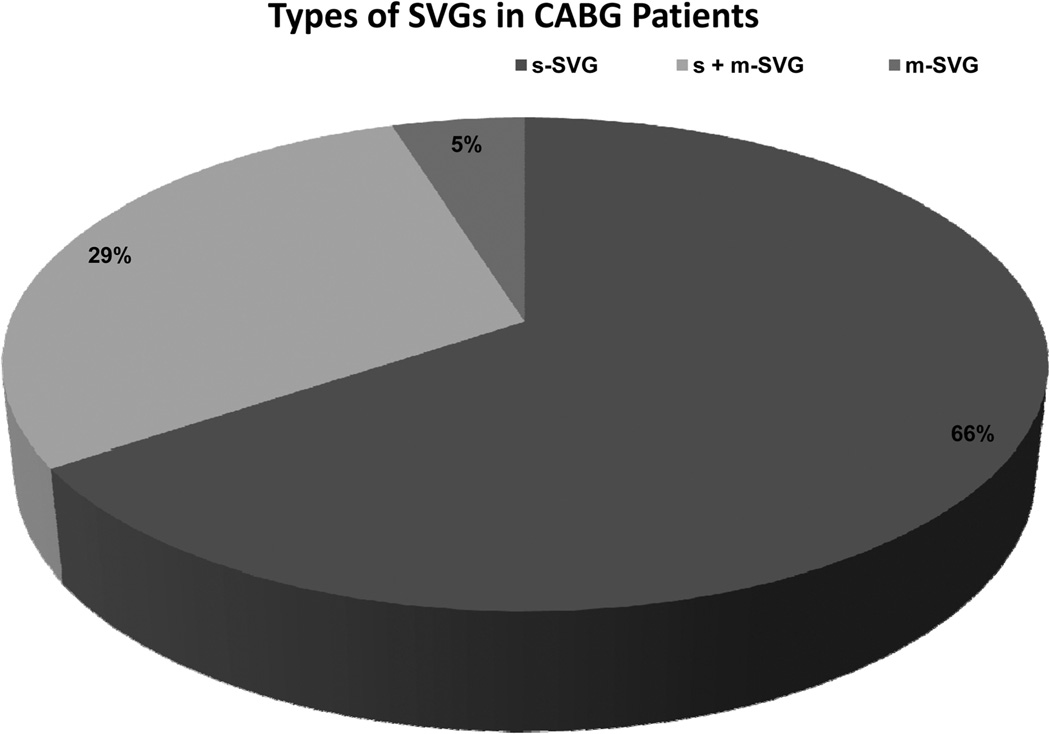
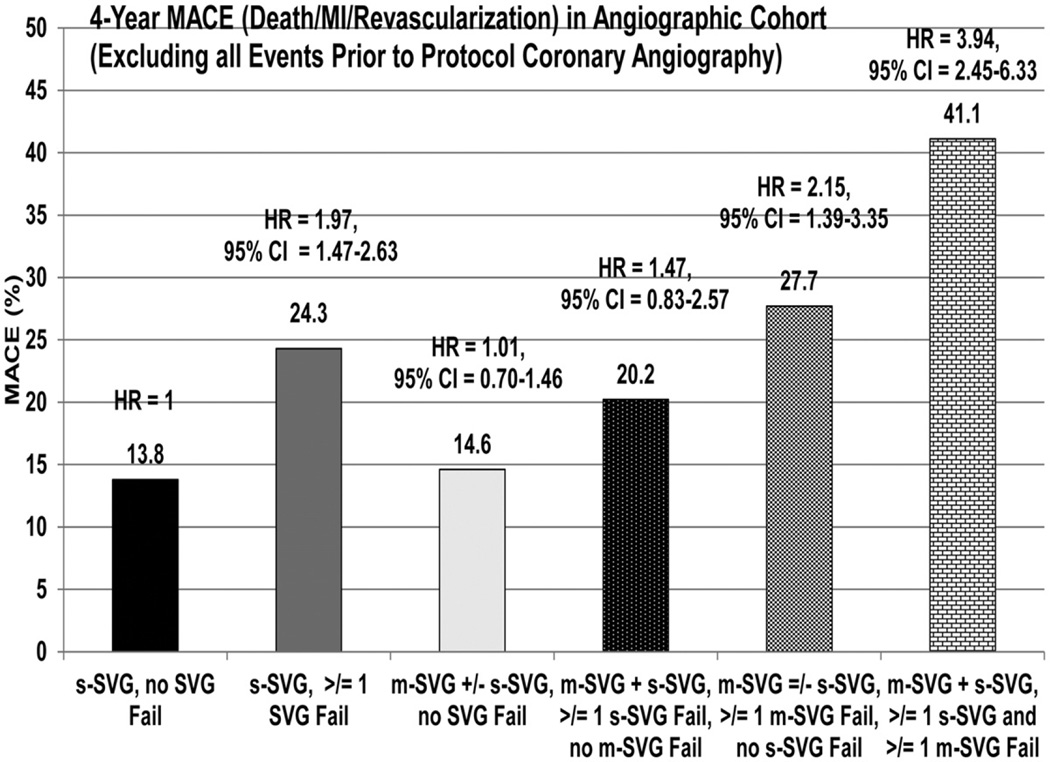
Methods and results: We studied the association of the use of m-SVG versus s-SVG conduits with 1-year SVG failure (defined as ≥75% angiographic stenosis) and 5-year clinical events (death; death or myocardial infarction [MI]; and death, MI, or revascularization) in 3014 patients undergoing their first CABG surgery enrolled in the Project of Ex-vivo Vein Graft Engineering via Transfection (PREVENT) IV. Of 3014 patients enrolled in PREVENT IV, 1045 (34.7%) had ≥1 m-SVGs during CABG. Vein graft failure at 1-year was higher for m-SVG compared with s-SVG (adjusted odds ratio 1.24, 95% confidence interval 1.03 to 1.48). At 5 years, the adjusted composite of death, MI (including perioperative MI), or revascularization (hazard ratio 1.15, 95% confidence interval 1.00 to 1.31) and death or MI (hazard ratio 1.21, 95% confidence interval 1.03 to 1.43) were significantly higher in patients receiving m-SVGs.
Conclusions: In patients undergoing first CABG surgery, the use of m-SVG was associated with a higher 1-year vein graft failure rate and trends toward worse clinical outcomes. Additional studies are needed to better understand the most appropriate conduit to improve long-term graft patency and clinical outcomes of patients undergoing CABG surgery. In the meantime, these data should encourage the use of s-SVG over m-SVG when feasible.
Conflict of interest statement
Please see https://dcri.org/about-us/conflict-of-interest for additional conflict of interest information for DCRI faculty. The other authors report no conflicts.
Figures
Comment in
-
Understanding saphenous vein graft patency.Circulation. 2011 Jul 19;124(3):273-5. doi: 10.1161/CIRCULATIONAHA.111.039842. Circulation. 2011. PMID: 21768550 No abstract available.
-
Surgery: Less is more for CABG conduits.Nat Rev Cardiol. 2011 Aug 2;8(9):480. doi: 10.1038/nrcardio.2011.116. Nat Rev Cardiol. 2011. PMID: 21808274 No abstract available.
References
-
- Flemma RJ, Johnson WD, Lepley D., Jr Triple aorto-coronary vein bypass for coronary insufficiency. Arch Surg. 1971;103:82–83. - PubMed
-
- Bartley TD, Bigelow JC, Page US. Aortocoronary bypass grafting with multiple sequential anastomoses to a single vein. Arch Surg. 1972;105:915–917. - PubMed
-
- Sewell WH, Sewell KV. Technique for the coronary snake graft operation. Ann Thorac Surg. 1976;22:58–65. - PubMed
-
- Grondin CM, Limet R. Sequential anastomoses in coronary grafting: technical aspects and early and late angiographic results. Ann Thorac Surg. 1977;23:1–8. - PubMed
-
- Meurala H, Valle M, Hekali P, Somer K, Frick MH, Harjola PT. Patency of sequential versus single vein grafts in coronary bypass surgery. Thorac Cardiovasc Surg. 1982;30:147–151. - PubMed
Publication types
MeSH terms
Grants and funding
LinkOut - more resources
Full Text Sources
Other Literature Sources
Medical
