


Quantification of amikacin in bronchial epithelial lining fluid in neonates
- PMID: 21709076
- PMCID: PMC3165321
- DOI: 10.1128/AAC.00277-11
Quantification of amikacin in bronchial epithelial lining fluid in neonates
Abstract
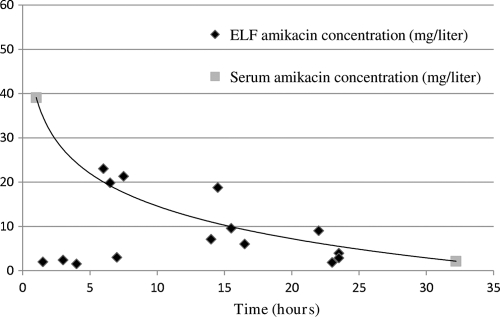
Amikacin efficacy is based on peak concentrations and the possibility of reaching therapeutic levels at the infection site. This study aimed to describe amikacin concentrations in the epithelial lining fluid (ELF) through bronchoalveolar lavage (BAL) in newborns. BAL fluid was collected in ventilated neonates treated with intravenous (i.v.) amikacin. Clinical characteristics, amikacin therapeutic drug monitoring serum concentrations, and the concentrations of urea in plasma were extracted from the individual patient files. Amikacin and urea BAL fluid concentrations were determined using liquid chromatography with pulsed electrochemical detection (LC-PED) and capillary electrophoresis with capacitively coupled contactless conductivity detection (CE-C(4)D), respectively. ELF amikacin concentrations were converted from BAL fluid concentrations through quantification of dilution (urea in plasma/urea in BAL fluid) during the BAL procedure. Twenty-two observations in 17 neonates (postmenstrual age, 31.9 [range, 25.1 to 41] weeks; postnatal age, 3.5 [range, 2 to 37] days) were collected. Median trough and peak amikacin serum concentrations were 2.1 (range, 1 to 7.1) mg/liter and 39.1 (range, 24.1 to 73.2) mg/liter; the median urea plasma concentration was 30 (8 to 90) mg/dl. The median amikacin concentration in ELF was 6.5 mg/liter, the minimum measured concentration was 1.5 mg/liter, and the maximum (peak) was 23 mg/liter. The highest measured ELF concentration was reached between 6 and 14.5 h after i.v. amikacin administration, and an estimated terminal elimination half-life was 8 to 10 h. The median and highest (peak) ELF amikacin concentrations observed in our study population were, respectively, 6.5 and 23 mg/liter. Despite the frequent use of amikacin in neonatal (pulmonary) infections, this is the first report of amikacin quantification in ELF in newborns.
Figures
References
-
- Allegaert K., et al. 2004. Effects of co-administration of ibuprofen-lysine on the pharmacokinetics of amikacin in preterm infants during the first days of life. Biol. Neonate 86:207–211 - PubMed
-
- Allegaert K., Scheers I., Cossey V., Anderson B. J. 2008. Covariates of amikacin clearance in neonates: the impact of postnatal age on predictability. Drug Metab. Lett. 2:286–289 - PubMed
-
- Been J. V., et al. 2010. Early alterations of growth factor patterns in bronchoalveolar lavage fluid from preterm infants developing bronchopulmonary dysplasia. Pediatr. Res. 67:83–89 - PubMed
-
- Boselli E., et al. 2007. Reliability of mini-bronchoalveolar lavage for the measurement of epithelial ling fluid concentrations of tobramycin in critically ill patients. Intensive Care Med. 33:1519–1523 - PubMed
Publication types
MeSH terms
Substances
LinkOut - more resources
Full Text Sources
