. 2011 Jul 12;108(28):11518-23.
doi: 10.1073/pnas.1102274108. Epub 2011 Jun 27.

OUROBOROS is a master regulator of the gametophyte to sporophyte life cycle transition in the brown alga Ectocarpus

Affiliations

OUROBOROS is a master regulator of the gametophyte to sporophyte life cycle transition in the brown alga Ectocarpus

Susana M Coelho et al. Proc Natl Acad Sci U S A. .

Abstract

The brown alga Ectocarpus siliculosus has a haploid-diploid life cycle that involves an alternation between two distinct generations, the sporophyte and the gametophyte. We describe a mutant, ouroboros (oro), in which the sporophyte generation is converted into a functional, gamete-producing gametophyte. The life history of the mutant thus consists of a continuous reiteration of the gametophyte generation. The oro mutant exhibited morphological features typical of the gametophyte generation and accumulated transcripts of gametophyte generation marker genes. Genetic analysis showed that oro behaved as a single, recessive, Mendelian locus that was unlinked to the IMMEDIATE UPRIGHT locus, which has been shown to be necessary for full expression of the sporophyte developmental program. The data presented here indicate that ORO is a master regulator of the gametophyte-to-sporophyte life cycle transition and, moreover, that oro represents a unique class of homeotic mutation that results in switching between two developmental programs that operate at the level of the whole organism.


Conflict of interest statement

The authors declare no conflict of interest.

Figures
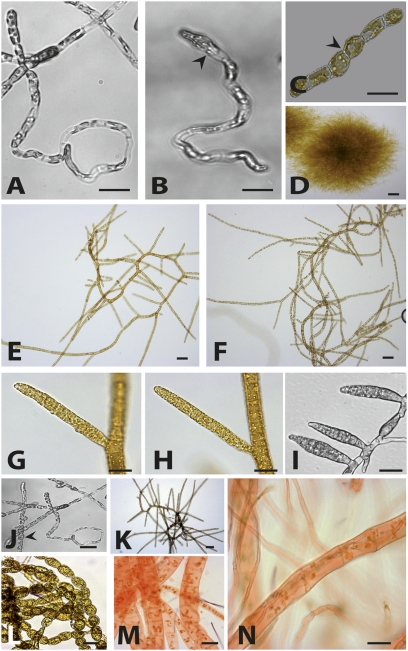
Fig. 1.
Fig. 1.
oro mutant parthenotes closely resemble wild-type gametophytes. Representative images are shown. (A) Wild-type gametophyte germling (4 d old). (B) oro parthenote germling (4 d old). Note the asymmetrical first cell division (arrowhead). (C) Wild-type partheno-sporophyte germling (2 d old). Note the symmetrical first cell division (arrowhead). (D) Adult wild-type sporophyte (3 wk old). (E) Adult wild-type gametophyte (3 wk old). (F) Adult oro parthenote (3 wk old). (G) Plurilocular gametangium of a wild-type gametophyte. (H) Plurilocular gametangium of an oro parthenote. (I) Plurilocular sporangia of a wild-type partheno-sporophyte. (J) Round cells present during the early development of a few oro individuals (arrowhead). (K) oro individuals that had round cells during early development reverted to gametophyte morphology. (L) Wild-type partheno-sporophytes stained with Congo red (no red staining). (M) Wild-type gametophytes stained with Congo red (showing the characteristic red color). (N) oro individuals are Congo red positive. (Scale bars: 10 μm.)
Fig. 2.
Fig. 2.
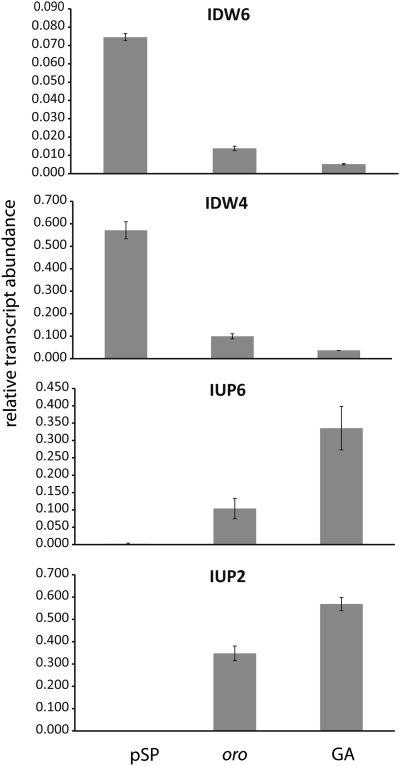
qRT-PCR analysis of the abundances of gene transcripts in the oro mutant compared with wild-type gametophyte (GA) and partheno-sporophyte (pSP). The abundance of transcripts of four genes that have been shown to be differentially expressed in the gametophyte and sporophyte generations (18) was assayed in oro individuals. Data are means of three independent biological replicates ± SE. Transcript abundance was significantly different in the oro and GA samples compared with the wild-type pSP sample for all of the genes tested (ANOVA, P < 0.05). (From top to bottom) IDW6, Esi0351_0007; IDW4, Esi0085_0048; IUP6, Esi0031_0170; IUP2, Esi0416_0001.
Fig. 3.
Fig. 3.
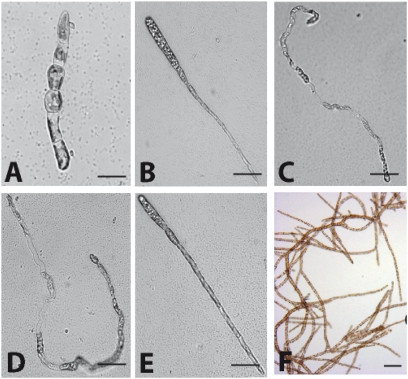
Segregation analysis of the oro and imm loci. (A) Germling showing a wild-type partheno-sporophyte phenotype. (B) Germling showing an imm phenotype. (C) Germling showing an oro phenotype. (D and E) Germlings showing imm oro double-mutant phenotypes. (F) imm-like germlings from the imm oro mutants develop into gametophytes. See text for details. (Scale bars: 10 μm.)
Fig. 4.
Fig. 4.
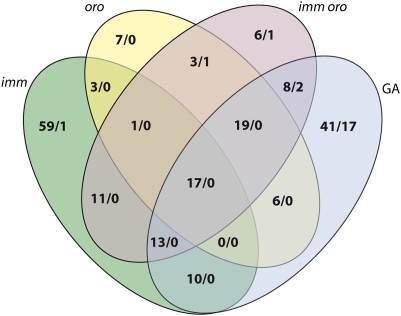
Venn diagram showing the overlap between the sets of genes that had significantly different transcript abundances in the mutant (imm, oro, imm oro) strains and in the wild-type gametophyte (GA) compared with the wild-type partheno-sporophyte. The two numbers separated by a slash indicate the number of genes whose transcripts were significantly more (to the left) or less (to the right) abundant in the indicated sample, compared with the wild-type partheno-sporophyte.
Fig. 5.
Fig. 5.
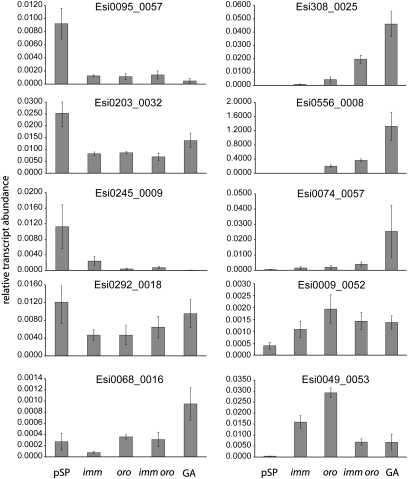
qRT-PCR analysis of the abundance of gene transcripts in wild-type partheno-sporophyte, imm, oro, imm oro, and wild-type gametophytes. Genes were selected either from the microarray analysis or based on their predicted function (see text for details). Data are means of three independent biological replicates ± SE.

References

    1. Coelho SM, et al. Complex life cycles of multicellular eukaryotes: New approaches based on the use of model organisms. Gene. 2007;406:152–170. - PubMed
    1. Thornber CS. Functional properties of the isomorphic biphasic algal life cycle. Integr Comp Biol. 2006;46:605–614. - PubMed
    1. Bicknell RA, Koltunow AM. Understanding apomixis: Recent advances and remaining conundrums. Plant Cell. 2004;16(Suppl):S228–S245. - PMC - PubMed
    1. Koltunow AM, Grossniklaus U. Apomixis: A developmental perspective. Annu Rev Plant Biol. 2003;54:547–574. - PubMed
    1. Ozias-Akins P, van Dijk PJ. Mendelian genetics of apomixis in plants. Annu Rev Genet. 2007;41:509–537. - PubMed

Publication types