


A prospective study of prepregnancy dietary iron intake and risk for gestational diabetes mellitus
- PMID: 21709294
- PMCID: PMC3120196
- DOI: 10.2337/dc11-0134
A prospective study of prepregnancy dietary iron intake and risk for gestational diabetes mellitus
Abstract
Objective: It is important to identify modifiable factors that may lower gestational diabetes mellitus (GDM) risk. Dietary iron is of particular interest given that iron is a strong prooxidant, and high body iron levels can damage pancreatic β-cell function and impair glucose metabolism. The current study is to determine if prepregnancy dietary and supplemental iron intakes are associated with the risk of GDM.
Research design and methods: A prospective study was conducted among 13,475 women who reported a singleton pregnancy between 1991 and 2001 in the Nurses' Health Study II. A total of 867 incident GDM cases were reported. Pooled logistic regression was used to estimate the relative risk (RR) of GDM by quintiles of iron intake controlling for dietary and nondietary risk factors.
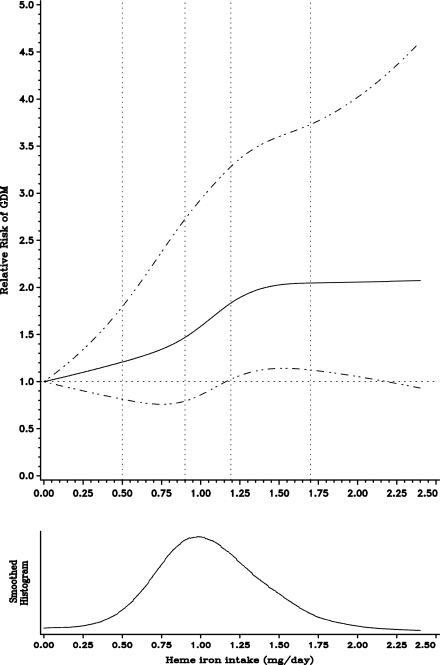
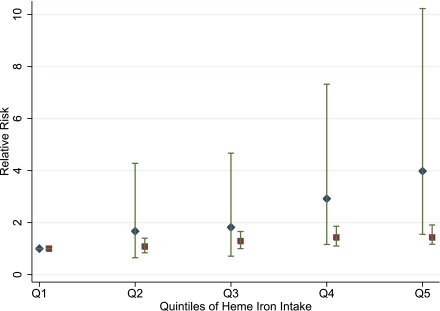
Results: Dietary heme iron intake was positively and significantly associated with GDM risk. After adjusting for age, BMI, and other risk factors, RRs (95% CIs) across increasing quintiles of heme iron were 1.0 (reference), 1.11 (0.87-1.43), 1.31 (1.03-1.68), 1.51 (1.17-1.93), and 1.58 (1.21-2.08), respectively (P for linear trend 0.0001). The multivariate adjusted RR for GDM associated with every 0.5-mg per day of increase in intake was 1.22 (1.10-1.36). No significant associations were observed between total dietary, nonheme, or supplemental iron intake and GDM risk.
Conclusions: These findings suggest that higher prepregnancy intake of dietary heme iron is associated with an increased GDM risk.
Figures
Comment in
-
Iron and diabetes revisited.Diabetes Care. 2011 Jul;34(7):1676-7. doi: 10.2337/dc11-0700. Diabetes Care. 2011. PMID: 21709301 Free PMC article. No abstract available.
References
-
- American Diabetes Association Gestational diabetes mellitus. Diabetes Care 2004;27(Suppl. 1):S88–S90 - PubMed
-
- Buchanan TA, Xiang A, Kjos SL, Watanabe R. What is gestational diabetes? Diabetes Care 2007;30(Suppl. 2):S105–S111 - PubMed
-
- Liu Q, Sun L, Tan Y, Wang G, Lin X, Cai L. Role of iron deficiency and overload in the pathogenesis of diabetes and diabetic complications. Curr Med Chem 2009;16:113–129 - PubMed
-
- Jiang R, Manson JE, Meigs JB, Ma J, Rifai N, Hu FB. Body iron stores in relation to risk of type 2 diabetes in apparently healthy women. JAMA 2004;291:711–717 - PubMed
Publication types
MeSH terms
Substances
Grants and funding
LinkOut - more resources
Full Text Sources
Medical
