. 2011;2(1):47-58.
doi: 10.1615/forumimmundisther.v2.i1.60.

Locostatin Disrupts Association of Raf Kinase Inhibitor Protein With Binding Proteins by Modifying a Conserved Histidine Residue in the Ligand-Binding Pocket

Affiliations

Locostatin Disrupts Association of Raf Kinase Inhibitor Protein With Binding Proteins by Modifying a Conserved Histidine Residue in the Ligand-Binding Pocket

Anwar B Beshir et al. For Immunopathol Dis Therap. 2011.

Abstract

Raf kinase inhibitor protein (RKIP) interacts with a number of different proteins and regulates multiple signaling pathways. Here, we show that locostatin, a small molecule that covalently binds RKIP, not only disrupts interactions of RKIP with Raf-1 kinase, but also with G protein-coupled receptor kinase 2. In contrast, we found that locostatin does not disrupt binding of RKIP to two other proteins: inhibitor of κB kinase α and transforming growth factor β-activated kinase 1. These results thus imply that different proteins interact with different regions of RKIP. Locostatin's mechanism of action involves modification of a nucleophilic residue on RKIP. We observed that after binding RKIP, part of locostatin is slowly hydrolyzed, leaving a smaller RKIP-butyrate adduct. We identified the residue alkylated by locostatin as His86, a highly conserved residue in RKIP's ligand-binding pocket. Computational modeling of the binding of locostatin to RKIP suggested that the recognition interaction between small molecule and protein ensures that locostatin's electrophilic site is poised to react with His86. Furthermore, binding of locostatin would sterically hinder binding of other ligands in the pocket. These data provide a basis for understanding how locostatin disrupts particular interactions of RKIP with RKIP-binding proteins and demonstrate its utility as a probe of specific RKIP interactions and functions.


Figures
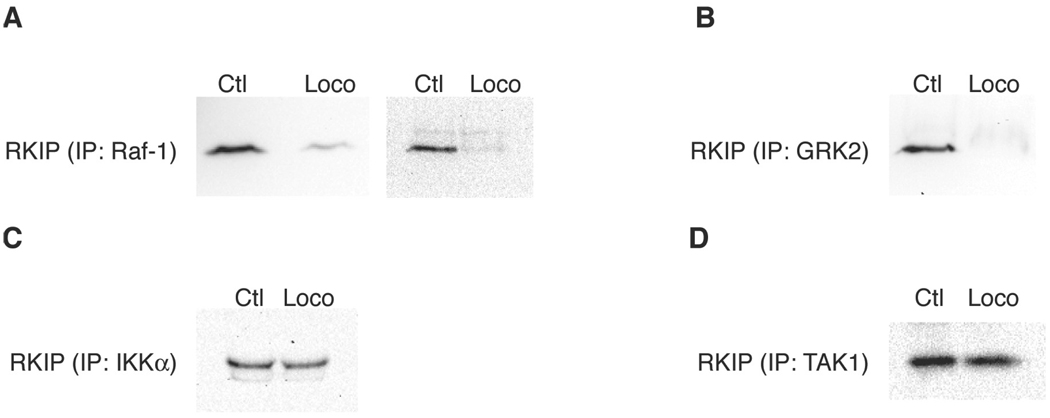
FIGURE 1
FIGURE 1
Locostatin disrupts binding of RKIP with Raf-1 and GRK2 but not IKKa or TAK1. Purified recombinant human RKIP (100 nM) was preincubated with locostatin (200 µM; Loco) or DMSO alone (0.2%, corresponding to the concentration of DMSO carrier solvent in the experimental treatment) as control (Ctl) at 37°C for 6 h and then added to immunoprecipitated samples of the following recombinant human RKIP-binding proteins: (A) Raf-1 (shown are HA-tagged Raf-1 on the left and FLAG-tagged Raf-1 on the right); (B) GRK2; (C) IKKa; (D) TAK1. After allowing binding of RKIP to its binding proteins for 1 h at room temperature, the samples were centrifuged and washed five times. The pellets were then subjected to SDS-PAGE and Western blot analysis with an anti-RKIP antibody. Each Western blot is representative of at least three separate experiments.
FIGURE 2
FIGURE 2
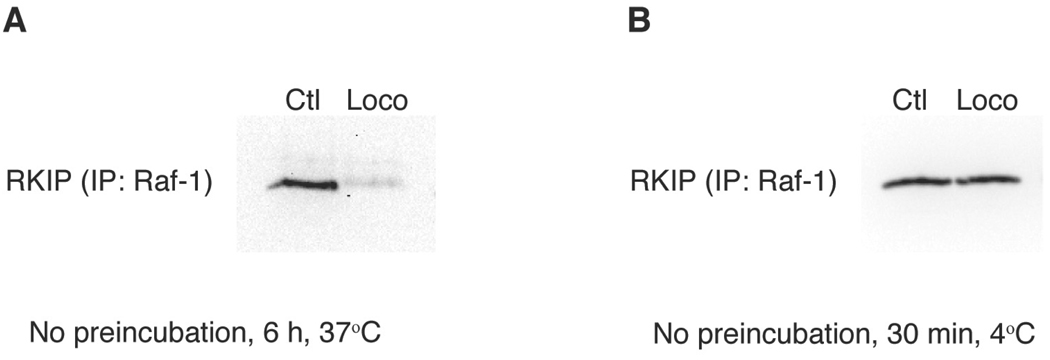
Locostatin disrupts binding of RKIP with Raf-1 without preincubation of RKIP with locostatin. RKIP (100 nM), immunoprecipitated FLAG-tagged Raf-1, and locostatin (200 µM; Loco) or DMSO alone (0.2%) as control (Ctl) were combined at the same time, then incubated for either (A) 6 h at 37°C or (B) 30 min at 4°C. After centrifugation and washing five times, the pellets were subjected to SDS-PAGE and Western blot analysis with an anti-RKIP antibody. Each Western blot is representative of at least three separate experiments.
FIGURE 3
FIGURE 3
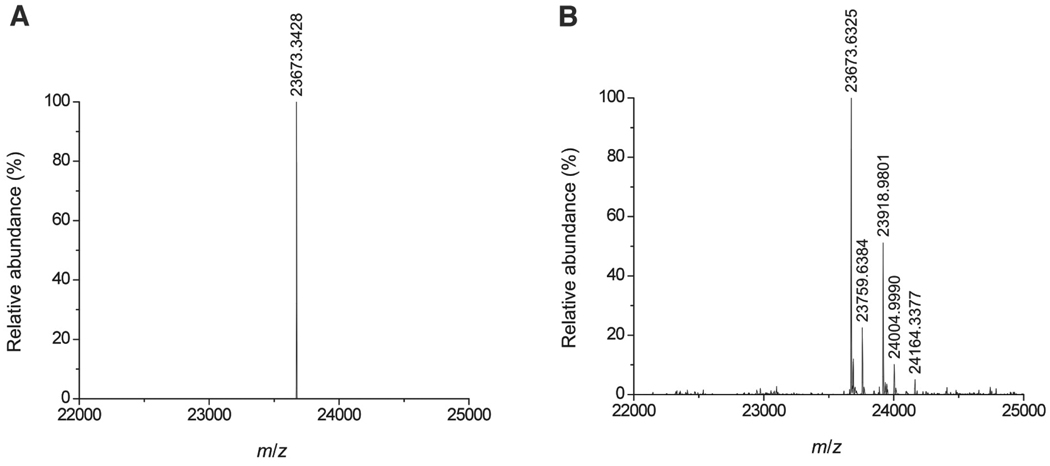
Modification of RKIP by locostatin. RKIP (20 µM) was incubated with locostatin (100 µM) or DMSO alone (0.1%) as control at 37°C for 6 h and then subjected to LC-MS. Mass spectra are shown for (A) the control RKIP sample and (B) the locostatin-treated RKIP sample. In addition to the His-tagged RKIP molecular ion peak, the mass spectrum in (B) shows a prominent peak at an m/z of RKIP+246 (corresponding to an RKIP-locostatin adduct) and a weaker peak at RKIP+86 (corresponding to an RKIP-butyrate adduct), as well as still weaker peaks at RKIP+2×246 and RKIP+246+86 (corresponding to a small degree of alkylation of a secondary site).
FIGURE 4
FIGURE 4
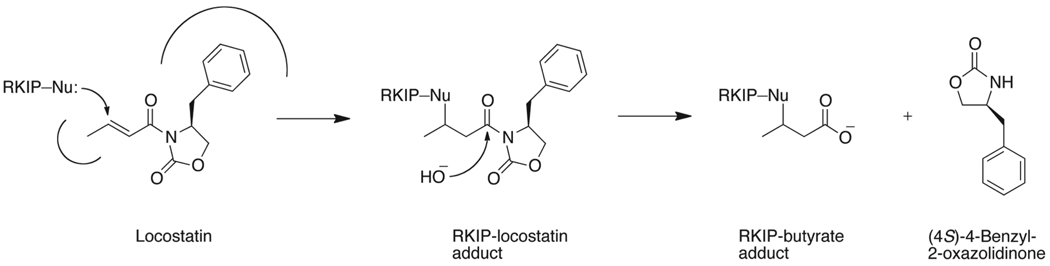
Mechanism of modification of RKIP by locostatin and hydrolysis of the bound locostatin. The scheme shows the putative mechanism of alkylation of RKIP by locostatin and hydrolysis of the RKIP-locostatin adduct to an RKIP-butyrate adduct, consistent with the MS data shown in Fig. 3.
FIGURE 5
FIGURE 5
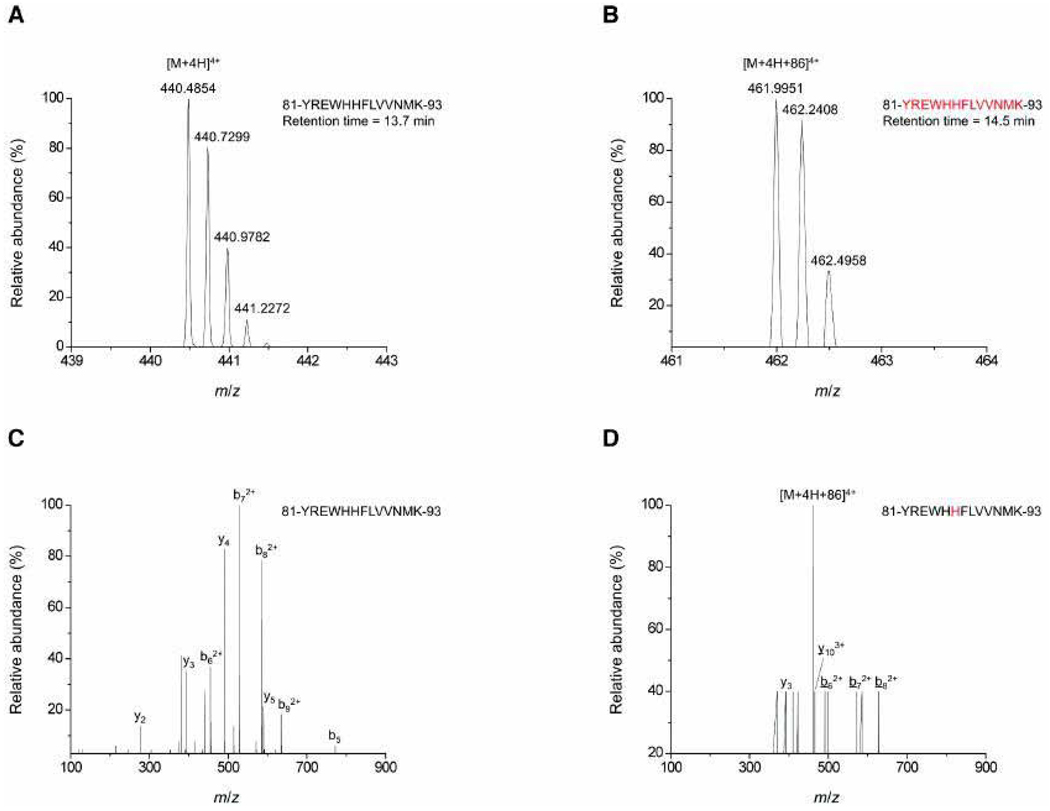
Locostatin modifies His86, a highly conserved residue in RKIP’s ligand-binding pocket. RKIP (20 µM) was incubated with locostatin (100 µM) or DMSO alone (0.1%) as control at 37°C for 24 h and then subjected to LC-MS/MS. Mass spectra are shown for the fragment 81-YREWHHFLVVNMK-93 from tryptic digestion of (A) the control RKIP sample and (B) the locostatin-treated RKIP sample. Tandem mass spectra are shown for the same tryptic fragment from (C) the control RKIP sample and (D) the locostatin-treated RKIP sample, with modified ions underlined.
FIGURE 6
FIGURE 6
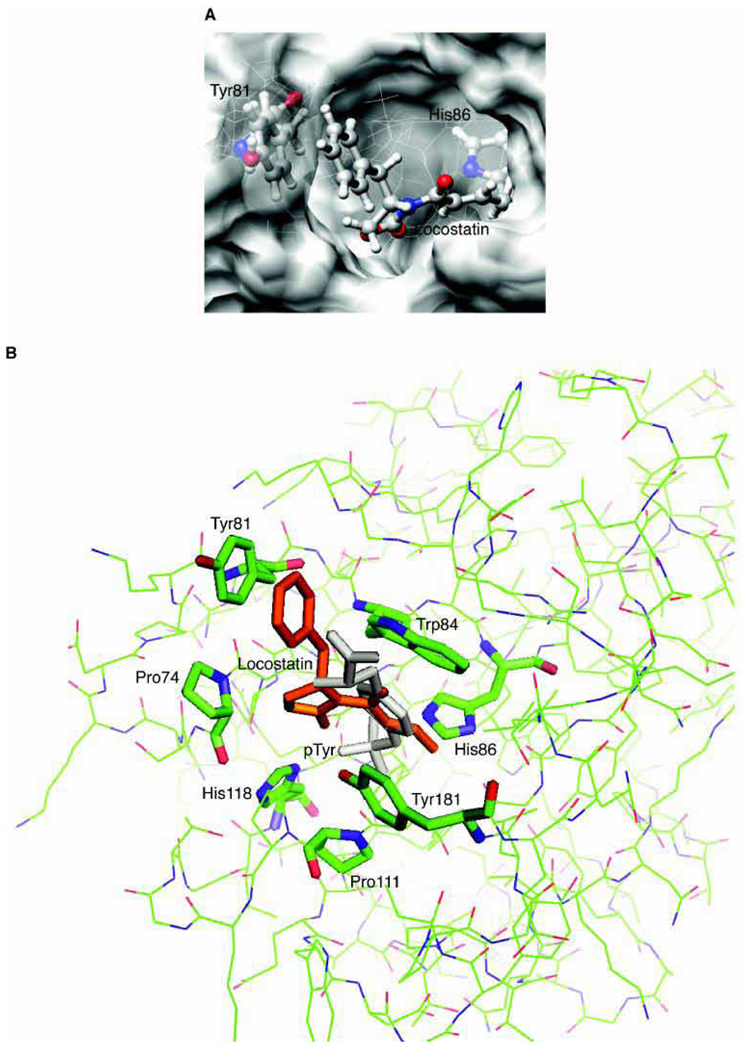
Computational modeling of the recognition interaction between locostatin and RKIP results in locostatin well positioned to modify His86 in RKIP’s ligand-binding pocket. The structure of human RKIP bound to pTyr (PDB code 2QYQ) was utilized for the docking calculations, after removing the pTyr coordinates to allow for docking of locostatin. (A) The docked structure for the calculated lowest-energy interaction of locostatin for the recognition step (not considering the subsequent alkylation reaction). (B) Superimposition of the docked locostatin molecule onto the RKIP-pTyr cocrystal structure, with locostatin in orange and pTyr in light gray. [Images for Figures 6A and 6B were, respectively, rendered with UCSF Chimera (http://www.cgl.ucsf.edu/chimera/) and PyMOL (http://www.pymol.org/).]

References

    1. Mc Henry KT, Ankala SV, Ghosh AK, Fenteany G. A non-antibacterial oxazolidinone derivative that inhibits epithelial cell sheet migration. ChemBioChem. 2002;3:1105–1111. - PubMed
    1. Mc Henry KT, Montesano R, Zhu S, Beshir AB, Tang HH, Yeung KC, Fenteany G. Raf kinase inhibitor protein positively regulates cell-substratum adhesion while negatively regulating cell-cell adhesion. J Cell Biochem. 2008;103:972–985. - PubMed
    1. Zhu S, Mc Henry KT, Lane WS, Fenteany G. A chemical inhibitor reveals the role of Raf kinase inhibitor protein in cell migration. Chem Biol. 2005;12:981–991. - PubMed
    1. Yeung K, Seitz T, Li S, Janosch P, McFerran B, Kaiser C, Fee F, Katsanakis KD, Rose DW, Mischak H, Sedivy JM, Kolch W. Suppression of Raf-1 kinase activity and MAP kinase signalling by RKIP. Nature. 1999;401:173–177. - PubMed
    1. Yeung K, Janosch P, McFerran B, Rose DW, Mischak H, Sedivy JM, Kolch W. Mechanism of suppression of the Raf/MEK/extracellular signal-regulated kinase pathway by the Raf kinase inhibitor protein. Mol Cell Biol. 2000;20:3079–3085. - PMC - PubMed

LinkOut - more resources