Subsequent bilateral thalamic haemorrhage
- PMID: 21709830
- PMCID: PMC3028922
- DOI: 10.1136/bcr.04.2009.1734
Subsequent bilateral thalamic haemorrhage
Abstract
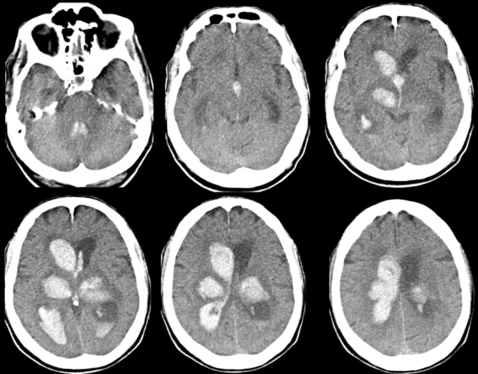
Simultaneous or subsequent bilateral thalamic haemorrhage is rare, and most reported cases are from Asian countries. An 80-year-old white Cuban man, with a history of arterial hypertension, suffered sudden onset of right hemiparesis. Computed tomography (CT) scan showed a left posteromedial thalamic haemorrhage. Two days later his condition suddenly deteriorated: blood pressure was 220/105 mm Hg, he was stuporous and tetraplegic, respiration was ataxic, and his gaze was fixed and deviated downward and inward. CT scan showed haemorrhages in both thalami, extending to the ventricles. 32 h later the patient died. There are few previous publications of simultaneous or subsequent bilateral thalamic haemorrhages and this is the first report involving a Hispanic patient. Prognosis in patients with bilateral thalamic haemorrhage is poor, and the mechanism underlying the development of subsequent and symmetrical bleeding is not clear.
Figures
References
-
- Fisher CM. The pathologic and clinical aspects of thalamic hemorrhage. Trans Am Neurol Assoc 1959; 84: 56–9 - PubMed
-
- Wijdicks EF, Kallmes DF, Manno EM, et al. Subarachnoid hemorrhage: neurointensive care and aneurysm repair. Mayo Clin Proc 2005; 80: 550–9 - PubMed
-
- Nielsen JM, Schramel JE. Bilateral thalamic hemorrhages; report of two cases with stupor but without coma. Bull Los Angel Neuro Soc 1953; 18: 193–6 - PubMed
-
- Tanikake T, Kawaguchi S, Tada T, et al. [Simultaneous, bilateral hypertensive intracranial hematomas]. No Shinkei Geka 1983; 11: 1085–90 - PubMed
-
- Morimoto K, Sumita Y, Kitajima H, et al. [Bilateral, symmetrical hemorrhagic infarction of the basal ganglia and thalamus following neonatal asphyxia]. No To Shinkei 1985; 37: 133–7 - PubMed
LinkOut - more resources
Full Text Sources