Review
. 2011 Nov;93(11):1897-904.
doi: 10.1016/j.biochi.2011.06.017. Epub 2011 Jun 21.

Mirtrons: microRNA biogenesis via splicing

Affiliations
Review

Mirtrons: microRNA biogenesis via splicing

Jakub O Westholm et al. Biochimie. 2011 Nov.

Abstract

A well-defined mechanism governs the maturation of most microRNAs (miRNAs) in animals, via stepwise cleavage of precursor hairpin transcripts by the Drosha and Dicer RNase III enzymes. Recently, several alternative miRNA biogenesis pathways were elucidated, the most prominent of which substitutes Drosha cleavage with splicing. Such short hairpin introns are known as mirtrons, and their study has uncovered related pathways that combine splicing with other ribonucleolytic machinery to yield Dicer substrates for miRNA biogenesis. In this review, we consider the mechanisms of splicing-mediated miRNA biogenesis, computational strategies for mirtron discovery, and the evolutionary implications of the existence of multiple miRNA biogenesis pathways. Altogether, the features of mirtron pathways illustrate unexpected flexibility in combining RNA processing pathways, and highlight how multiple functions can be encoded by individual transcripts.


Figures

Figure 1
Figure 1
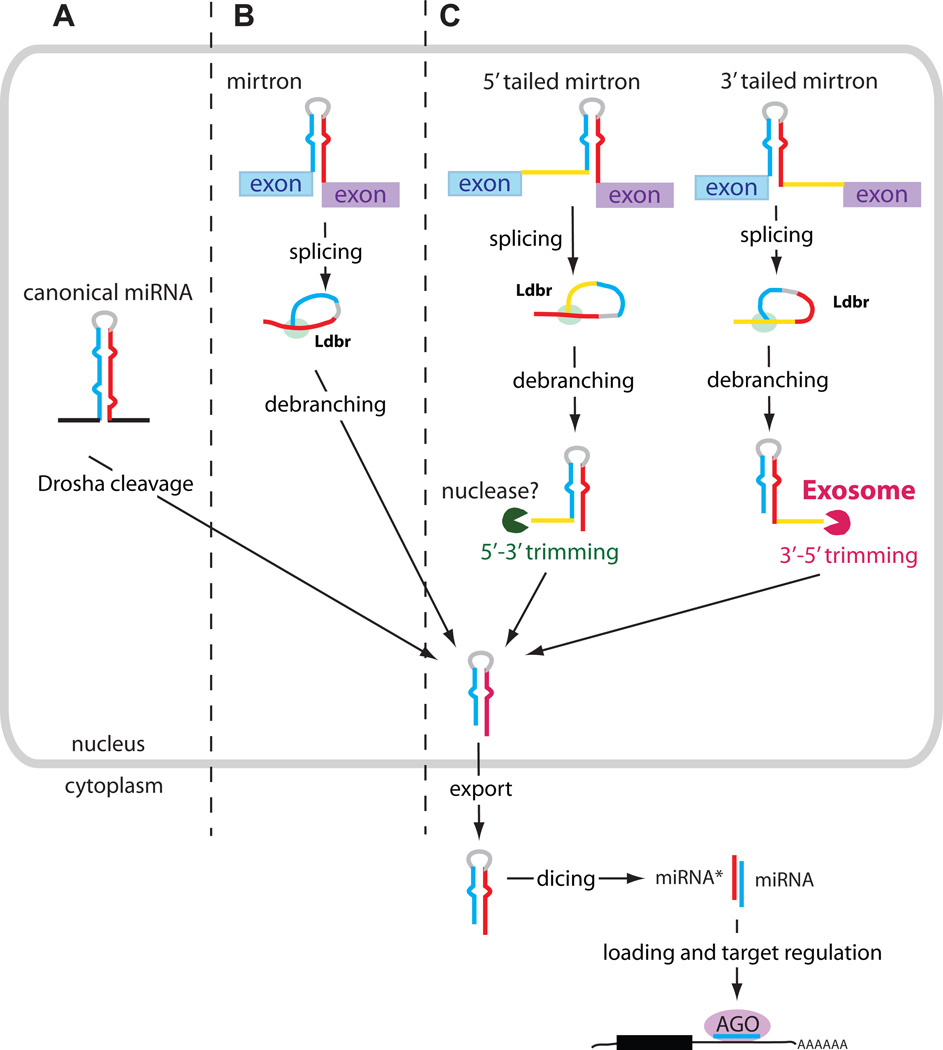
Schematic overview of canonical miRNA and mirtron biogenesis. (A) The canonical miRNA pathway produces pre-miRNAs by Drosha cleavage of pri-miRNA transcripts. (B) Introns entering the mirtron pathway are spliced and debranched by lariat debranching enzyme (Ldbr), after which they fold into pre-miRNA hairpins. (C) Tailed mirtrons also undergo splicing and debranching, after which the tails on the resulting hairpins are trimmed back. 3’ tails are trimmed by the RNA exosome, while the enzymes responsible for 5’ trimming are not known. All of these pathways generate pre-miRNA hairpins, whose subsequent steps of nuclear export, Dicer cleavage and loading into Argonaute complexes are shared.
Figure 2
Figure 2
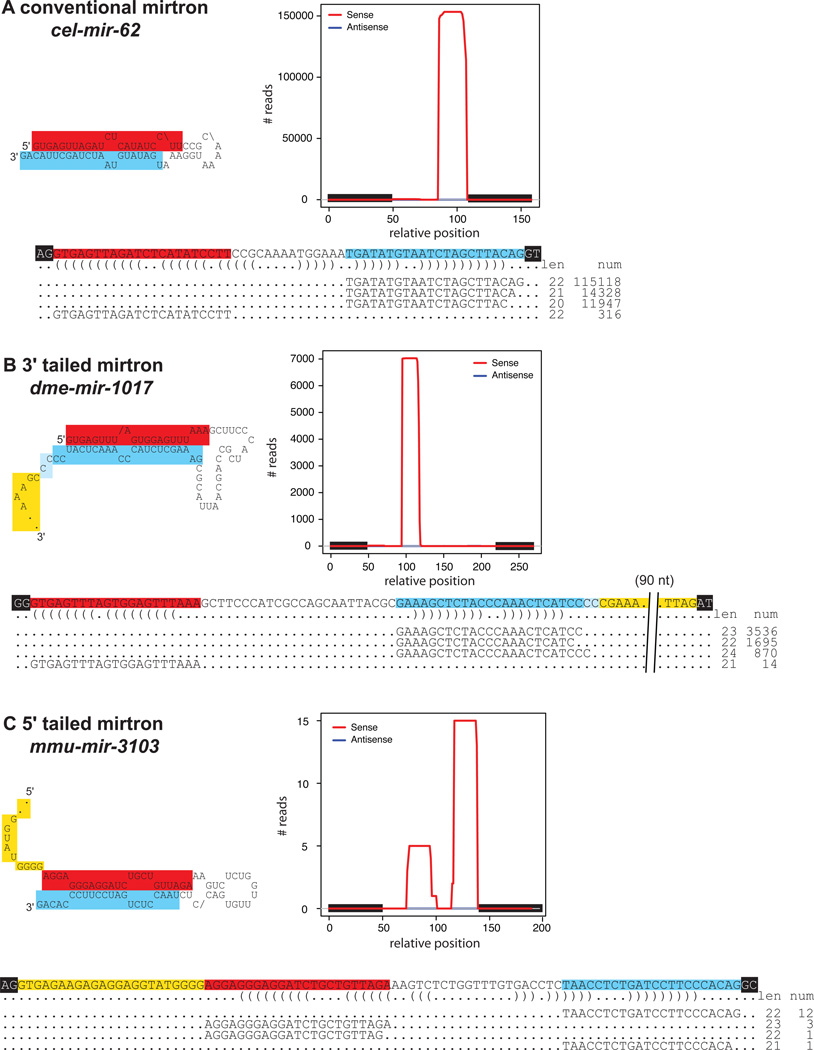
Examples of conventional and tailed mirtrons. (A) C. elegans mir-62 generates small RNA reads extending to both splice donor and acceptor sites, and the miRNA/star duplex exhibits a 3' overhang on the terminal loop side indicating Dicer cleavage of its precursor hairpin. The pre-miRNA hairpin displays the 0:2 overhang characteristic of invertebrate mirtrons. (B) Drosophila mir-1017 is a 3’ tailed mirtron whose precursor intron exhibits a pre-miRNA hairpin initiating with the GUGAGU splice donor site, followed by a ~100 nucleotide tail on the 3’ end. Otherwise, the properties of its cloned short RNAs are similar to conventional mirtrons. (C) Mouse mir-3103 is a 5’ tailed mirtron, with a 23 nt 5’ tail prior to a pre-miRNA hairpin that extends to the AG splice acceptor. In all schematics, the mature RNA species are highlighted in blue, the miRNA* in red, the terminal loops in gray, the tailed regions in yellow, and the flanking exons in black. Cloned reads for cel-mir-62 were compiled earlier [52], cloned reads for dme-mir-1017 and mmu-mir-3103 are from miRBase v16 (http://www.mirbase.org). To highlight the specificity of Dicer processing, only the most abundant mature miRNA and miRNA* reads are shown in the alignments. Since less abundant reads are not shown, the total read numbers in the graphs are greater than those tallied in the alignments. The graphs also reflect that almost all the short RNA reads derive from the same strand as host mRNA transcription.

References

    1. Kim VN, Han J, Siomi MC. Biogenesis of small RNAs in animals. Nat Rev Mol Cell Biol. 2009;10:126–139. - PubMed
    1. Czech B, Hannon GJ. Small RNA sorting: matchmaking for Argonautes. Nat Rev Genet. 2010;12:19–31. - PMC - PubMed
    1. Kozomara A, Griffiths-Jones S. miRBase: integrating microRNA annotation and deep-sequencing data. Nucleic Acids Res. 2011;39:D152–D157. - PMC - PubMed
    1. Rhoades MW, Reinhart BJ, Lim LP, Burge CB, Bartel B, Bartel DP. Prediction of plant microRNA targets. Cell. 2002;110:513–520. - PubMed
    1. Axtell MJ, Westholm JO, Lai EC. Vive la différence: biogenesis and evolution of microRNAs in plants and animals. Genome Biol. 2011;12:221–221. 213. - PMC - PubMed

Publication types

LinkOut - more resources