


Duffy negative antigen is no longer a barrier to Plasmodium vivax--molecular evidences from the African West Coast (Angola and Equatorial Guinea)
- PMID: 21713024
- PMCID: PMC3119644
- DOI: 10.1371/journal.pntd.0001192
Duffy negative antigen is no longer a barrier to Plasmodium vivax--molecular evidences from the African West Coast (Angola and Equatorial Guinea)
Abstract
Background: Plasmodium vivax shows a small prevalence in West and Central Africa due to the high prevalence of Duffy negative people. However, Duffy negative individuals infected with P. vivax have been reported in areas of high prevalence of Duffy positive people who may serve as supply of P. vivax strains able to invade Duffy negative erythrocytes. We investigated the presence of P. vivax in two West African countries, using blood samples and mosquitoes collected during two on-going studies.
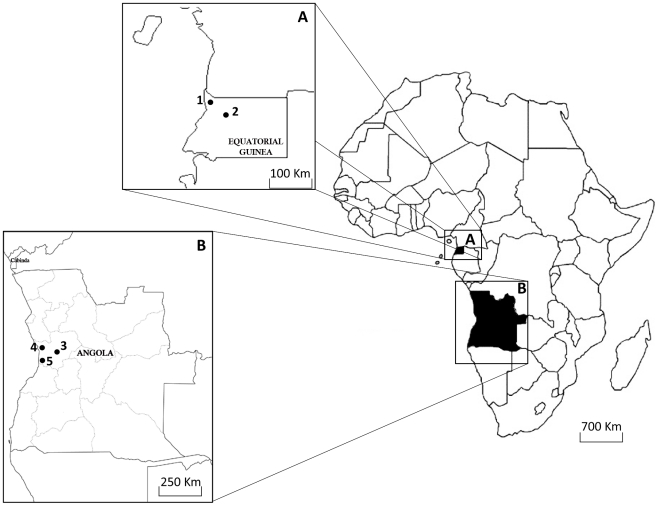
Methodology/findings: Blood samples from a total of 995 individuals were collected in seven villages in Angola and Equatorial Guinea, and 820 Anopheles mosquitoes were collected in Equatorial Guinea. Identification of the Plasmodium species was achieved by nested PCR amplification of the small-subunit rRNA genes; P. vivax was further characterized by csp gene analysis. Positive P. vivax-human isolates were genotyped for the Duffy blood group through the analysis of the DARC gene. Fifteen Duffy-negative individuals, 8 from Equatorial Guinea (out of 97) and 7 from Angola (out of 898), were infected with two different strains of P. vivax (VK210 and VK247).
Conclusions: In this study we demonstrated that P. vivax infections were found both in humans and mosquitoes, which means that active transmission is occurring. Given the high prevalence of infection in mosquitoes, we may speculate that this hypnozoite-forming species at liver may not be detected by the peripheral blood samples analysis. Also, this is the first report of Duffy negative individuals infected with two different strains of P. vivax (VK247 and classic strains) in Angola and Equatorial Guinea. This finding reinforces the idea that this parasite is able to use receptors other than Duffy to invade erythrocytes, which may have an enormous impact in P. vivax current distribution.
Conflict of interest statement
The authors have declared that no competing interests exist.
Figures

References
Publication types
MeSH terms
Substances
LinkOut - more resources
Full Text Sources
Molecular Biology Databases
