


Mast cell progenitor trafficking and maturation
- PMID: 21713649
- PMCID: PMC3554263
- DOI: 10.1007/978-1-4419-9533-9_2
Mast cell progenitor trafficking and maturation
Abstract
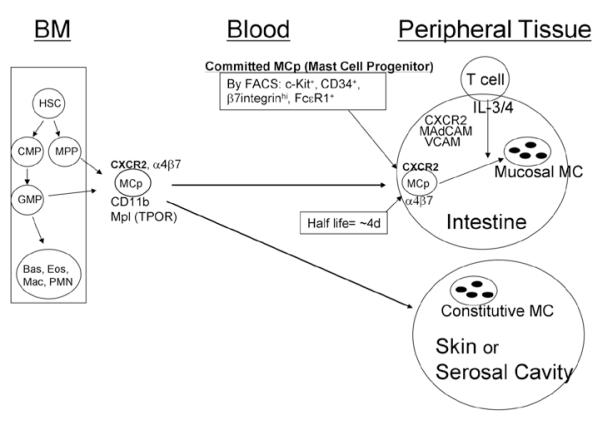
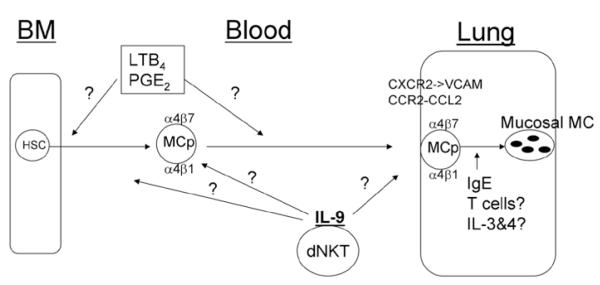
Mast cells are derived from the hematopoietic progenitors found in bone marrow and spleen. Committed mast cell progenitors are rare in bone marrow suggesting they are rapidly released into the blood where they circulate and move out into the peripheral tissues. This migration is controlled in a tissue specific manner. Basal trafficking to the intestine requires expression of α4β7 integrin and the chemokine receptor CXCR2 by the mast cell progenitors and expression of MAdCAM-1 and VCAM-1 in the intestinal endothelium; and is also controlled by dendritic cells expressing the transcriptional regulatory protein T-bet. None of these play a role in basal trafficking to the lung. With the induction of allergic inflammation in the lung, there is marked recruitment of committed mast cell progenitors to lung and these cells must express α4β7 and α4β1 integrins. Within the lung there is a requirement for expression of VCAM-1 on the endothelium that is regulated by CXCR2, also expressed on the endothelium. There is a further requirement for expression of the CCR2/CCL2 pathways for full recruitment of the mast cell progenitors to the antigen-inflamed lung.
Figures
References
-
- Kitamura Y, Yokoyama M, Matsuda H, et al. Spleen colony-forming cell as common precursor for tissue mast cells and granulocytes. Nature. 1981;291(5811):159–160. - PubMed
-
- Gurish MF, Pear WS, Stevens RL, et al. Tissue-regulated differentiation and maturation of a v-abl-immortalized mast cell-committed progenitor. Immunity. 1995;3(2):175–186. - PubMed
-
- Metcalfe DD, Baram D, Mekori YA. Mast cells Physiol Rev. 1997;77(4):1033–1079. - PubMed
-
- Kitamura Y, Shimada M, Hatanaka K, et al. Development of mast cells from grafted bone marrow cells in irradiated mice. Nature. 1977;268(5619):442–443. - PubMed
-
- Kitamura Y, Go S, Hatanaka K. Decrease of mast cells in W/Wv mice and their increase by bone marrow transplantation. Blood. 1978;52(2):447–452. - PubMed
Publication types
MeSH terms
Grants and funding
LinkOut - more resources
Full Text Sources
Medical
Miscellaneous
