


Retroviral restriction and dependency factors in primates and carnivores
- PMID: 21715018
- PMCID: PMC3902784
- DOI: 10.1016/j.vetimm.2011.06.002
Retroviral restriction and dependency factors in primates and carnivores
Abstract
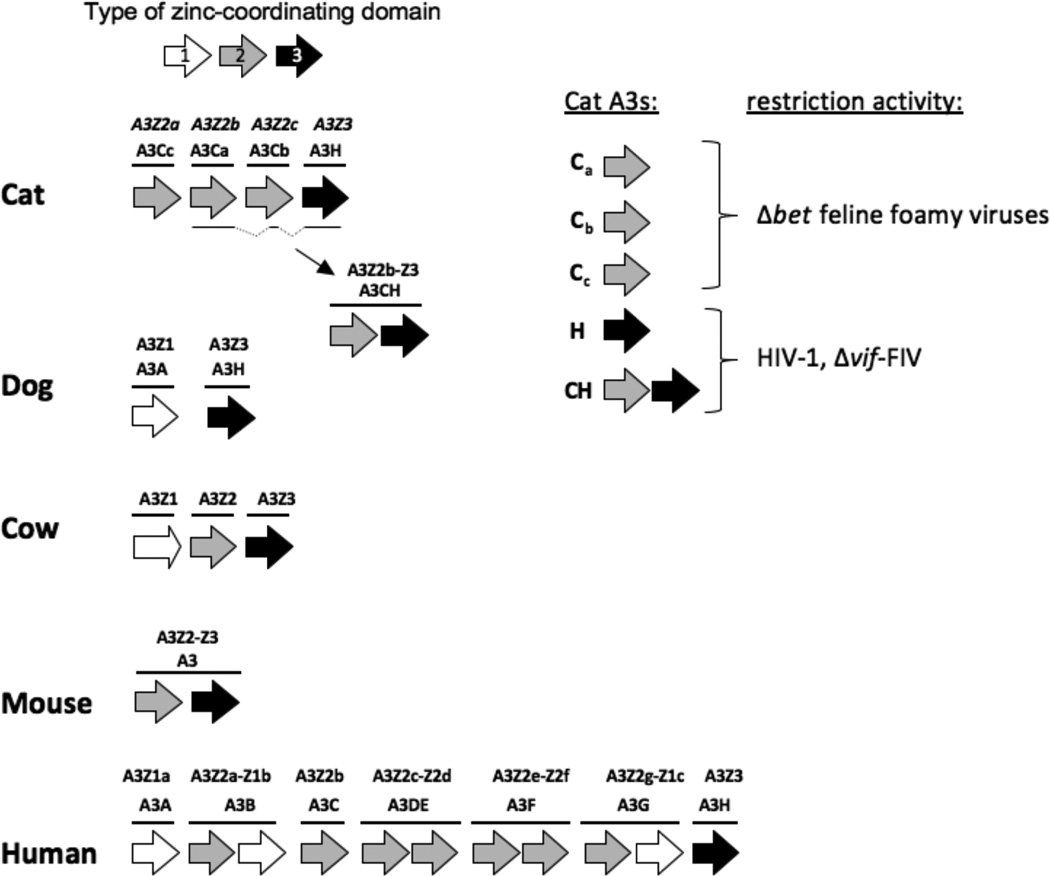
Recent studies have extended the rapidly developing retroviral restriction factor field to cells of carnivore species. Carnivoran genomes, and the domestic cat genome in particular, are revealing intriguing properties vis-à-vis the primate and feline lentiviruses, not only with respect to their repertoires of virus-blocking restriction factors but also replication-enabling dependency factors. Therapeutic application of restriction factors is envisioned for human immunodeficiency virus (HIV) disease and the feline immunodeficiency virus (FIV) model has promise for testing important hypotheses at the basic and translational level. Feline cell-tropic HIV-1 clones have also been generated by a strategy of restriction factor evasion. We review progress in this area in the context of what is known about retroviral restriction factors such as TRIM5α, TRIMCyp, APOBEC3 proteins and BST-2/Tetherin.
Copyright © 2011 Elsevier B.V. All rights reserved.
Conflict of interest statement
All authors declare that there is no conflict of interest.
Figures
References
-
- Ambrose Z, KewalRamani VN, Bieniasz PD, Hatziioannou T. HIV/AIDS: in search of an animal model. Trends Biotechnol. 2007:333–337. - PubMed
-
- Antunes A, Troyer JL, Roelke ME, Pecon-Slattery J, Packer C, Winterbach C, Winterbach H, Hemson G, Frank L, Stander P, Siefert L, Driciru M, Funston PJ, Alexander KA, Prager KC, Mills G, Wildt D, Bush M, O'Brien SJ, Johnson WE. The evolutionary dynamics of the lion Panthera leo revealed by host and viral population genomics. PLoS Genet. 2008;4:e1000251. - PMC - PubMed
-
- Asaoka K, Ikeda K, Hishinuma T, Horie-Inoue K, Takeda S, Inoue S. A retrovirus restriction factor TRIM5alpha is transcriptionally regulated by interferons. Biochem. Biophys. Res. Commun. 2005:1950–1956. - PubMed
Publication types
MeSH terms
Grants and funding
LinkOut - more resources
Full Text Sources
Miscellaneous
