Prenatal lead exposure and weight of 0- to 5-year-old children in Mexico city
- PMID: 21715242
- PMCID: PMC3230436
- DOI: 10.1289/ehp.1003184
Prenatal lead exposure and weight of 0- to 5-year-old children in Mexico city
Abstract
Background: Cumulative prenatal lead exposure, as measured by maternal bone lead burden, has been associated with smaller weight of offspring at birth and 1 month of age, but no study has examined whether this effect persists into early childhood.
Objective: We investigated the association of perinatal maternal bone lead, a biomarker of cumulative prenatal lead exposure, with children's attained weight over time from birth to 5 years of age.
Methods: Children were weighed at birth and at several intervals up until 60 months. Maternal tibia and patella lead were measured at 1 month postpartum using in vivo K-shell X-ray fluorescence. We used varying coefficient models with random effects to assess the association of maternal bone lead with weight trajectories of 522 boys and 477 girls born between 1994 and 2005 in Mexico City.
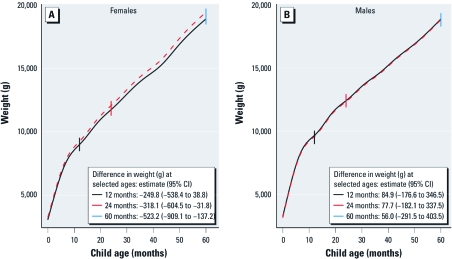
Results: After controlling for breast-feeding duration, maternal anthropometry, and sociodemographic characteristics, a 1-SD increase in maternal patella lead (micrograms per gram) was associated with a 130.9-g decrease in weight [95% confidence interval (CI), -227.4 to -34.4 g] among females and a 13.0-g nonsignificant increase in weight among males (95% CI, -73.7 to 99.9 g) at 5 years of age. These associations were similar after controlling for concurrent blood lead levels between birth and 5 years.
Conclusions: Maternal bone lead was associated with lower weight over time among female but not male children up to 5 years of age. Given that the association was evident for patellar but not tibial lead levels, and was limited to females, results need to be confirmed in other studies.
Conflict of interest statement
The contents of this article are solely the responsibility of the authors and do not necessarily represent the official views of the NIEHS, National Institutes of Health, or the U.S. EPA.
The authors declare they have no actual or potential competing financial interests.
Figures
References
-
- Andrews KW, Savitz DA, Hertz-Picciotto I. Prenatal lead exposure in relation to gestational age and birth weight: a review of epidemiologic studies. Am J Ind Med. 1994;26(1):13–32. - PubMed
-
- Aro AC, Todd AC, Amarasiriwardena C, Hu H. Improvements in the calibration of 109Cd K X-ray fluorescence systems for measuring bone lead in vivo. Phys Med Biol. 1994;39(12):2263–2271. - PubMed
-
- Ballew C, Khan LK, Kaufmann R, Mokdad A, Miller DT, Gunter EW. Blood lead concentration and children’s anthropometric dimensions in the Third National Health and Nutrition Examination Survey (NHANES III), 1988–1994. J Pediatr. 1999;134(5):623–630. - PubMed
-
- Barker DJ. Adult consequences of fetal growth restriction. Clin Obstet Gynecol. 2006;49(2):270–283. - PubMed
-
- Binkin NJ, Yip R, Fleshood L, Trowbridge FL. Birth weight and childhood growth. Pediatrics. 1988;82(6):828–834. - PubMed
Publication types
MeSH terms
Substances
Grants and funding
- P30ES017885/ES/NIEHS NIH HHS/United States
- P01 ES012874/ES/NIEHS NIH HHS/United States
- P20 ES018171/ES/NIEHS NIH HHS/United States
- P20 ES018171/RD834800/ES/NIEHS NIH HHS/United States
- R01 ES007821/ES/NIEHS NIH HHS/United States
- R01 ES013744/ES/NIEHS NIH HHS/United States
- P42-ES05947/ES/NIEHS NIH HHS/United States
- P42 ES005947/ES/NIEHS NIH HHS/United States
- R01 ES014930/ES/NIEHS NIH HHS/United States
- T32 DK 007703-16/DK/NIDDK NIH HHS/United States
- P30 ES017885/ES/NIEHS NIH HHS/United States
- T32 DK007703/DK/NIDDK NIH HHS/United States
- K23 ES000381/ES/NIEHS NIH HHS/United States
- R01-ES007821/ES/NIEHS NIH HHS/United States
LinkOut - more resources
Full Text Sources
Medical