


Piriformis muscle: clinical anatomy with computed tomography in korean population
- PMID: 21716616
- PMCID: PMC3111565
- DOI: 10.3344/kjp.2011.24.2.87
Piriformis muscle: clinical anatomy with computed tomography in korean population
Abstract
Background: The objective was to evaluate the distance from the skin and the diameter of the piriformis muscle and their relationship to the body mass index (BMI).
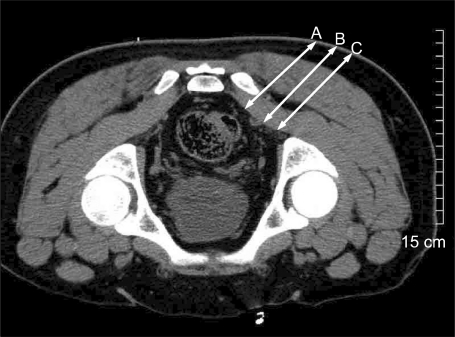
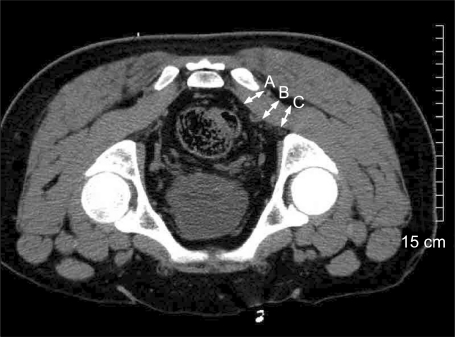
Methods: The study was a prospective study involving 60 patients. Patients were prepared on a radiological table in the prone position. Several images were obtained of each. In this view, the distance between the subcutaneous tissue and the piriformis muscle, and the diameter of the piriformis, were measured at three points (medially to laterally).
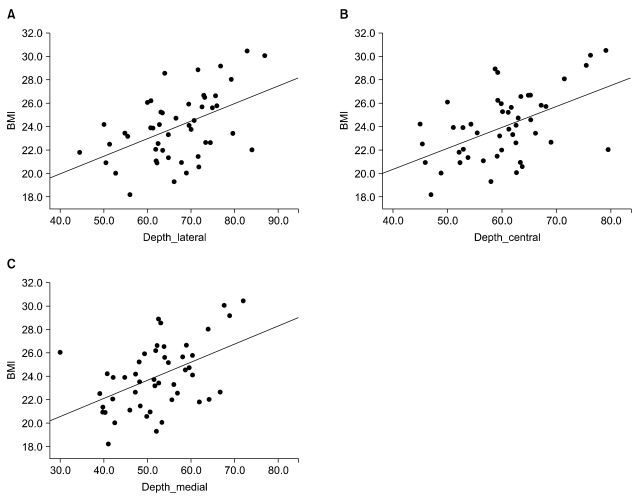
Results: The distance to the piriformis from the skin was 6.6 ± 0.9 cm, 6.3 ± 0.8 cm, and 5.2 ± 0.9 cm in terms of the lateral, center, and medial measurement, respectively. The center of the piriformis had a greater diameter with 1.7 ± 0.4 (0.9-2.5) cm. The distance to the piriformis increased with BMI.
Conclusions: This study shows that the lateral of the piriformis muscle has a relatively greater distance from the skin. The center of the piriformis showed a greater diameter than other two portions. We found that the distance of the piriformis from subcutaneous tissues was correlated with BMI, but the diameter of the piriformis was not affected by BMI. These measurements can be used as a reference for determining the piriformis injection site in patients with piriformis syndrome.
Keywords: CT; anatomy; muscle; piriformis.
Figures
References
-
- Ozaki S, Hamabe T, Muro T. Piriformis syndrome resulting from an anomalous relationship between the sciatic nerve and piriformis muscle. Orthopedics. 1999;22:771–772. - PubMed
-
- Hallin RP. Sciatic pain and the piriformis muscle. Postgrad Med. 1983;74:69–72. - PubMed
-
- Parziale JR, Hudgins TH, Fishman LM. The piriformis syndrome. Am J Orthop (Belle Mead NJ) 1996;25:819–823. - PubMed
-
- Chen WS. Bipartite piriformis muscle: an unusual cause of sciatic nerve entrapment. Pain. 1994;58:269–272. - PubMed
LinkOut - more resources
Full Text Sources