


Sodium metabisulfite-induced polymerization of sickle cell hemoglobin incubated in the extracts of three medicinal plants (Anacardium occidentale, Psidium guajava, and Terminalia catappa)
- PMID: 21716622
- PMCID: PMC3113351
- DOI: 10.4103/0973-1296.80670
Sodium metabisulfite-induced polymerization of sickle cell hemoglobin incubated in the extracts of three medicinal plants (Anacardium occidentale, Psidium guajava, and Terminalia catappa)
Abstract
Background: The exploitation and utilization of vast varieties of herbal extracts may serve as alternative measures to deter aggregation of deoxygenated sickle cell hemoglobin (deoxyHbS) molecules.
Objective: The present in vitro study ascertained the capacity of three medicinal plants, namely, Anacardium occidentale, Psidium guajava, and Terminalia catappa, to alter polymerization of HbS.
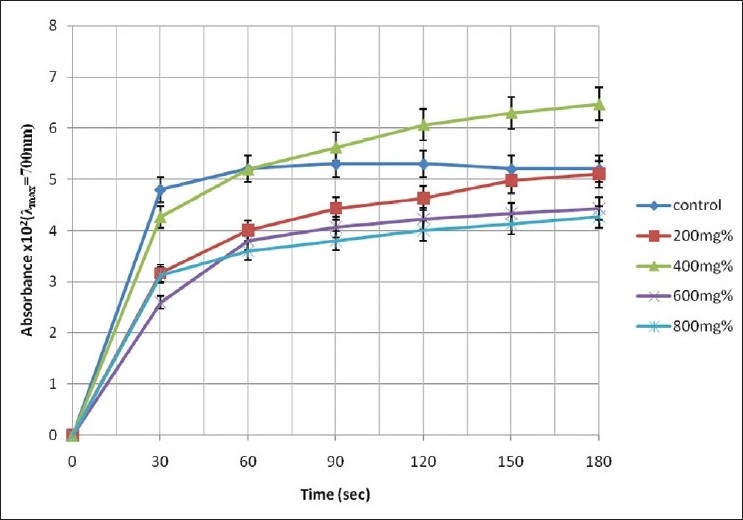
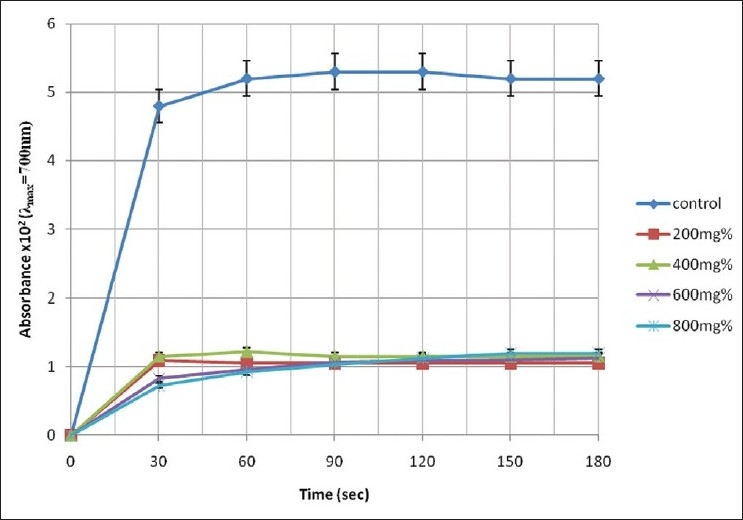
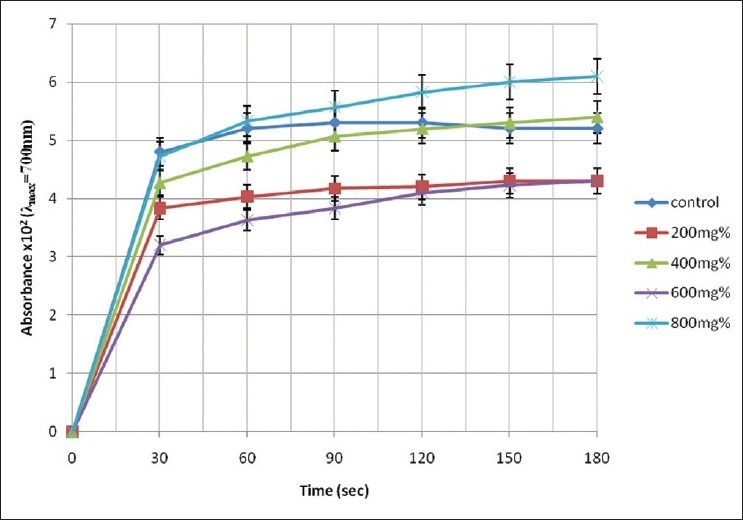
Materials and methods: Spectrophotometric method was used to monitor the level of polymerization of hemolysate HbS molecules treated with sodium metabisulfite (Na(2) S(2) O(5)) at a regular interval of 30 s for a period of 180 s in the presence of separate aqueous extracts of A. occidentale, P. guajava, and T. catappa. At time intervals of 30 s, the level of polymerization was expressed as percentage of absorbance relative to the control sample at the 180th s.
Results: Although extracts of the three medicinal plants caused significant (P < 0.05) reduction in polymerization of deoxyHbS molecules, the corresponding capacity in this regard diminished with increase in incubation time. Aqueous extract of P. guajava exhibited the highest capacity to reduced polymerization of deoxyHbS molecules. Whereas at t > 60 s, extract concentration of 400 mg% of A. occidentale activated polymerization of deoxyHbS molecules by 6.23±1.34, 14.53±1.67, 21.15±1.89, and 24.42±1.09%, 800 mg% of T. catappa at t > 30 s gave values of 2.50±1.93, 5.09±1.96, 10.00±0.99, 15.38±1.33, and 17.31±0.97%.
Conclusion: The capacity of the three medicinal plants to interfere with polymerization of deoxyHbS molecules depended on the duration of incubation and concentration of the extracts.
Keywords: A. occidentale; DeoxyHbS; P. guajava; Polymerization; T. catappa.
Conflict of interest statement
Figures
References
-
- Taylor L. The Healing Power of Rainforest Herbs. 2005. Available from: http://www.rain-tree.com/book2.htm. [retrieved on 2010 Aug 16]
-
- Bicalho B, Rezende CM. Volatile compounds of cashew apple (Anacardium occidentale L.) Z. Naturforsch. 2001;56:35–9. - PubMed
-
- Mota ML, Thomas G, Barbosa-filho JM. Anti-inflammatory actions of tannins isolated from the bark of Anacardium occidentale L. J Ethnopharmacol. 1985;13:289–300. - PubMed
-
- Kudi AC, Umoh JU, Eduvic LO, Getu J. Screening of some Nigerian medicinal plants for antibacterial activity. J Ethanopharm. 1999;67:225–8. - PubMed
-
- Kubo I, Kinst-Hori I, Yokokawa Y. Tyrosinase inhibitors from Anacardium occidentale fruits. J Nat Prod. 1994;57:545–51. - PubMed
LinkOut - more resources
Full Text Sources
Other Literature Sources