


doi: 10.1155/2011/159541.
Epub 2011 May 22.
The psoas compartment block for hip surgery: the past, present, and future
Affiliations
- PMID: 21716721
- PMCID: PMC3119414
- DOI: 10.1155/2011/159541
Item in Clipboard
The psoas compartment block for hip surgery: the past, present, and future
Anesthesiol Res Pract.
2011.
Abstract
A posterior lumbar plexus block or psoas compartment block (PCB) is an effective locoregional anesthetic technique for analgesia and anesthesia of the entire lower extremity including the hip. Since the first description in the early seventies, this technique has been modified based on advanced knowledge of the anatomical localization of the lumbar plexus and the improvement of technical equipment. This paper provides an overview of the history, clinical efficacy, and risk profile of the PCB focused on hip surgery. Current status and future expectations are discussed.
Figures
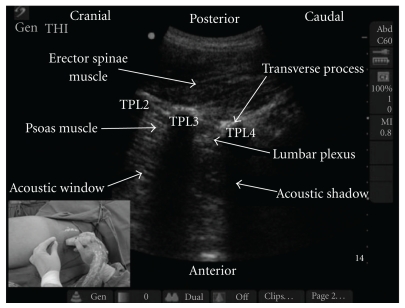
Longitudinal sonogram of the lumbar paravertebral region showing an optimal scan for lumbar plexus block. Picture in the inset shows the orientation of the ultrasound transducer and the direction in which the needle is introduced (long axis) during an ultrasound-guided lumbar plexus block. TP: transverse process. (picture used with permission from [20].
References
-
- Koller C. On the use of cocaine for producing anaesthesia on the eye. The Lancet. 1884;2:990–992.
-
- Bier A. Versuche über cocainisirung des rückenmarkes. Deutsche Zeitschrift für Chirurgie. 1899;51(3-4):361–369.
-
- Winnie AP, Ramamurthy S, Durrani Z. The inguinal paravascular technic of lumbar plexus anesthesia: the “3 in 1 block”. Anesthesia and Analgesia. 1973;52(6):989–996. - PubMed
-
- Winnie AP, Ramamurthy S, Durrani Z, Radonjic R. Plexus blocks for lower extremity surgery: new answers to old problems. Anesthesiology Review. 1974;1:11–16.
-
- Chayen D, Nathan H, Chayen M. The psoas compartment block. Anesthesiology. 1976;45(1):95–99. - PubMed
LinkOut - more resources
Full Text Sources
Other Literature Sources
Miscellaneous
