. 2012 Jun 1;130(11):2672-84.
doi: 10.1002/ijc.26269. Epub 2011 Aug 24.

Health and economic impact of HPV 16/18 vaccination and cervical cancer screening in Eastern Africa

Affiliations

Health and economic impact of HPV 16/18 vaccination and cervical cancer screening in Eastern Africa

Nicole G Campos et al. Int J Cancer. .

Abstract

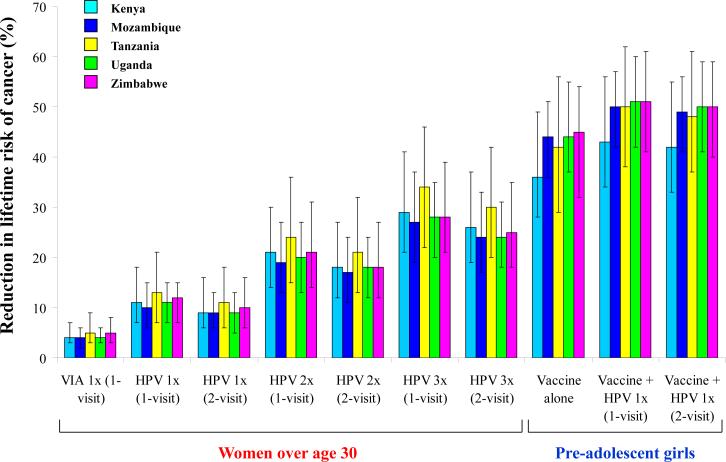
Eastern Africa has the world's highest cervical cancer incidence and mortality rates. We used epidemiologic data from Kenya, Mozambique, Tanzania, Uganda, and Zimbabwe to develop models of HPV-related infection and disease. For each country, we assessed HPV vaccination of girls before age 12 followed by screening with HPV DNA testing once, twice, or three times per lifetime (at ages 35, 40, 45). For women over age 30, we assessed only screening (with HPV DNA testing up to three times per lifetime or VIA at age 35). Assuming no waning immunity, mean reduction in lifetime cancer risk associated with vaccination ranged from 36 to 45%, and vaccination followed by screening once per lifetime at age 35 with HPV DNA testing ranged from 43 to 51%. For both younger and older women, the most effective screening strategy was HPV DNA testing three times per lifetime. Provided the cost per vaccinated girl was less than I$10 (I$2 per dose), vaccination had an incremental cost-effectiveness ratio [I$ (international dollars)/year of life saved (YLS)] less than the country-specific per capita GDP, a commonly cited heuristic for "very cost-effective" interventions. If the cost per vaccinated girl was between I$10 (I$2 per dose) and I$25 (I$5 per dose), vaccination followed by HPV DNA testing would save the most lives and would be considered good value for public health dollars. These results should be used to catalyze design and evaluation of HPV vaccine delivery and screening programs, and contribute to a dialogue on financing HPV vaccination in poor countries.


Figures

Figure 1
Figure 1. Reduction in lifetime risk of cancer attributable to selected vaccination and screening strategies
Colored vertical bars represent the mean reduction in lifetime risk of cancer (on the y-axis) for selected strategies (on the x-axis) in each country (light blue: Kenya; dark blue: Mozambique; yellow: Tanzania; green: Uganda; pink: Zimbabwe). Error bars represent the range of uncertainty in cancer reduction based on the 50 top-fitting parameter sets in each country. VIA = visual inspection with acetic acid; HPV = HPV DNA testing; 1x = screening once per lifetime at age 35; 2x = screening twice per lifetime at ages 35 and 40; 3x = screening three times per lifetime at ages 35, 40, and 45.
Figure 2
Figure 2. Impact of vaccine effectiveness and coverage level on reduction in lifetime risk of cancer in Kenya
Colored vertical bars represent the mean reduction in cancer risk (on the y-axis) at different levels of overall vaccine effectiveness (60-100%, on the x-axis) for varying levels of vaccination coverage (i.e., proportion of the target population that receives at least one dose of vaccine) (blue, 25%; purple, 50%; pink, 75%). Error bars represent the range of uncertainty in cancer reduction based on the 50 top-fitting parameter sets. Overall vaccine effectiveness is a function of per-dose efficacy and the attrition rate following each dose (e.g., for an attrition rate of 40%: of the girls who received at least one dose, 40% received only the first dose, 24% received two doses, and 36% received three doses). For example, an overall vaccine effectiveness of approximately 60% would be realized with a vaccine conferring 100% efficacy with administration of 3 doses, 50% for 2 doses, and no benefit for 1 dose, and an attrition rate of 40% between each dose. The table at the top of the graph describes scenarios that yield costs, benefits, and reduction in cancer risk similar to each corresponding level of overall effectiveness shown.
Figure 3
Figure 3. Impact of vaccination coverage and screening coverage on reduction in the lifetime risk of cancer and the incremental cost-effectiveness ratio of vaccination followed by one screening per lifetime with one-visit HPV DNA testing (comparator: vaccine alone; cost per vaccinated girl: I$10), Uganda
Colored vertical bars represent mean reduction in lifetime risk of cancer (on the primary y-axis) at different levels of vaccination coverage (25-75%, on the x-axis) and screening coverage (green, 25%; blue, 50%; pink, 75%). Error bars represent the range of uncertainty in cancer reduction based on the 50 top-fitting parameter sets. Lines with colors corresponding to level of screening coverage represent the incremental cost-effectiveness ratio (on the secondary y-axis) at different levels of vaccination coverage. The dashed black line represents a threshold of 30% cancer reduction. ICER=incremental cost-effectiveness ratio; YLS = years of life saved.

References

    1. Ferlay J, Shin HR, Bray F, Forman D, Mathers C, Parkin DM. GLOBOCAN 2008, Cancer incidence and mortality worldwide: IARC CancerBase No. 10. International Agency for Research on Cancer; Lyon, France: 2010. [September 22, 2010]. Available online at http://globocan.iarc.fr.
    1. Smith JS, Lindsay L, Hoots B, Keys J, Franceschi S, Winer R, Clifford GM. Human papillomavirus type distribution in invasive cervical cancer and high-grade cervical lesions: a meta-analysis update. Int J Cancer. 2007;121:621–32. - PubMed
    1. World Health Organization (WHO)/Institute Català d'Oncologia (ICO) Information Centre on HPV and Cervical Cancer (HPV Information Centre) [September 22, 2010];Summary report on HPV and cervical cancer statistics in Africa. 2010 Available online at www.who.int/hpvcentre.
    1. Chirenje ZM, Rusakaniko S, Kirumbi L, Ngwalle EW, Makuta-Tlebere P, Kaggwa S, Mpanju-Shumbusho W, Makoae L. Situation analysis for cervical cancer diagnosis and treatment in East, Central, and Southern African countries. Bull World Health Organ. 2001;79:127–32. - PMC - PubMed
    1. Denny L, Quinn M, Sankaranarayanan R. Chapter 8: Screening for cervical cancer in developing countries. Vaccine. 2006;24:S71–7. - PubMed

Publication types