


Early fasciotomy in patients with extremity vascular injury is associated with decreased risk of adverse limb outcomes: a review of the National Trauma Data Bank
- PMID: 21719009
- PMCID: PMC3777619
- DOI: 10.1016/j.injury.2011.06.006
Early fasciotomy in patients with extremity vascular injury is associated with decreased risk of adverse limb outcomes: a review of the National Trauma Data Bank
Abstract
Introduction and objectives: Lower extremity (LE) arterial trauma and its treatment may lead to extremity compartment syndrome (ECS). In that setting, the decision to perform fasciotomies is multifactoral and is not well delineated. We evaluated the outcomes of patients with surgically treated LE arterial injury who underwent early or delayed fasciotomies.
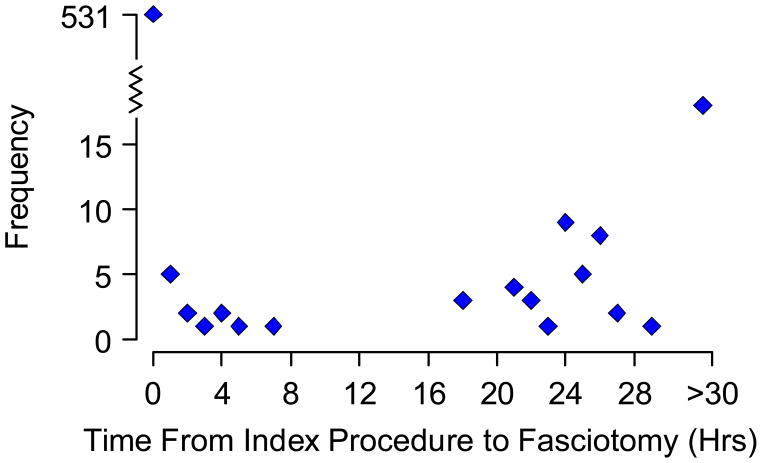
Methods: The National Trauma Data Bank (NTDB) was retrospectively reviewed for patients who had LE arterial trauma and underwent both open vascular repair and fasciotomies. Exclusion criteria were additional non-LE vascular trauma, head or spinal cord injuries, crush injuries, burn injuries, and declaration of death on arrival. Patients were divided into those who had fasciotomies performed within 8h (early group) or >8h after open vascular repair (late group). Comparative analyses of demographics, injury characteristics, complications, and outcomes were performed.
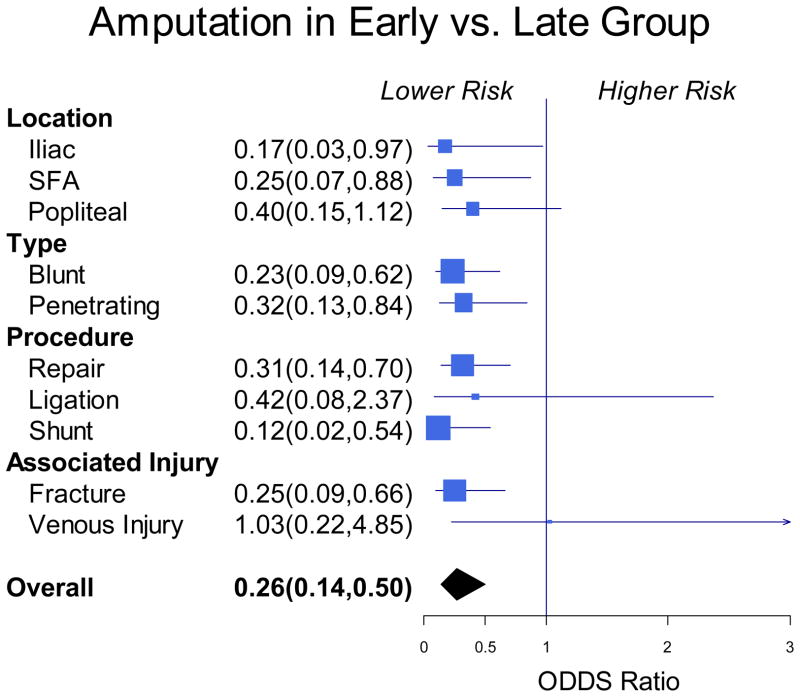
Results: Of the 1469 patient admissions with lower extremity arterial trauma that met inclusion criteria there were 612 patients (41.7%) who underwent fasciotomies. There were 543 and 69 patients in the early and late fasciotomy groups, respectively. There was no significant difference in age, injury severity, mechanism of injury, associated injuries, and type of vascular repair between the groups. A higher rate of iliac artery injury was observed in the late fasciotomy group (23.2% vs. 5.9%, P<.001). Patients in the early fasciotomy group had lower amputation rate (8.5% vs. 24.6%, P<.001), lower infection rate (6.6% vs. 14.5%, P = .028) and shorter total hospital stay (18.5 ± 20.7 days vs. 24.2 ± 14.7 days, P = .007) than those in the late fasciotomy group. On multivariable analysis, early fasciotomy was associated with a 4-fold lower risk of amputation (Odds Ratio 0.26, 95% CI 0.14-0.50, P<.0001) and 23% shorter hospital LOS (Means Ratio 0.77, 95% CI 0.64-0.94, P = .01).
Conclusion: Early fasciotomy is associated with improved outcomes in patients with lower extremity vascular trauma treated with surgical intervention. Our findings suggest that appropriate implementation of early fasciotomy may reduce amputation rates in extremity arterial injury.
Copyright © 2011 Elsevier Ltd. All rights reserved.
Figures
References
-
- MacGowan W. Acute ischaemia complicating limb trauma. J Bone Joint Surg Br. 1968;50:472–81. - PubMed
-
- Williams AB, Luchette FA, Papaconstantinou HT, Lim E, Hurst JM, Johannigman JA, et al. The effect of early versus late fasciotomy in the management of extremity trauma. Surgery. 1997;122:861–6. - PubMed
-
- Guerrero A, Gibson K, Kralovich KA, Pipinos I, Agnostopolous P, Carter Y, et al. Limb loss following lower extremity arterial trauma: what can be done proactively? Injury. 2002;33:765–9. - PubMed
-
- Finkelstein JA, Hunter GA, Hu RW. Lower limb compartment syndrome: course after delayed fasciotomy. J Trauma. 1996;40:342–4. - PubMed
-
- Heemskerk J, Kitslaar P. Acute compartment syndrome of the lower leg: retrospective study on prevalence, technique, and outcome of fasciotomies. World J Surg. 2003;27:744–7. - PubMed
MeSH terms
Grants and funding
LinkOut - more resources
Full Text Sources
Medical
Miscellaneous
