


Activation of p38 mitogen-activated protein kinase promotes peritoneal fibrosis by regulating fibrocytes
- PMID: 21719683
- PMCID: PMC3525367
- DOI: 10.3747/pdi.2010.00200
Activation of p38 mitogen-activated protein kinase promotes peritoneal fibrosis by regulating fibrocytes
Abstract
Background: Peritoneal fibrosis is a serious complication of long-term peritoneal dialysis, and yet the precise pathogenic mechanisms of peritoneal fibrosis remain unknown. Fibrocytes participate in tissue fibrosis and express chemokine receptors that are necessary for migration. The p38 mitogen-activated protein kinase (MAPK) pathway regulates the production of chemokines and has been demonstrated to contribute to the pathogenesis of various fibrotic conditions. Accordingly, we used an experimental mouse model of peritoneal fibrosis to examine the dependency of fibrocytes on p38MAPK signaling.
Methods: Peritoneal fibrosis was induced in mice by the injection of 0.1% chlorhexidine gluconate (CG) into the abdominal cavity. Mice were treated with FR167653, a specific inhibitor of p38MAPK, and immunohistochemical studies were performed to detect fibrocytes and cells positive for phosphorylated p38MAPK. The involvement of p38MAPK in the activation of fibrocytes also was also investigated in vitro.
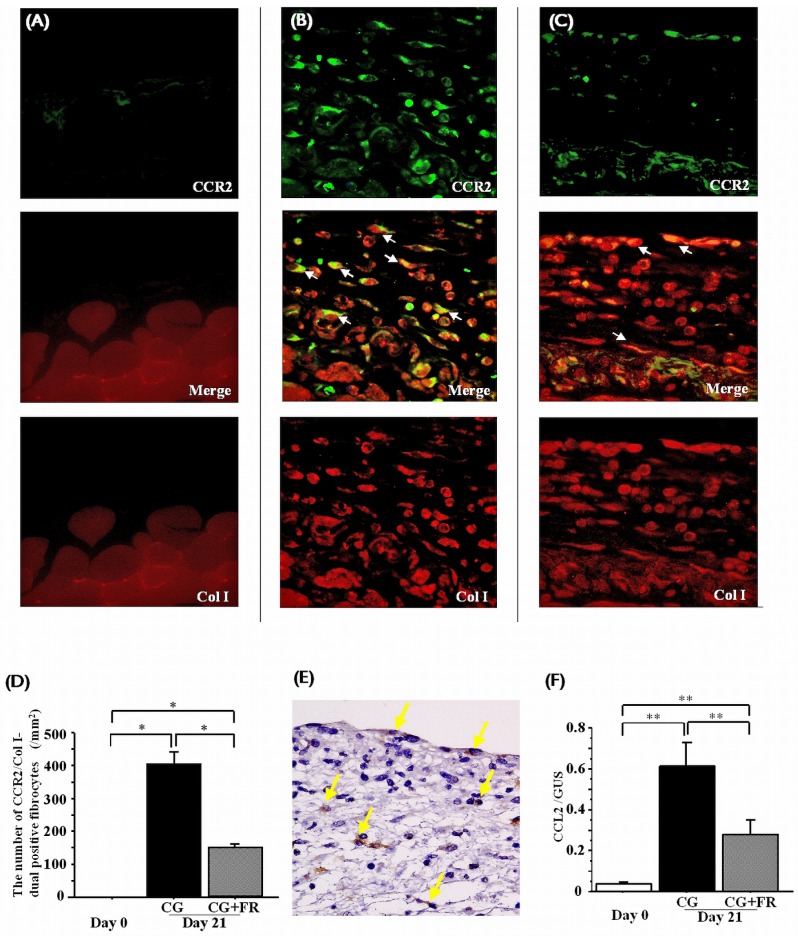
Results: Fibrocytes infiltrated peritoneum in response to CG, and that response was accompanied by progressive peritoneal fibrosis. The phosphorylation of p38MAPK, as defined by CD45+ spindle-shaped cells, was detected both in peritoneal mesothelial cells and in fibrocytes. The level of peritoneal expression of CCL2, a chemoattractant for fibrocytes, was upregulated by CG injection, and treatment with FR167653 reduced the number of cells positive for phosphorylated p38MAPK, the peritoneal expression of CCL2, and the extent of peritoneal fibrosis. Pretreatment with FR167653 inhibited the expression of procollagen type I α1 induced by transforming growth factor-β1.
Conclusions: Our results suggest that p38MAPK signaling contributes to peritoneal fibrosis by regulating fibrocyte function.
Figures




Comment in
-
A role for fibrocytes in peritoneal fibrosis?Perit Dial Int. 2012 Jan-Feb;32(1):4-6. doi: 10.3747/pdi.2011.00071. Perit Dial Int. 2012. PMID: 22302922 Free PMC article. No abstract available.
References
-
- Selgas R, Fernandez–Reyes MJ, Bosque E, Bajo MA, Borrego F, Jimenez C, et al. Functional longevity of the human peritoneum: how long is continuous peritoneal dialysis possible? Results of a prospective medium long-term study. Am J Kidney Dis 1994; 23:64–73 - PubMed
-
- Davies SJ, Bryan J, Phillips L, Russell GI. Longitudinal changes in peritoneal kinetics: the effects of peritoneal dialysis and peritonitis. Nephrol Dial Transplant 1996; 11:498–506 - PubMed
-
- Cnossen TT, Konings CJ, Kooman JP, Lindholm B. Peritoneal sclerosis—aetiology, diagnosis, treatment and prevention. Nephrol Dial Transplant 2006; 21(Suppl 2):ii38–41 - PubMed
Publication types
MeSH terms
Substances
LinkOut - more resources
Full Text Sources
Other Literature Sources
Research Materials
Miscellaneous
