


Reduced phase-advance of plasma melatonin after bright morning light in the luteal, but not follicular, menstrual cycle phase in premenstrual dysphoric disorder: an extended study
- PMID: 21721857
- PMCID: PMC3377494
- DOI: 10.3109/07420528.2011.567365
Reduced phase-advance of plasma melatonin after bright morning light in the luteal, but not follicular, menstrual cycle phase in premenstrual dysphoric disorder: an extended study
Abstract
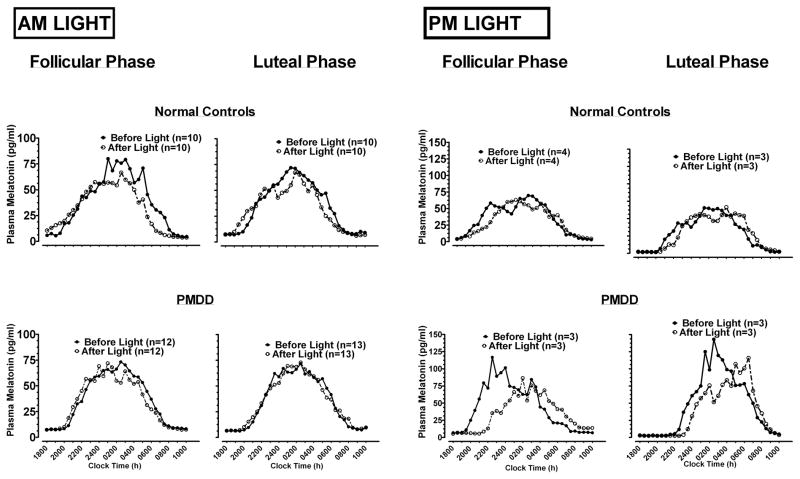
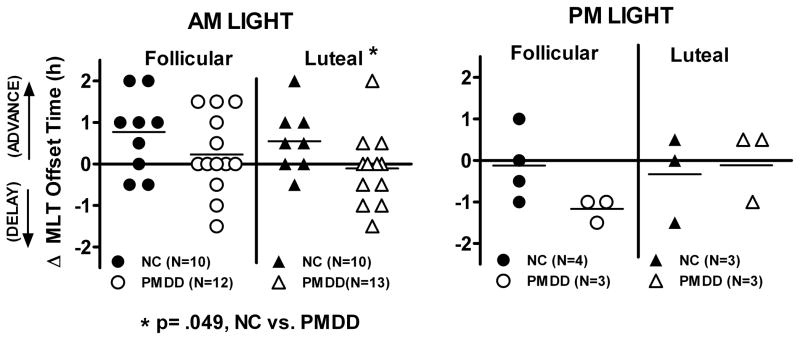
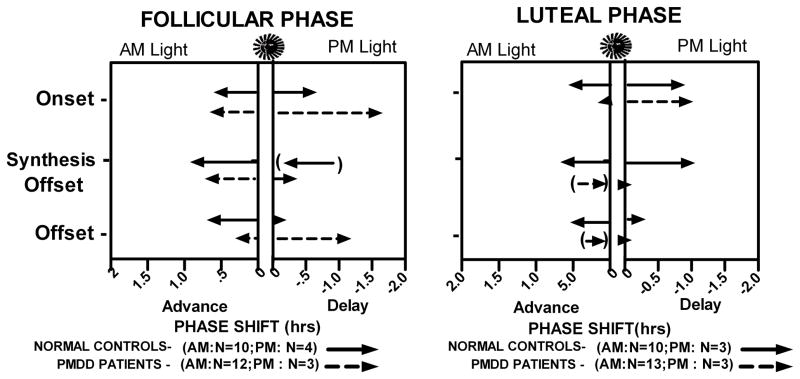
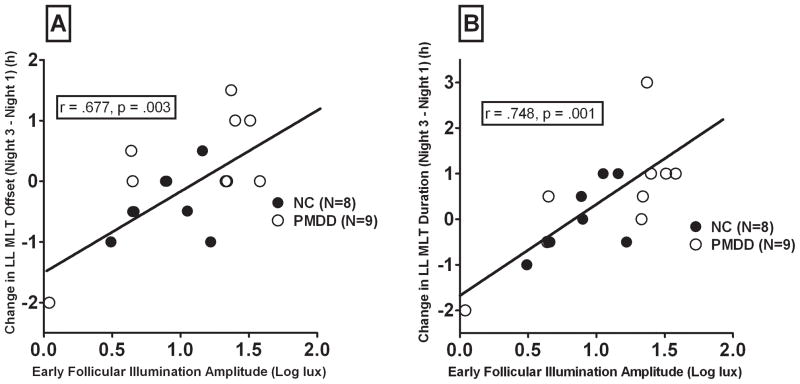
The authors previously observed blunted phase-shift responses to morning bright light in women with premenstrual dysphoric disorder (PMDD). The aim of this study was to determine if these findings could be replicated using a higher-intensity, shorter-duration light pulse and to compare these results with the effects of an evening bright-light pulse. In 17 PMDD patients and 14 normal control (NC) subjects, the authors measured plasma melatonin at 30-min intervals from 18:00 to 10:00 h in dim (<30 lux) or dark conditions the night before (Night 1) and after (Night 3) a bright-light pulse (administered on Night 2) in both follicular and luteal menstrual cycle phases. The bright light (either 3000 lux for 6 h or 6000 lux for 3 h) was given either in the morning (AM light), 7 h after the dim light melatonin onset (DLMO) measured the previous month, or in the evening (PM light), 3 h after the DLMO. In the luteal, but not in the follicular, phase, AM light advanced melatonin offset between Night 1 and Night 3 significantly less in PMDD than in NC subjects. The effects of PM light were not significant, nor were there significant effects of the light pulse on melatonin measures of onset, duration, peak, or area under the curve. These findings replicated the authors' previous finding of a blunted phase-shift response to morning bright light in the luteal, but not the follicular, menstrual cycle phase in PMDD compared with NC women, using a brighter (6000 vs. 3000 lux) light pulse for a shorter duration (3 vs. 6 h). As the effect of PM bright light on melatonin phase-shift responses did not differ between groups or significantly alter other melatonin measures, these results suggest that in PMDD there is a luteal-phase subsensitivity or an increased resistance to morning bright-light cues that are critical in synchronizing human biological rhythms. The resulting circadian rhythm malsynchonization may contribute to the occurrence of luteal phase depressive symptoms in women with PMDD.
Figures
References
-
- Anderson DC, Hopper BR, Lasley BL, Yen SS. A simple method for the assay of eight steroids in small volumes of plasma. Steroids. 1976;28:179–96. - PubMed
-
- APA. Diagnostic and Statistical Manual of Mental Disorders. 4. American Psychiatric Association; Washington, D. C: 1994.
-
- Beck AT, Ward CH, Mendelson M, Mock J, Erbaugh J. An inventory for measuring depression. Arch Gen Psychiatry. 1961;4:561–71. - PubMed
Publication types
MeSH terms
Substances
Grants and funding
LinkOut - more resources
Full Text Sources
Medical
Research Materials
