


The impact of the aging population on coronary heart disease in the United States
- PMID: 21722862
- PMCID: PMC3159777
- DOI: 10.1016/j.amjmed.2011.04.010
The impact of the aging population on coronary heart disease in the United States
Abstract
Background: The demographic shift toward an older population in the United States will result in a higher burden of coronary heart disease, but the increase has not been quantified in detail. We sought to estimate the impact of the aging US population on coronary heart disease.
Methods: We used the Coronary Heart Disease Policy Model, a Markov model of the US population between 35 and 84 years of age, and US Census projections to model the age structure of the population between 2010 and 2040.
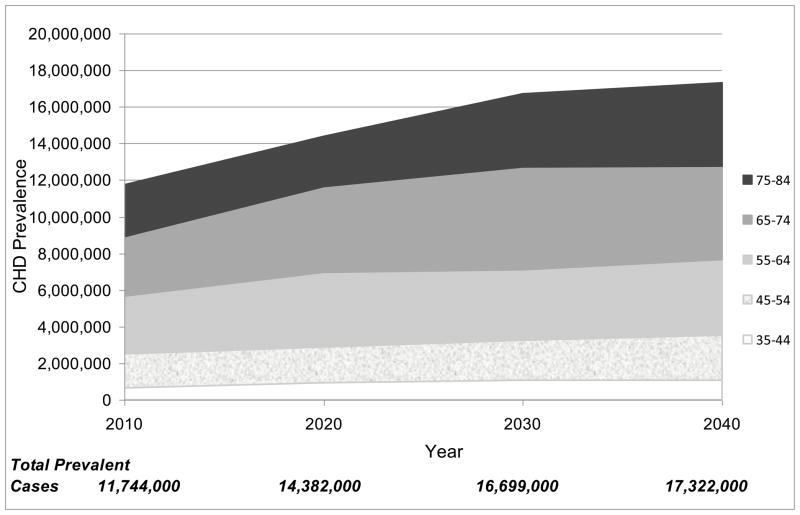
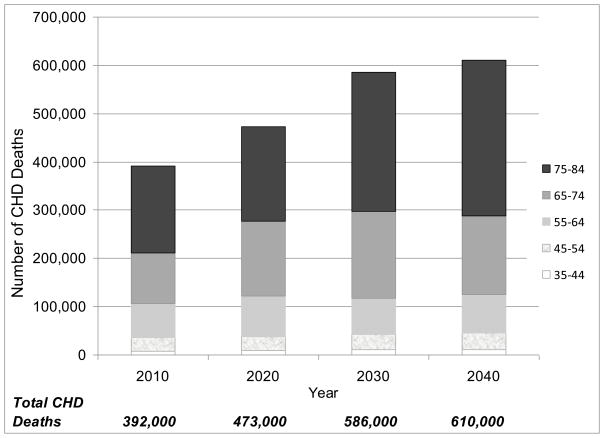
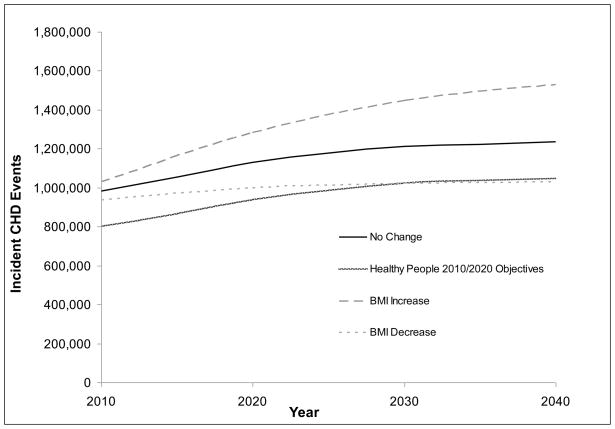
Results: Assuming no substantive changes in risks factors or treatments, incident coronary heart disease is projected to increase by approximately 26%, from 981,000 in 2010 to 1,234,000 in 2040, and prevalent coronary heart disease by 47%, from 11.7 million to 17.3 million. Mortality will be affected strongly by the aging population; annual coronary heart disease deaths are projected to increase by 56% over the next 30 years, from 392,000 to 610,000. Coronary heart disease-related health care costs are projected to rise by 41% from $126.2 billion in 2010 to $177.5 billion in 2040 in the United States. It may be possible to offset the increase in disease burden through achievement of Healthy People 2010/2020 objectives or interventions that substantially reduce obesity, blood pressure, or cholesterol levels in the population.
Conclusions: Without considerable changes in risk factors or treatments, the aging of the US population will result in a sizeable increase in coronary heart disease incidence, prevalence, mortality, and costs. Health care stakeholders need to plan for the future age-related health care demands of coronary heart disease.
Copyright © 2011 Elsevier Inc. All rights reserved.
Figures
References
-
- Centers for Disease Control and Prevention. Trends in Aging - United States and Worldwide. MMWR. 2003;52:101–106. - PubMed
-
- U.S. Census Bureau. US Interim Projections by Age, Sex, Race, and Hispanic Origin 2008. Vol. 2009. 2008.
-
- Heron M, Hoyert DL, Murphy SL, et al. Deaths: Final Data for 2006. National Vital Statistics Reports 2009. 57(14) - PubMed
-
- Goldman L. Cost-effectiveness perspectives in coronary heart disease. Am Heart J. 1990;119(3 Pt 2):733–9. discussion 739–40. - PubMed
Publication types
MeSH terms
Grants and funding
LinkOut - more resources
Full Text Sources
