


Indoor air pollution and blood pressure in adult women living in rural China
- PMID: 21724522
- PMCID: PMC3230444
- DOI: 10.1289/ehp.1003371
Indoor air pollution and blood pressure in adult women living in rural China
Abstract
Background: Almost half of the world's population uses coal and biomass fuels for domestic energy. Limited evidence suggests that exposure to air pollutants from indoor biomass combustion may be associated with elevated blood pressure (BP).
Objective: Our aim was to assess the relationship between air pollution exposure from indoor biomass combustion and BP in women in rural China.
Methods: We measured 24-hr personal integrated gravimetric exposure to fine particles < 2.5 µm in aerodynamic diameter (PM2.5) and systolic BP (SBP) and diastolic BP (DBP) in the winter and summer among 280 women ≥ 25 years of age living in rural households using biomass fuels in Yunnan, China. We investigated the association between PM2.5 exposure and SBP and DBP using mixed-effects models with random intercepts to account for correlation among repeated measures.
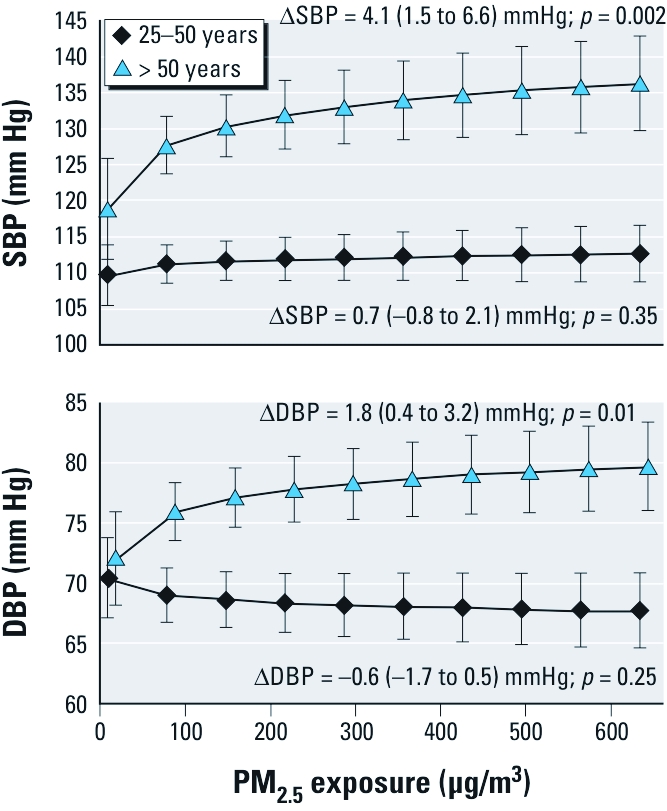
Results: Personal average 24-hr exposure to PM2.5 ranged from 22 to 634 µg/m3 in winter and from 9 to 492 µg/m3 in summer. A 1-log-µg/m3 increase in PM2.5 exposure was associated with 2.2 mm Hg higher SBP [95% confidence interval (CI), 0.8 to 3.7; p = 0.003] and 0.5 mm Hg higher DBP (95% CI, -0.4 to 1.3; p = 0.31) among all women; estimated effects varied by age group. Among women > 50 years of age, a 1-log-µg/m3 increase in PM2.5 exposure was associated with 4.1 mm Hg higher SBP (95% CI, 1.5 to 6.6; p = 0.002) and 1.8 mm Hg higher DBP (95% CI, 0.4 to 3.2; p = 0.01). PM2.5 exposure was positively associated with SBP among younger women, but the association was not statistically significant.
Conclusion: PM2.5 exposure from biomass combustion may be a risk factor for elevated BP and hence for cardiovascular events. Our findings should be corroborated in longitudinal studies.
Conflict of interest statement
This article represents the authors’ views and not necessarily those of the sponsoring agencies. Mention of commercial products in the manuscript does not constitute endorsement or recommendation.
The authors declare they have no actual or potential competing financial interests.
Figures
Comment in
-
Indoor PM pollution and elevated blood pressure: cardiovascular impact of indoor biomass burning.Environ Health Perspect. 2011 Oct;119(10):A442. doi: 10.1289/ehp.119-a442b. Environ Health Perspect. 2011. PMID: 22069780 Free PMC article. No abstract available.
References
-
- Albalak R, Bruce N, McCracken JP, Smith KR, de Gallardo T. Indoor respirable particulate matter concentrations from an open fire, improved cookstove, and LPG/open fire combination in a rural Guatemalan community. Environ Sci Technol. 2001;35:2650–2655. - PubMed
-
- Barnoya J, Glantz SA. Cardiovascular effects of secondhand smoke: nearly as large as smoking. Circulation. 2005;111:2684–2698. - PubMed
-
- Barregard L, Sällsten G, Gustafson P, Andersson L, Johansson L, Basu S, et al. Experimental exposure to wood smoke particles in healthy humans: effects on markers of inflammation, coagulation and lipid peroxidation. Inhal Toxicol. 2006;18:845–853. - PubMed
-
- Bautista LE, Correa A, Baumgartner J, Breysse P, Matanoski GM. Indoor charcoal smoke and acute respiratory infections in young children in the Dominican Republic. Am J Epidemiol. 2009;169:572–580. - PubMed
Publication types
MeSH terms
Substances
LinkOut - more resources
Full Text Sources
Medical