


Review
doi: 10.1007/978-3-7091-0693-8_11.
Intracranial hemorrhage: mechanisms of secondary brain injury
Affiliations
- PMID: 21725733
- PMCID: PMC3285293
- DOI: 10.1007/978-3-7091-0693-8_11
Item in Clipboard
Review
Intracranial hemorrhage: mechanisms of secondary brain injury
Acta Neurochir Suppl.
2011.
Abstract
ICH is a disease with high rates of mortality and morbidity, with a substantial public health impact. Spontaneous ICH (sICH) has been extensively studied, and a large body of data has been accumulated on its pathophysiology. However, the literature on traumatic ICH (tICH) is limited, and further investigations of this important topic are needed. This review will highlight some of the cellular pathways in ICH with an emphasis on the mechanisms of secondary injury due to heme toxicity and to events in the coagulation process that are common to both sICH and tICH.
Conflict of interest statement
Figures
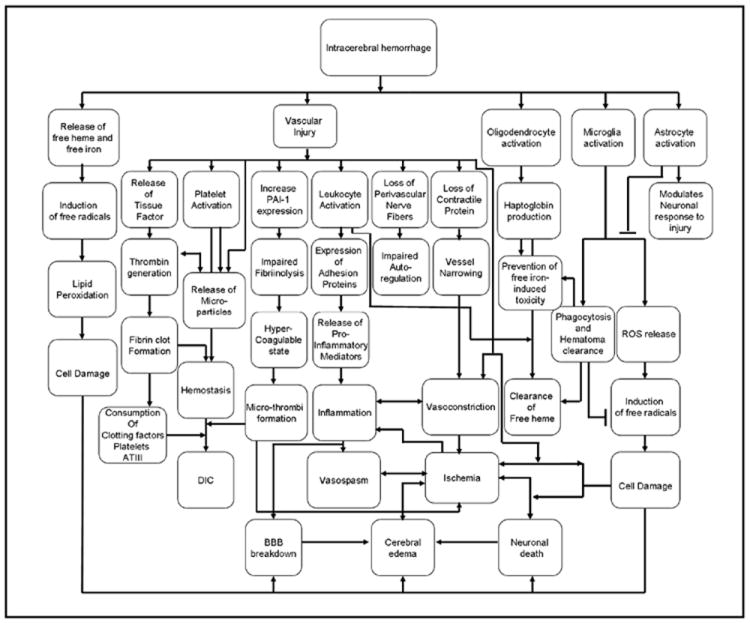
Representative pathways of secondary brain injury after ICH.
References
-
- Narayan RK, Maas AI, Servadei F, Skolnick BE, Tillinger MN, Marshall LF. Progression of traumatic intracerebral hemorrhage: a prospective observational study. J Neurotrauma. 2008;25:629–639. - PubMed
-
- White CL, Griffith S, Caron JL. Early progression of traumatic cerebral contusions: characterization and risk factors. J Trauma. 2009;67:508–514. discussion 514-505. - PubMed
-
- Wu HM, Huang SC, Hattori N, Glenn TC, Vespa PM, Hovda DA, Bergsneider M. Subcortical white matter metabolic changes remote from focal hemorrhagic lesions suggest diffuse injury after human traumatic brain injury. Neurosurgery. 2004;55:1306–1315. discussion 1316-1307. - PubMed
-
- Immonen RJ, Kharatishvili I, Grohn H, Pitkanen A, Grohn OH. Quantitative MRI predicts long-term structural and functional outcome after experimental traumatic brain injury. Neuroimage. 2009;45:1–9. - PubMed
Publication types
MeSH terms
Substances
Grants and funding
LinkOut - more resources
Full Text Sources