


Three new loci for determining x chromosome inactivation patterns
- PMID: 21726665
- PMCID: PMC3157618
- DOI: 10.1016/j.jmoldx.2011.05.003
Three new loci for determining x chromosome inactivation patterns
Abstract
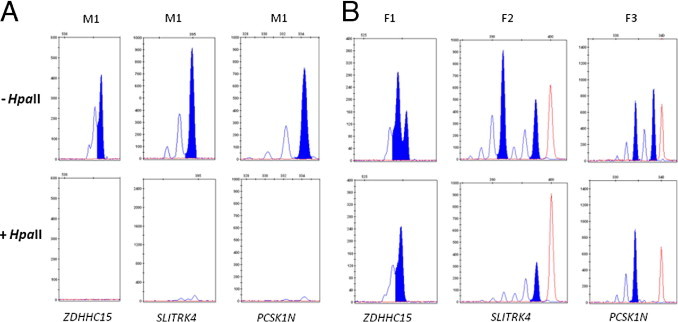
The analysis of X chromosome inactivation (XCI) patterns is a widely used diagnostic tool in clinical practice when investigating X-linked diseases. The most commonly used assay to determine XCI patterns takes advantage of a locus within the androgen receptor (AR) gene. This PCR-based assay relies on two differentially methylated restriction enzyme sites (HpaII) and a polymorphic repeat located within this locus. Although highly informative, this locus is not always sufficient to evaluate the X-inactivation status in X-linked disorders. We have identified three new loci that can be used to determine XCI patterns in a methylation-sensitive PCR-based assay. All three loci contain polymorphic repeats and a methylation-sensitive restriction enzyme (HpaII) site, methylation of which was shown to correlate with XCI. DNA from 60 females was used to estimate the heterozygosity of these new loci. The reliability of the loci was validated by showing a high correlation between the results obtained by employing the new loci and the AR locus using DNA from 15 females who were informative for all four loci. Altogether, we show that these loci can be applied easily in molecular diagnostic laboratories, either as a supplement or as an alternative to the existing AR assay.
Copyright © 2011. Published by Elsevier Inc.
Figures
References
-
- Lyon M.F. X-chromosome inactivation as a system of gene dosage compensation to regulate gene expression. Prog Nucleic Acid Res Mol Biol. 1989;36:119–130. - PubMed
-
- Orstavik K.H. X chromosome inactivation in clinical practice. Hum Genet. 2009;126:363–373. - PubMed
-
- Nelson D.L. NEMO, NFkappaB signaling and incontinentia pigmenti. Curr Opin Genet Dev. 2006;16:282–288. - PubMed
-
- Tefferi A., Thibodeau S.N., Solberg L.A., Jr Clonal studies in the myelodysplastic syndrome using X-linked restriction fragment length polymorphisms. Blood. 1990;75:1770–1773. - PubMed
MeSH terms
Substances
LinkOut - more resources
Full Text Sources
Research Materials
