


The research agenda in ICU telemedicine: a statement from the Critical Care Societies Collaborative
- PMID: 21729894
- PMCID: PMC3130530
- DOI: 10.1378/chest.11-0610
The research agenda in ICU telemedicine: a statement from the Critical Care Societies Collaborative
Abstract
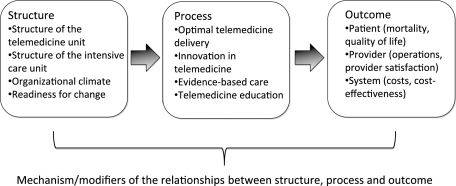
ICU telemedicine uses audiovisual conferencing technology to provide critical care from a remote location. Research is needed to best define the optimal use of ICU telemedicine, but efforts are hindered by methodological challenges and the lack of an organized delivery approach. We convened an interdisciplinary working group to develop a research agenda in ICU telemedicine, addressing both methodological and knowledge gaps in the field. To best inform clinical decision-making and health policy, future research should be organized around a conceptual framework that enables consistent descriptions of both the study setting and the telemedicine intervention. The framework should include standardized methods for assessing the preimplementation ICU environment and describing the telemedicine program. This framework will facilitate comparisons across studies and improve generalizability by permitting context-specific interpretation. Research based on this framework should consider the multidisciplinary nature of ICU care and describe the specific program goals. Key topic areas to be addressed include the effect of ICU telemedicine on the structure, process, and outcome of critical care delivery. Ideally, future research should attempt to address causation instead of simply associations and elucidate the mechanism of action in order to determine exactly how ICU telemedicine achieves its effects. ICU telemedicine has significant potential to improve critical care delivery, but high-quality research is needed to best inform its use. We propose an agenda to advance the science of ICU telemedicine and generate research with the greatest potential to improve patient care.
Figures
References
-
- Perednia DA, Allen A. Telemedicine technology and clinical applications. JAMA. 1995;273(6):483–488. - PubMed
-
- Groves RH, Jr, Holcomb BW, Jr, Smith ML. Intensive care telemedicine: evaluating a model for proactive remote monitoring and intervention in the critical care setting. Stud Health Technol Inform. 2008;131:131–146. - PubMed
-
- Angus DC, Shorr AF, White A, Dremsizov TT, Schmitz RJ, Kelley MA. Committee on Manpower for Pulmonary and Critical Care Societies (COMPACCS) Critical care delivery in the United States: distribution of services and compliance with Leapfrog recommendations. Crit Care Med. 2006;34(4):1016–1024. - PubMed
-
- Angus DC, Kelley MA, Schmitz RJ, White A, Popovich J., Jr Committee on Manpower for Pulmonary and Critical Care Societies (COMPACCS) Caring for the critically ill patient. Current and projected workforce requirements for care of the critically ill and patients with pulmonary disease: can we meet the requirements of an aging population? JAMA. 2000;284(21):2762–2770. - PubMed
-
- Yoo EJ, Dudley RA. Evaluating telemedicine in the ICU. JAMA. 2009;302(24):2705–2706. - PubMed
Publication types
MeSH terms
Grants and funding
LinkOut - more resources
Full Text Sources
Medical
