


Phylogenetic sequence variations in bacterial rRNA affect species-specific susceptibility to drugs targeting protein synthesis
- PMID: 21730122
- PMCID: PMC3165350
- DOI: 10.1128/AAC.01398-10
Phylogenetic sequence variations in bacterial rRNA affect species-specific susceptibility to drugs targeting protein synthesis
Abstract
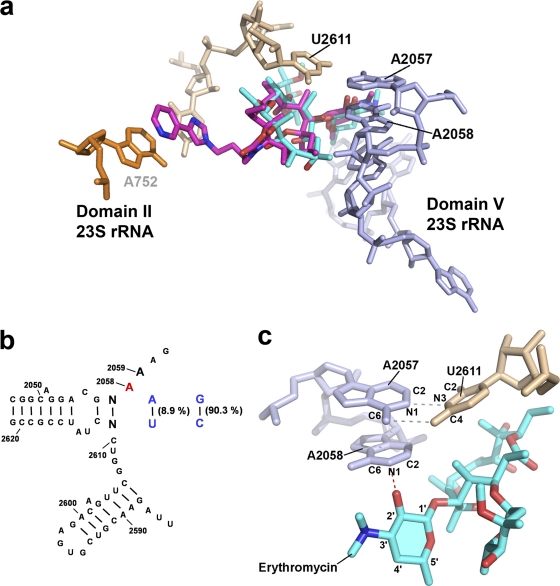
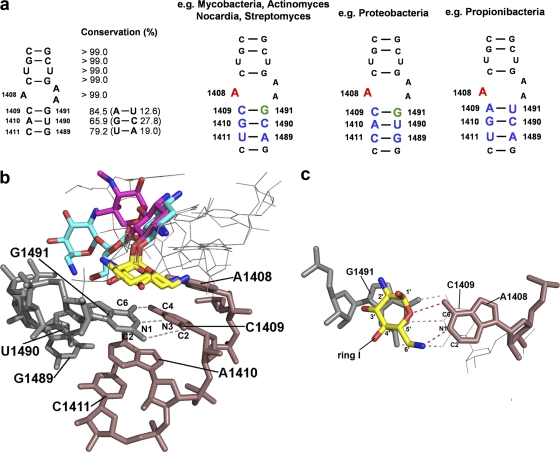
Antibiotics targeting the bacterial ribosome typically bind to highly conserved rRNA regions with only minor phylogenetic sequence variations. It is unclear whether these sequence variations affect antibiotic susceptibility or resistance development. To address this question, we have investigated the drug binding pockets of aminoglycosides and macrolides/ketolides. The binding site of aminoglycosides is located within helix 44 of the 16S rRNA (A site); macrolides/ketolides bind to domain V of the 23S rRNA (peptidyltransferase center). We have used mutagenesis of rRNA sequences in Mycobacterium smegmatis ribosomes to reconstruct the different bacterial drug binding sites and to study the effects of rRNA sequence variations on drug activity. Our results provide a rationale for differences in species-specific drug susceptibility patterns and species-specific resistance phenotypes associated with mutational alterations in the drug binding pocket.
Figures
References
-
- Carter A. P., et al. 2000. Functional insights from the structure of the 30S ribosomal subunit and its interactions with antibiotics. Nature 407:340–348 - PubMed
-
- Davies J., Gorini L., Davis B. D. 1965. Misreading of RNA codewords induced by aminoglycoside antibiotics. Mol. Pharmacol. 1:93–106 - PubMed
-
- De Stasio E. A., Dahlberg A. E. 1990. Effects of mutagenesis of a conserved base-paired site near the decoding region of Escherichia coli 16 S rRNA. J. Mol. Biol. 212:127–133 - PubMed
Publication types
MeSH terms
Substances
LinkOut - more resources
Full Text Sources
